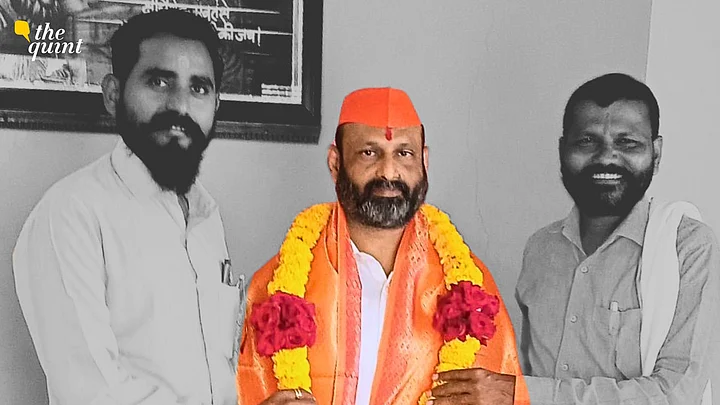
‘A hero who went to prison for the cause of Hindutva…’
‘A leader who won’t let love jihad snatch Hindu daughters from the community…’
‘A former corporator and social worker who ensured maximum development…’
These were some of the ways in which some voters perceive Shrikant Jagannath Pangarkar, one of the key accused in the murder of journalist Gauri Lankesh, in Jalna Municipal Corporation’s Ward 13D.
“The election and that matter (the Gauri Lankesh murder case) have got nothing to do with each other,” Pangarkar told the media in Jalna a week before polling for the municipal elections on 15 January. In the results declared last week, Pangarkar emerged victorious.
Interestingly, Pangarkar’s victory against a heavyweight of the Bharatiya Janata Party (BJP) — Raosaheb Dhoble — came with a margin of merely 184 votes. The BJP, in Jalna, performed exceedingly well, winning 41 of the 65 seats in the city’s first municipal corporation election.
Contesting as an independent candidate, Pangarkar’s win from the ward is no ordinary feat. The criminal charges against him go well beyond merely being a co-conspirator in the Gauri Lankesh murder case.
Pangarkar, who served as a corporator from the Shiv Sena for a decade, was largely away from active politics after 2011, more so after his arrest in 2018. So how did he manage to win an election against a BJP veteran? What were the core agendas of his campaign? How do his voters perceive him?
A look at his campaign, career, and criminal history.
A Firebrand Hindutva Leader With a Career in Mainstream Politics
Pangarkar is not new to mainstream politics. A firebrand leader, he served as a member of the Jalna Municipal Council from 2001 to 2011, completing two terms.
Shrikant’s father, Jagannath Pangarkar, too was a BJP councillor for a long time.
In the recently concluded elections, two of his cousins, Anamika Pangarkar and Ashok Pangarkar, won from Jalna’s wards 13B and 14B respectively, on BJP tickets. Both have been associated with the party for several years and have previously served as councillors.
Pangarkar’s politics is rooted in promoting the Hindutva cause, for which he has worked with several local right-wing organisations, including the Hindu Janjagran Samiti (HJS), over the years.
A father of two, Pangarkar is described by his supporters as a ‘devout middle-class Hindu who worked to promote dharma’. For years, Pangarkar has been a firm believer in concepts such as ‘love jihad’ and ‘land jihad’, and has been an active organiser of events aimed at ‘spreading awareness’, along with several local Hindutva outfits like the HJS.
After his stint as a councillor till 2006, Pangarkar shifted to Chhatrapati Sambhaji Nagar (formerly Aurangabad), reportedly for better educational opportunities for his children. However, there are conflicting versions regarding his association with the Shiv Sena thereafter. When he was arrested by the Maharashtra Anti-Terrorism Squad (ATS) in an arms funding case, the Shiv Sena at the time distanced itself from Pangarkar, stating that he was barely associated with the party’s functioning in Jalna after 2006.
After he was granted bail in the Gauri Lankesh murder case in 2024, Pangarkar was formally inducted into the Eknath Shinde-led Shiv Sena.
In October 2024, Pangarkar was formally re-inducted into the Shinde-led Shiv Sena in the presence of MLA and former state minister Arjun Khotkar.
Describing Pangarkar as a ‘veteran Shiv Sainik’, Khotkar said he was inducted after the completion of all judicial proceedings in the case. Khotkar also went on to appoint him as the chief of the Jalna Assembly poll campaign, scheduled to take place a month later.
Following two days of public outrage and media backlash, the party issued a formal notification stating: “The Chief Minister of Maharashtra and chief leader of Shiv Sena, Eknath Shinde, has ordered the cancellation of any order of appointment of Shrikant Pangarkar. All orders issued at the district level by the party in Jalna stand null and void.”
Pangarkar subsequently went on to rejoin the HJS, a far-right Hindutva outfit that works for the cause of a ‘Hindu rashtra’ and claims to address ‘social issues like love jihad’.
How Pangarkar Won Jalna Civic Election
Contesting on an auto-rickshaw symbol, his campaign rested on four key factors — sarvangin vikas (overall development), mahila suraksha (women’s safety), samajik ekta (social unity), and sadaiva uplabdh (always available).
Observers on the ground who have closely followed his politics over the years describe him as a leader who connects with voters and excels at maintaining interpersonal relationships. Looking to capitalise on this sentiment, Pangarkar chose not to hold a mass rally to address his supporters and instead focused solely on door-to-door campaigning.
Observers credit his victory to his ‘mitra company’ and the goodwill he has maintained as a leader of the Teli community. For three weeks, Pangarkar held nukkad sabhas at community centres and at the private residences of his supporters to explain his agenda and poll promises.
His core supporters, however, were unfazed by the criminal cases against him — a sentiment they propagated during the election campaign by portraying him as “a man who went to prison for Hindutva”.
Given the social capital he has built over the years within local Hindutva circles and outfits, Pangarkar did not face difficulty in finding supporters to actively campaign for him. Most of these supporters framed their messaging around him being a ‘Hindutva warrior’ and ‘anti–love jihad’.
However, his victory did not come without strategic support from the Eknath Shinde-led Shiv Sena — specifically, backdoor resources allegedly provided by some local Sena leaders, sources said.
Though the Sena publicly steered clear of Pangarkar in this election, the fact that the party did not field a candidate against him became one of the most talked-about aspects of the Jalna polls.
What also worked in Pangarkar’s favour, observers said, was the disgruntlement among Brahmins and some upper-caste groups in Jalna against the BJP for not fielding candidates from their communities.
'Not Just Gauri Lankesh': The Legal Proceedings in Multiple Cases
Even though his supporters describe him as a ‘humble social worker’, the legal cases against Pangarkar go well beyond the allegations in the Gauri Lankesh murder case.
In August 2018, he was arrested by the Maharashtra Anti-Terrorism Squad (ATS) under the Unlawful Activities (Prevention) Act (UAPA) and the Explosives Act, on allegations of conspiring to organise attacks in five cities across Maharashtra. He was arrested along with Hindu Govansh Samiti coordinator Vaibhav Raut and his aides, Sharad Kalaskar and Sudhanva Gondhalekar. The Maharashtra ATS alleged that a huge cache of arms was seized from Raut, Kalaskar, and Gondhalekar, which was ‘funded’ by Pangarkar. The seized arsenal included crude bombs, pistols, and air guns. The allegations also included a conspiracy to disrupt the Sunburn Festival held in Pune.
The group was also alleged to have planned attacks on Maratha Kranti Morcha rally sites. Kalaskar and Gondhalekar are also alleged to be involved in the murders of rationalist Narendra Dabholkar, CPI leader Govind Pansare, scholar M. M. Kalburgi, and journalist Gauri Lankesh.
The ATS also claimed to have seized electronic devices, documents, and literature from Pangarkar’s residence. Pangarkar was also briefly detained by the Central Bureau of Investigation (CBI) for questioning in the Dabholkar case.
Pangarkar is one of several men accused of executing the murder of journalist Gauri Lankesh, along with Amol Kale, Parashuram Waghmore, Ganesh Miskin, Amit Baddi, Bharat Kurane, Sudhanva Gondhalekar, and Sharad Kalaskar.
According to the Karnataka Special Investigation Team (SIT), Pangarkar was charged as a co-conspirator who allegedly briefed the accused on precautions to take and provided them with legal training on what to do if they were caught.
“The matter (the Gauri Lankesh murder case) and this election have no connection at all. That matter is sub judice in Karnataka. I am standing before the wheels of justice, and I am sure that I will get justice because I am 100% innocent in the case. It will take time, but justice will be done. The agencies had a misunderstanding; hence they arrested me. But the charges will not be proved legally because I have not done anything,” Pangarkar told the media during the campaign.