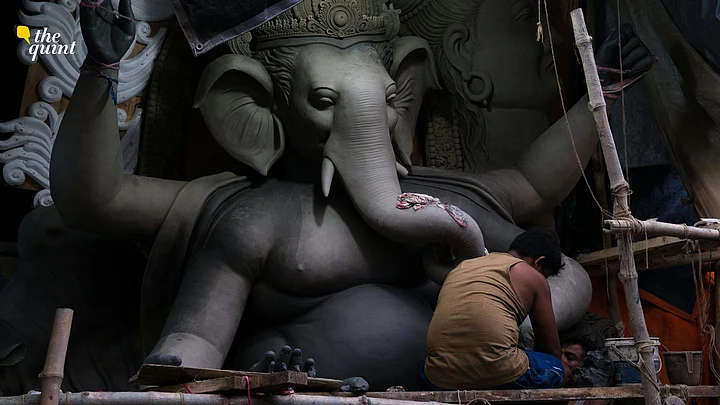
Every September, as lakhs of Ganesh idols wind their way towards the rivers for visarjan, the festival is retold as a story of anti-colonial defiance: Bal Gangadhar Tilak, the story goes, took a private, domestic Ganesh Chaturthi and made it public in 1893 to unite Hindus against British rule. Yet what gets left out of this dominant tale is caste.
Kumhars are an artisanal OBC (Other Backward Class) caste, historically known for their clay and pottery craftsmanship. The word is derived from kumbha (earthen pot) and kar (maker). For generations, Kumhars have supplied villages with essential earthenware, including cooking vessels (handi), water jars, lamps, and ritual items for festivals.
They are also known as Prajapati (lord of creatures), Kusavar (in parts of South India), and Kumbhakāra. These different names and regional identities make their position within the caste hierarchy complex.
Despite being an OBC caste themselves, Kumhars are more deeply integrated into the practice of Ganesh idol-making because of their historical ties to the craft and are respected for their work.
While many murtikhanas are now owned by Kumhars across the Delhi-NCR region, the karigars, or artisans, who work under them mostly belong to other oppressed castes.
To understand how caste shapes Ganesh murti-making, we visited a range of Ganesh manufacturers, making our way through small, makeshift workshops, often tucked deep inside muddy lanes, made of wood and bamboo and run by families in Badarpur, Tughlakabad, and Faridabad, to large showrooms in Karol Bagh and CR Park, facing the street and buzzing with customers eager to buy murtis.
At most places, the artisans belonged to the Kumhar, Dhobi, Yadav, Berwa, and Pasi communities, mostly working under a Kumhar or Brahmin owner as daily-wage labourers.
While many workers employed by large manufacturers were anxious to talk, others, particularly those working in family-owned businesses, were open to sharing their stories and struggles.
'Oppressed Caste Artisans Can Make Ganesh’s Body, Not Face'
When asked about the daily-wage workers from non-Kumhar communities who work under him, an artisan explained, “Most of my workers are Kumhars. If you are from another caste, a lower caste, it is a problem for them.”
“They can make the whole body but not the face. That’s the only problem. I give them (workers from Bihar and Bengal) the work that they are deserving of, other small things.”An artisan told The Quint
What explains this? The making of a deity’s face has long been regarded as a morally prestigious task that “breathes life into the idol”.
Sumit Samos, a researcher and anti-caste activist, explained:
“The idea of a low caste is also very hierarchical. Who gets to perform what kind of labour? That’s where I think ritual comes in. Labour in India is not just free wage labour, where you work and then you’re compensated for it. Your identity decides what sort of, what kind of work you do. Because when you feel like you’re doing something for God, it translates into their moral standing in society and caste hierarchy.”
Ganesh Chaturthi's Brahmanical History
Theories and research by historians reflect the layers of caste, as well as its absence. For instance, historian Richard Cashman, whose The Myth of the Lokamanya remains the standard academic account, argued that Tilak used the Ganapati festival precisely to bridge Brahmins with the Congress’s traditional mass base: “an instrumental, not organic, act of caste-bridging”.
Historians such as Aslam Syed have long noted that Tilak explicitly modelled the new Ganeshotsav on the structure of Muharram: the ten-day cycle, the public idol, and the immersion, as a Hindu counter to it.
Both historian Gail Omvedt and Biswamoy Pati have also described the early Ganapati utsav as a Brahmin-dominated affair that excluded non-Brahmin participation, even as it claimed to speak for all Hindus.
However, this remains contested, as some more recent historians, such as Raminder Kaur, push back against the “Brahmin-dominated” framing. They point out that early organisers such as Khasgiwale and Natu, albeit orthodox, drew figures from outside the tightest caste circles, and that Tilak himself downplayed rather than claimed sole authorship of the idea.
Thus, the ‘unity beyond caste’ narrative was contested from the start. A festival installed in public spaces by a Brahmin reformer as a nationalist and social-engineering project used caste-coded imagery and patterns of access, shaping the hierarchies of who actually sculpts, sells, and profits from the idols over the decades.
Cultural Capital Through Labour Division
The argument of purity, therefore, plays a huge role. Mukesh, a Kumhar, shared: “In our profession, we are Kumhar Pandits. Everyone knows that, even our mud is pure. Even our mud gets sold at high prices, just by name alone that we are Kumhars.”
Anthropologist and author Balmurti Natrajan, who has extensively researched OBC communities such as the Kumhar, explained: “There is yet another kind of conventional cultural capital that is the knowledge of working the wheel... those Kumhar who are Kumhar possess this kind of capital in abundance. This sort of conventional cultural capital is in embodied form, directly on the bodies of skilled Kumhar: the greater the skill, the greater this kind of conventional cultural capital.”
Mukesh expressed a sense of belonging and attachment to his work, rooted in his cultural identity as a Kumhar, while also stressing that he himself would not discriminate against artisans from other castes. “I still teach them. This art is such that if someone has that desire, why can’t they do that work?”
He further explained that when customers enquire about caste, he, as the owner, protects his workers by identifying himself as a Kumhar.
Another craftsman from Tughlakabad, belonging to the Bairwa community, reaffirmed this hierarchy, stating: “Kumhars take pre-made murtis and start unnecessarily reworking and redecorating them, while we do the making.”
However, as stated by Natrajan, even within the Kumhar community, the hierarchy is prominent and varied. In his book, The Culturization of Caste in India, based on interviews, he states: “Jhariya Kumhars are descended from the lineage of King Daksh Prajapati. They used to wear the sacred thread (conventionally worn by upper-caste groups), being also of high caste... ‘We are not Harijans like the Kumhars from Rewa, whom we see as untouchables. If they came to our house, we would wash the place where they sat with water since they rear and eat pigs,’ said the interviewee.”
Mukesh further emphasised that, no matter who makes the murti, he ‘touches each one’.
The concept of touch has long had roots in caste, from the very coining of the term ‘untouchable’. However, historian Natrajan argues that untouchability is really about keeping people in their socio-economic place, rather than being literally about touch alone. In his book, he describes this as “neo-casteism rooted in heterophilia, desire for and yearning to see and maintain cultural difference along lines of caste”, rather than a fear of differentiation.
‘Exclusion by Inclusion’
The Quint spoke to a craftsman from the Yadav community who worked in Delhi as a daily-wage labourer for three months leading up to Ganesh Chaturthi and wished to remain anonymous.
He shared that, like him, his earlier generations, including his father and grandfather, had also been involved in pottery-making. However, they had never made deities. He was the first in his family to do so, as the craft had been dying and there were not many avenues left.
He said that people from his caste were given the work of making the frame or mould, while the faces of the idols were made only by Kumhars or craftsmen from other dominant castes, such as Baniya and Brahmin.
He told The Quint that, since he had never had the opportunity to learn the skill, he did not feel confident making the faces now. When asked about his views on this, he said that the communities had adjusted and found work accordingly.
Many artisans shared this forced acceptance of labour segregation. Some had internalised the caste hierarchy by accepting their lack of access to the skill, while others did so out of economic necessity, as they needed to earn a living. Many experienced both.
“Kumhars are not treated as untouchables. In other parts of the country, some of them take up the title of ‘Vishwakarma’ (all-maker). They have a certain space within the religious economy, as does everyone else, except those at the very bottom. And once they are allowed that space, they take that as a moral performance to gain moral ground,” explained Samos.
He added that traditional communities are allowed to be part of that, and hence there isn’t a very clear-cut revolt or dissent within Hinduism.
As long as they have a place in the hierarchy, they don’t want to or feel like they can dismantle the past. Yet, in the larger world, they are excluded from higher education spaces and access to capital to get into business. It’s a form of exclusion by inclusion. You include them in the cultural realm and then exclude them socially and economically. That is how caste maintains itself.Sunit Samos to The Quint
'Customers Also Inquire About Caste'
Another artisan from Tughlakabad, who hails from the Bairwa community, said: “They ask in a joking manner where we are from. When we say Rajasthan, they say, ‘Oh, you’re from a good place, that’s good’,” emphasising that, as viewed by their customers, caste is not a strict hierarchy but rather an overlapping one.
A wholesaler in Faridabad who does not sell to individual customers also said, “Individual customers enquire about caste, in the wholesale business they care only about the price. It is these upper class buyers who do.”
Mukesh and others, including front-facing staff at showrooms, reaffirmed this. They stated that questions about both the sellers’ and artisans’ caste were very common, with occasional questions about religion as well.
The same artisan from Tughlakabad also shared that he could not shave his head for his father’s last rites because customers refused to buy from the family of a deceased person. He therefore had to wait until after the Ganesh season was over to do so. He said, “What is this faith that does not have a place for the family of the dead?”
With Ganesh Chaturthi here, caste, camouflaged as artisanal identity, manifests itself not just in the act of sale, as customers enquire about and make decisions based on the artisan’s caste, but also within the artisans’ workshops, where the same caste hierarchies take a different form.
This results in more complex forms of intra-community discrimination, while labour segregation is given a legitimised form through pride in caste-based cultural identity and a desire for a sense of belonging within the caste hierarchy.
"A legitimisation of caste hierarchy by finding a place for oneself. Artisan communities might not want to become Brahmins or Kshatriyas, but they are fine as long as they are within the closed space of it," remarked Samos.