
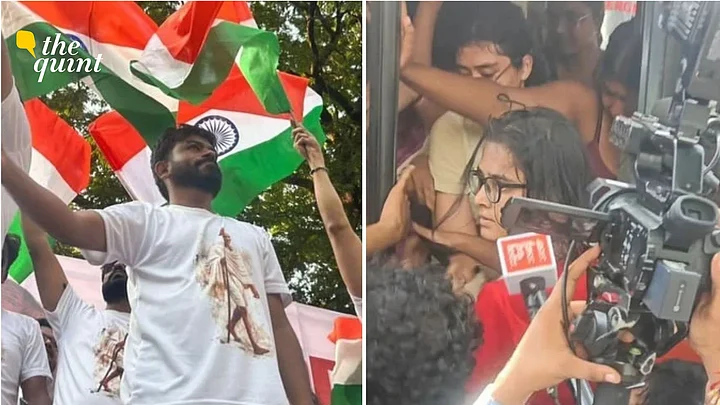
Two major protests took place in India on 2 October. Both protests had the same demands. Both were denied official permission. The leadership of both protests asserted that the call was for a peaceful Gandhian protest. And yet, one received full cooperation from the state, while the other faced a complete ban, a brutal police crackdown and mass detentions.
As the world celebrated the birth anniversary of the Mahatma, protesters in the national capital who gave a call for peaceful protests to demand the resignation of Chief Election Commissioner Gyanesh Kumar faced a violent crackdown. The protest called by the Cockroach Janta Party (CJP) in Mumbai, meanwhile, received complete cooperation from the police. The gathering of thousands concluded successfully without any reported incident of violence.
Thousands of security personnel on the ground, Metro station closures, route diversions, tear gas vans, water cannons and hundreds of buses across central Delhi to detain protesters: the Delhi Police could not have made it clearer that it was in no mood to cooperate. The Mumbai Police, meanwhile, not only held talks with Abhijeet Dipke and the CJP leadership but also facilitated the smooth flow of protesters thronging Shivaji Park.