(Exposing hate and communalism is a key focus area in The Quint's reportage. Become a member and support our journalism).
"They pulled the hijab off my face at the protest site. I felt physically violated. How can the police do that?" Delhi University student Haifa Shafeeq asks.
On 10 October, when India's national capital was turned into a fortress in response to a call for protest given by the Cockroach Janta Party (CJP) to demand action against Chief Election Commissioner (CEC) Gyanesh Kumar, Shafeeq was among those who sat in front of a Delhi Police bus in an attempt to stop protesters from being detained.
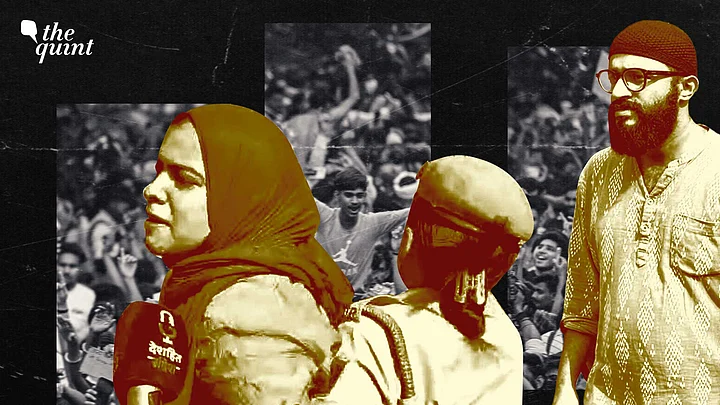
"Right then, two women officers tried to detain my friend... As they dragged her, I tried to intervene. That's when they started to attack me... They grabbed my hijab and pulled it off," Shafeeq, an activist with the Fraternity Movement, a students-youth group affiliated to the Welfare Party of India, tells The Quint.
She recalls that a group of protesters helped them escape. She was, however, detained later in the evening, the first of many to come in the week after.
"The next day, on 11 October, when we were protesting a group of cops isolated us from the media. Many of the protesters in my group were Muslim. They asked our names and then beat up the male protesters. This was deliberate profiling. We were all detained after that."Haifa Shafeeq
The Quint contacted Connaught Place police station for clarification on both incidents, but was refused comment by an officer over phone.
On 16 October, Shafeeq was among the eight women from student organisations, including the Fraternity Movement, All India Students Association (AISA), and Krantikari Yuva Sangathan (KYS), who were brutally dragged and detained at the Connaught Place police station for several hours after 6 pm. It took a team of activists to secure their release.
The protests against the Special Intensive Revision (SIR) of electoral rolls—an exercise that has impacted large numbers of Muslim voters—have seen a more severe repression from the police and authorities than its predecessor, the anti-NEET protests, in July. This time, the police have acted without exception, violently detaining students, lawyers, activists, actors, politicians, former chief ministers, members of Parliament, influencers and journalists alike.
Yet, several Muslim protesters and journalists reporting from the ground have alleged facing deliberate, communally charged slurs, and attacks from police as well as "right-wing goons", especially when the person is visibly Muslim, such as someone wearing a hijab or a skullcap.
Communal Slurs, Assault Against Muslim Women
Fida Fathima, a journalist working with independent news digital portal Maktoob, states that right-wing "protesters" called her "Topi Media", and asked her whether she came from "Burhan's camp". The incident took place on 11 October. Videos of the incident have been accessed and independently verified by The Quint.
Fathima, along with other Maktoob reporters, many of whom were Muslim, were on ground covering the protests when some right-wing "protesters" and content creatores started following them around. Fathima alleges that many of them had lanyards around their necks, signifying a press card, though they were not from any formal channel and did not show their IDs properly when asked.
Media reports, videos, and testimonies from The Quint reporters on ground confirms the presence of "right-wing goons" who invaded the protests 10 October onwards, and in many cases, were given free reign by the police to rabblerouse, intimidate, and abuse CJP and anti-CEC protesters and mediapersons.
"I saw them surround another woman and harass her... she was crying. She was Hindu, and a supporter of the anti-SIR protests. I tried to save her from the heckling. That's when they started calling me "Topi Media". It's a new term they have seemingly come up with to counter the "Godi media" tag. 'Topi' is a reference to the skullcap, and I assume they called me that because I was in a hijab."
Apart from targeting Muslims, the right-wing "journalists" were also seen and heard spreading anti-Muslim propaganda. The journalist, who was being harassed when Fathima intercepted her, tells The Quint,
"They were asking why we are against SIR, did we even know the full form of SIR, and did we want to save the illegal Bangladeshis and Rohingyas. They asserted that all the people whose names were struck off [from the voter lists] were illegally living in India."
Lyricist and activist Farnaz (name changed) alleges to The Quint that she was sexually assaulted during a protest in Connaught Place on 12 October, when she was groped by a man. "When I screamed, a protester turned around and slapped him, and he fled. He exploited the rush," she recounts, adding that her fellow protesters, too, faced deliberate harassment because "as Muslim women, we carry our identity." Farnaz posted about the incident on social media as well.
Senior journalist and author Rana Ayyub, who frequently faces doxing and online abuse based on her religious identity, alleges that during the 10 October protest, she was heckled by a right-wing mob "in the presence of cops".
"They said I was 'jihadi media'. When I aproached the cops nearby, they blamed me for provoking the men," she narrates. Such behaviour, she adds, is a manifestation of political and police power in a majority-ruled state, wherein the minority is reduced to the stereotypes associated with their visible markers.
"It is hard for them, be it police or hecklers, to accept that a Muslim, especially a Muslim woman who is a minority within a minority, can be educated or qualified enough to be a journalist. So they tag her 'anti-national', 'jihadi', and so on."Rana Ayyub
Activist Zakia Soman of the Muslim Mahila Adhikar Manch adds that such profiling and language used against Muslims, including journalists, finds precedent in the political rhetoric of the country, wherein the "Prime Minister himself had said at an election rally in Dumka, Jharkhand, in 2019 that those who are creating violence can be identified by their clothes itself". December 2019 was the beginning of the anti-CAA and anti-NRC protests.
"Such communal language seeps down to the institutional level, especially the police and the administration, who are tasked with maintaining law and order," Soman adds.
'Topi Walon Ko Pakdo'
On 16 October, when different student and Left groups were mobilising across different parts of central Delhi, AISA and Fraternity Movement cadres decided to mobilise outside Mandi House Metro Station and march to Central Park.
Lubaib Basheer, national general secretary of the Fraternity Movement, who was among the protesters.
He recalls that when AISA leader Neha Bora joined the march, the police deployment increased manifold. Despite her detention shortly afterwards, the cadres continued to try and march till Central Park.
That's when, Basheer says, he heard a police official in uniform yell, "Topi walon ko padko" (Catch the men wearing skullcaps).
"We were surrounded by police and unidentified persons who were intimidating the protesters. In the scuffle, someone hit me on the head and took off my skullcap. I did not see who it was," he tells The Quint.
"I have been wearing them [skullcaps] to these protests because I think it's important for Muslims to reclaim the public discourse space."Lubaib Basheer
Shaheen Bagh to Jamia
Jamia Millia Islamia PhD scholar and activist Mohd Alfauz Azmi and a resident of Jamia Nagar states that within the Muslim-populated neighbourhoods, there is visible reticence about joining the protests for fear of being profiled or targeted.
"Areas like Okhla, Jamia Nagar, Shaheen Bagh and others with high Muslim density are some of the worst affected in terms of SIR deletions. And yet, while Muslims are participating in the anti-SIR protests, most of them are part of political or student body groups. Ordinary residents are hardly joining."Mohd Alfauz Azmi
Azmi says that activists have attempted to geographically decentralise the anti-CEC protests from central Delhi to these localities where the issue has had an impact but most residents, including his own neighbours, resisted any mobilisation. "The memory of the aftermath of Shaheen Bagh and Jamia protests remains strong," he adds.
Basheer also alleges that the police are trying to intimidate residents by raiding homes and offices of activists.
"They raided the Fraternity Movement office as well. Our landlord is a Muslim too... he was helpless. Many Muslim students rent flats in these areas. Some tenants and landlords are now saying they will ask tenants to leave if police keeps coming," he adds.
Azmi, who was pre-emptively detained on 9 October by Jamia Nagar police and kept at the station for nearly 22 hours, and before that detained during the anti-NEET protests in July as well, states that while it may be hard to gauge if Muslims are facing more detentions than others, religious profiling is definitely taking place.
"When I was detained in July, they took me to Chattrasaal Stadium (the area comes under Model Town police station), which they had turned into a detention centre, where I was kept overnight. There, cops asked me where I was from and what my name was. When I said I was from Jamia, they said, 'What else can we expect from you?'"
Although Soman and Ayyub concede certain sections of the Muslim community are expressing legitimate concerns about Muslim profiling, they both believe large numbers from the community are nevertheless stepping forward to join the protests.
"The one good thing about Hindutva politics has been the visibalisation of Muslim dissent beyond just older men in skullcaps to women and youth. They came out in 2019; they are coming out again now," Soman states.
However, she adds a note of caution. "While participation is important, I think the leadership of these protests should remain in the hands of majority community, or non-Muslims. We have seen that their religious identity has made them an easy target for prolonged legal battles since the days of the anti-CAA/NRC protests."
As instructed by Delhi Police ACP Ranjay Atrishya of the Public Relations Office (PRO), The Quint has written a detailed email seeking their response on the allegations of communally charged slurs, as well as about the raids and overnight detentions of activists. The Quint also reached out to Jagpreet Singh of the PRO department for a comment on the same. Their responses were awaited. This article will be updated as and when they revert.