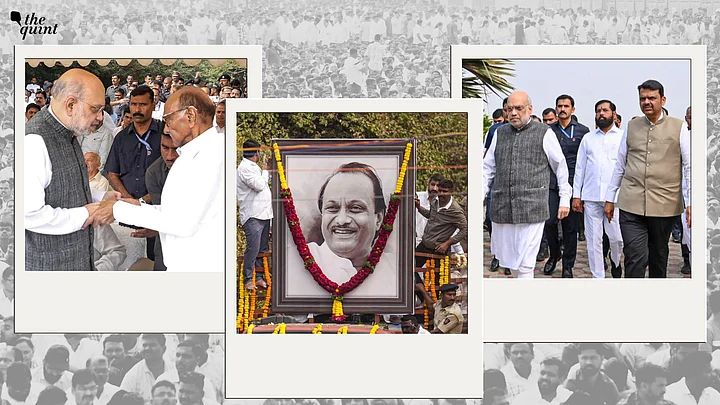
Within an hour of the news of Maharashtra Deputy CM Ajit Pawar’s death breaking on 28 January, anchors and analysts on TV news discussions were quick to debate ‘what next’ for the Mahayuti alliance, the two Nationalist Congress Parties, and state politics.
Ajit Pawar’s untimely demise has undoubtedly left a leadership void in the party. Unlike most political dynasties, the line of succession in Ajit Pawar’s Nationalist Congress Party (NCP) had not been clearly defined.
In the Nationalist Congress Party – Sharadchandra Pawar (NCPSP), there is a clear line of succession, with Supriya Sule and firebrand leaders like Rohit Pawar. However, the faction has weakened over the past two and a half years since Ajit Pawar engineered a split and joined the Nationalist Democratic Alliance (NDA).
Ajit Pawar’s death has led analysts and observers to ask three key questions:
Will the two NCPs reunite?
Will the Bharatiya Janata Party (BJP) now absorb Ajit Pawar’s leaders?
What options lie before Sharad Pawar?
These questions are valid, but neither are the answers simple, nor is Maharashtra’s politics as predictable.
To answer these questions, one must first understand the succession line-up of both NCPs.
The NCP Sans Ajit Pawar
If we look within Ajit Pawar's family, his wife, Sunetra Pawar, is a first-time Rajya Sabha MP. Among their two sons, it is only the elder, Parth Pawar, who is politically active. Parth emerged as a key figure after the NCP’s split in 2023, taking on a central role in managing his father’s campaigns and political representations.
However, despite his involvement, Parth lacks the political clout and administrative influence his father once had over the party. His bid for the 2024 Assembly elections also ended in defeat.
Sunetra Pawar, who is reportedly being considered as a potential deputy CM candidate, is not only new to active politics but also lacks significant influence within the party and organisational experience. She had kept her distance from political affairs until the need arose to field her against Supriya Sule in the 2024 Lok Sabha elections from Baramati. Sule secured a landslide victory, achieving her largest-ever margin. Subsequently, Sunetra was nominated for the Rajya Sabha seat, a move that drew criticism from many, including senior leaders like Chhaggan Bhujbal.
Looking beyond the family, Bhujbal, Praful Patel, Hasan Mushrif, and Sunil Tatkare are among the prominent figures. While each is a strongman in his own right, their influence remains limited. None possess the same statewide appeal or the deep-rooted support among NCP followers that Ajit Pawar commanded.
Within the NCPSP, Supriya Sule is a recognised national figure, exerting considerable influence over core NCP supporters, regardless of faction. However, despite the party's commendable performance in the 2024 Lok Sabha elections, where it won 8 out of 10 contested seats, the NCP faced a drubbing in both the Assembly and municipal elections. This stark contrast suggests a significant shift in the party’s ground-level presence and support, which appears to have gravitated towards Ajit Pawar’s faction.
Will the Two NCPs Merge?
The cracks within the ruling alliance were evident even when Ajit Pawar was alive. Conflicts had already surfaced between local NCP units and the BJP/Sena in several constituencies. This was precisely why, in the recently concluded municipal elections, the NCP chose not to ally with the BJP anywhere in the state. Instead, it allied with NCPSP in Pune and Pimpri Chinchwad.
Many NCP MLAs have previously raised concerns about "harassment" from their BJP and Sena counterparts and local party units. However, the understanding between Fadnavis and Ajit Pawar kept these conflicts in check. With Ajit Pawar gone, many NCP leaders on the ground may no longer feel compelled to toe the line.
This raises the question: will they return to Sharad Pawar?
Most senior leaders from Ajit Pawar’s camp, including Bhujbal, Hasan Mushrif, and Narhari Zirwal, hold influential portfolios in the state cabinet. Rajya Sabha MP Praful Patel is also the party’s working president. It seems unlikely that these senior leaders would want to merge with NCPSP, which is currently a politically weaker force in the state.
One option for Sharad Pawar is to capitalise on the growing discontent among junior leaders, including MLAs and corporators, to bolster his own influence.
Another option is to merge his party with Ajit Pawar’s faction and join the Mahayuti. However, this would neither benefit his party's standing on the ground, nor would it be a suitable option for the BJP, which already harboured internal discontent over Ajit Pawar.
This situation places Fadnavis in a particularly precarious position
Why Ajit Pawar's Death Has Increased Fadnavis' Troubles
The discontent with Ajit Pawar within the Sena leadership was as strong as it was in the BJP, with many believing that if Ajit Pawar had not been part of the Mahayuti, Shinde could have still negotiated his way to the CM post. In Ajit Pawar's absence, attempts by Shinde’s NCP to pressure Fadnavis into dropping the NCP may gain more momentum.
With 132 MLAs in the state Assembly, the BJP is just 12 seats short of the majority mark. So, the presence of two alliance partners prevented the BJP from strengthening the bargaining power of either.
Letting go of the NCP would mean empowering Shinde further within the alliance, whose leaders are already in conflict with the BJP in several areas, including Thane.
Dropping the NCP from the alliance may also trigger an exodus of the party’s leaders and MLAs to Sharad Pawar, thus strengthening a formidable Opposition force the BJP has long sought to weaken.
Simply put, removing the current NCP leaders from the alliance or facilitating any possible merger of the two NCPs in the state would weaken the BJP’s position in Maharashtra.
Political observers believe one way out of this rut for Fadnavis would be to incorporate key leaders from Ajit Pawar's NCP into the BJP. However, this would not only risk overcrowding the party but also further upset Shinde.
The number of ‘existential’ issues arising from the death of Ajit Pawar underscores the strategic importance the leader held in the state’s political landscape. His sudden exit has not only left a void but has also turned the tables for many, extending far beyond his own party and influence.