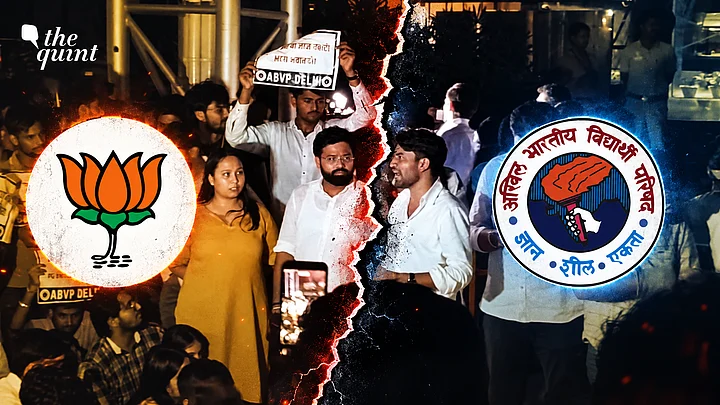
The most important angle in the political aftermath of the tragic Satya Niketan building collapse, has been the Akhil Bharatiya Vidyarthi Parishad's (ABVP) protests against the BJP-controlled Municipal Corporation of Delhi.
Is this a case of controlled Opposition from within the Sangh Parivar? Or is there more to it?
This is not the first time the ABVP has protested against a body run by the BJP or a BJP government. It won't be the last time either.
We analysed several such protests over a period spanning 28 years, beginning with the first NDA government in 1998, to answer three central questions.
Why does the ABVP protest against the BJP?
How is it different from other protests by the ABVP?
Has the equation between ABVP and BJP changed after Prime Minister Narendra Modi came to power in 2014?
ABVP-BJP Equation
The relationship between the ABVP and the BJP isn't like between any other student outfit and political party in the country. The reason for this is the relationship between the RSS and the BJP. The ABVP is the student wing of the RSS, not the BJP. This is an important difference.
In fact, even its relationship with RSS is much more than just as its students wing.
Former Sangh ideologue KN Govindacharya linked it to the ban on the RSS following Mahatma Gandhi's assassination in 1948. “In the aftermath of Gandhi-ji’s assassination, the RSS was banned, starting in February 1948...the Sangh wanted to find a way to organise and continue its meetings normally. So it started meeting under the name of the Akhil Bharatiya Vidyarthi Parishad," he said.
However, within the ABVP, this version is contested. Many current and former members say that the outfit's formation had nothing to do with the ban. In either case, given the chronology, it is safe to say that ABVP acted as a major front for the RSS during the ban period and that the two organisations have deep ties.
Pre-dating the BJP and ties to RSS has given the ABVP some autonomy from the BJP though many of the party's leaders do come from its ranks. Govindacharya stressed on this autonomy during his conversation with Caravan. According to him, ABVP “has been developed as a self-sufficient and self-dependent organisation, with a spirit of cooperation towards other members of the same school of thought.”
The equation has begun to change to some extent under PM Modi. We'll come to that later in the article.
The ABVP has protested against BJP-led governments, municipal bodies and BJP-appointed university administrations on several occasions in the past. We studied 40 such cases since the mid-1990s.
One of the most serious incidents took place in 2022 when ABVP cadres stormed the residence of the BJP home minister in Karnataka, Araga Jnanendra, over the murder of BJYM worker Praveen Nettaru. The police had to lathi-charge and detain several of them.
In 2009, ABVP cadres in Himachal Pradesh demonstrated outside the function of then BJP CM Prem Kumar Dhumal to protest against the 'hostile attitude' of the Mandi Deputy Commissioner. To protest against the lathi-charge, the ABVP called for a massive state-wide bandh, disrupting classes in over 150 colleges.
Another major confrontation was in Madhya Pradesh under Shivraj Singh Chouhan in 2006 when ABVP cadres were accused of causing the death of professor HS Sabhwarwal. They outfit had accused the Chouhan government of "buckling under pressure". The accused were later acquitted as several witnesses turned hostile.
However, there is a pattern to the ABVP's protests under BJP governments. A vast majority of these protests have been against university administrations or local officials. On very rare occasions does the ABVP demand the resignation of a BJP minister of chief minister or burn the effigy of a BJP leader. This is in sharp contrast to how ABVP protests under non-BJP governments, where such demands and methods are common.
In a majority of cases, ABVP protests against BJP governments are framed as being against a "bad policy" or a few individual officials, whereas protests against non-BJP governments are more likely to be framed as being against the entire regime or in ideological terms. Not surprisingly, BJP-led bodies or BJP state governments are more likely to agree to the demands of the ABVP.
A major factor that compels ABVP protests against BJP-ruled bodies is the competition they face from other student outfits. In the protests we examined, Himachal Pradesh showed the highest number of cases of ABVP protesting against the BJP government or BJP-led bodies. This can partly be attributed to the active role of Congress-backed and Left-aligned student bodies.
Change Since 2014
The Modi years have marked an even greater synergy between the BJP and ABVP. This synergy isn't due to any organisational mechanism imposed from the top. Rather, it has come from below. PM Modi's immense popularity in the Hindutva ecosystem changed the power equation in favour of the BJP at least in his first two terms. Modi is seen as a PM who has delivered on most of the Sangh's core ideological projects, like the abrogation of Article 370 and construction of the Ram Mandir in Ayodhya.
This synergy is contrast to the Vajpayee years. At that time, there was a perception in the Sangh (including the ABVP) that the government hasn't done enough on core ideological issues and it is too liberal on the economic front.
The ABVP organised two major protests against the Vajpayee government: in 1999 against a new patent law and in 2002 on the issue of unemployment and disinvestment in education. ABVP protesting against the Modi government, even on a purely policy issue, is unthinkable.
Other elements to the BJP-ABVP synergy post-2014 are the institutional support and resources that the ABVP gets by virtue of the BJP's national dominance, giving it an advantage over other student outfits.
Germany-based anthropologist Aastha Tyagi did her PhD on the ABVP and much of her fieldwork was during the Modi government's second term.
"During fieldwork, the connections between local RSS, BJP and ABVP units were seamless," Tyagi writes in her thesis.
Since 2014, there has been an unprecedented capture of political and administrative power by the BJP. The ABVP has become an active part of this. For the first four decades since Independence, ABVP's USP was the fact that it was seen as an outfit of ideological resistance in campuses. Since 2014, it has become associated with power.
"In my fieldwork experience, I found many differences to the pre-2014 (BJP coming to power) members of the Sangh and the post-2014 members. One of the key differences was that (post-2014) members had a lot more faith and hope in the state machinery to serve the cause of the movement,"Aastha Tyagi, Germany-based anthropologist
The culture of power has harmed the ABVP in some ways. "A culture has been created in the organisation in which people are more obsessed with getting an MLA or municipal councillor ticket, or influence appointments in universities, than on ideological work," a former ABVP functionary from Rajasthan told The Quint.
Tyagi writes in her thesis, "Although ABVP claims to be separate from the BJP and associates itself as the student wing of the RSS (a convenient strategy), the aspiration of many ABVP members is to enter electoral politics through the BJP".
The former functionary from Rajasthan says that the pursuit of the fruits of power has led to a "disconnect" with students.
"Winning elections and winning support are two different things," the functionary said.
This disconnect came out in the open following the Cockroach Janta Party protest.
The Post-NEET Pivot
The CJP protest which led to education minister Dharmendra Pradhan's resignation, was a major wake-up call for the ABVP. There were questions raised within the organisation, as well as fron the Sangh, as to why they had failed to assess the mood among a large section of students.
One diagnosis that emerged from the post-Pradhan introspection was that the ABVP was seen as synonymous with the Modi government and, therefore, faced a trust deficit as a body that could fight for students' interests.
The ABVP has since been attempting a course correction, with a series of protests since July this year, some of them targeting BJP-ruled bodies or BJP-appointed university administrations.
The protests against the MCD authorities following the Satya Niketan building collapse must also be seen in this light. The optics of the protests were also interesting. Saffron colour or ABVP flags were downplayed and protests were consciously given a more neutral vibe.
The ABVP is now in uncharted waters. After having enjoyed dominance and support due to the larger dominance of the BJP under Modi, it is now confronted with a new reality: of a fading Brand Modi with the youth at the centre of disaffection.