
ADVERTISEMENTREMOVE AD

Why Tribals in Odisha’s Sacred Hills Are Up in Arms Over a Road Project

Locals allege that, on 7 April, a police team armed with lathis and tear gas shells unleashed mayhem on them.

Published
story-hero-img
i
Aa
Aa
Small
Aa
Medium
Aa
Large

Nearly a fortnight after the violent clashes between an armed-to-the-teeth police party and tribals protesting against bauxite mining in the Sijimali hills in Kantamal village of Odisha's Rayagada district, an uneasy calm prevails in the village and its surrounding areas.

The tribals continue their round-the-clock vigil at the place where the construction of a three-km-long road leading to the bauxite mines led to violence on 7 April. Meanwhile, the administration, facing stinging criticism from various quarters, is wary of repeating the police excesses that marked the incident.

"It was 2.30 am when a large contingent of policemen, packed into 10 buses, and nearly a dozen vehicles and armed with lathis, guns, and tear gas shells, barged into our village and unleashed utter mayhem in the village," recalls Subas Singh Majhi.

Majhi is the president of the Maa, Maati, Mali Suraksha Parishad, an anti-mining community organisation spearheading the resistance against bauxite mining in the hills the tribals consider sacred.

"They locked up many of the houses from outside to ensure that the people couldn't come out and then dragged sleeping people out from other houses and mercilessly beat them up. Even women and children were not spared as the cops wielded their lathis and burst tear gas shells."

Majhi further adds thay at least 50 villagers, including many women, were injured. "But such is the fear among villagers that we can't even take them to the hospital lest they get arrested by the police."

On its part, the police have said 58 of their men were injured in the violent counter-attack by villagers using traditional weapons like axes and swords, besides pelting stones at the police personnel. Six of the seriously injured policemen had to be shifted to a hospital in Vishakhapatnam.

ADVERTISEMENTREMOVE AD

What's Happening in Sijimali Hills?

The long and unrelenting protests of local tribals, backed by activists, against mining in the bauxite-rich Sijimali (Tijimali in local parlance) hills by a multinational company, with active support of the local administration, remind one of the Niyamgiri agitation in the second decade of the century.

While it is difficult to say if the final outcome would go the way of the Niyamgiri case, which ended in victory for the agitating tribals with the intervention of the Supreme Court, the similarities are unmistakable. For one thing, the company involved is the same: Vedanta.

For another, the tribals in and around the Sijimali hills, like their counterparts in Niyamgiri, consider the hill sacred, the abode of their god, Tijiraja, who, they believe, protects them.

Then there is the role of the Mohan Charan Majhi government which, like the erstwhile Naveen Patnaik government, looks determined to push through the mining project even if it means the loss of lives and livelihoods of the tribals in the area.

The agitation that started soon after Vedanta was granted the mining lease over an area of 1,548.786 hectares—which includes 699 hectares of forest land—for 50 years in February 2023, reached a flashpoint on 7 April 2026 when a large contingent of policemen armed with lathis, guns, and tear gas shells swooped down on Kantamal village at 3 am.

Villagers allege that electricity to the village had been cut off before the cops arrived. The police team also resorted to blank firing in a bid to intimidate the people. But it had the exact opposite effect. Peaceful till that point, the agitation turned violent as the villagers retaliated by throwing stones on the cops.

A Vedanta official declined to comment on the 7 April incident, saying, “It’s a matter between the villagers and the district administration. We are nowhere in the picture.”

Contesting Claims

The seeds of the 7 April incident were actually sown four days earlier on 3 April when the Rayagada district administration imposed Section 163 of the Bharatiya Nyaya Sanhita (Section 144 of the IPC earlier) to facilitate the construction of a three-km long road leading to the Sijimali bauxite mines. The protests by the locals, however, continued despite the prohibitory orders.

It wasn’t the first time the police allegedly took action either. Nearly a month before—on 7 March—they had entered Talampadar village, another protest stronghold, in the wee hours, and arrested 21 people, among them 10 women, including a 19-year-old pregnant woman. Arbitrary arrests and detentions under false and fabricated cases have continued unabated since the protest started in July 2023, says Narendra Mohanty, convener of the Campaign Against Fabricated Cases, Odisha.

Rayagada Superintendent of Police (SP) Swathy S Kumar had said after the incident that the police had gone into the village to arrest Majhi, against whom a non-bailable warrant issued by a local court was pending.

Curiously, Majhi told The Quint that he wasn't even aware that any case or warrant was pending against him and found out about the 14 cases he has been named in only after the SP's statement.

It is also rather strange that after all that happened in the wee hours of 7 April, no one from the village—including the man for whom the police had presumably gone into the village in the first place—has been arrested so far.

When asked about this, SP Kumar told The Quint:

"Right now, our priority is to ensure the well-being of the policemen injured in the attack by the villagers. Mercifully, the six seriously injured have now been released from the hospital."

While informing that three cases have been registered against the villagers for the violence, the SP declined to go into the details of the incident, saying, "I have already given a statement on what exactly transpired on that day and have nothing more to add to it."

ADVERTISEMENTREMOVE AD

Discrepancies Galore

The point to note is that the construction of the road was initiated despite the fact that the mining project is yet to receive Stage-II clearance, mandatory for any project-related construction from the Ministry of Environment and Forests (MoEF). The MoEF is still in the process of reviewing the forest clearance following an order of the Orissa High Court, acting on a petition alleging that the consent of the eight concerned Gram Sabhas was obtained fraudulently.

A perusal of the official documents pertaining to the purported ‘consent’, obtained under RTI, and accessed by The Quint, shows some glaring discrepancies.

Names of minors, non-residents, and even deceased people figure in the list of those who supposedly gave consent to mining by Vedanta.

Minors who can’t write have been shown as having signed the documents while graduates have thumb impressions against their name. Last but not the least, all eight Gram Sabhas were apparently conducted on the same day (8 December 2023) at the same time (10 am) in the presence of the same officials.

Prafulla Samantaray, eminent social activist and 2017 winner of the Golden Environment Award, considered the Green Nobel, says there is more to the issue than mere violation of laws.

“We must not lose sight of the fact that ecologically, the rich bauxite mines in the Eastern Ghats, spread over the districts of Kalahandi, Rayagada, and Koraput, is a highly sensitive area. We should exercise extreme caution while allowing any mining activities in these hills, which are home to numerous perennial streams," Samantaray tells The Quint.

"But the government appears to have thrown all caution to the wind. Not only Sijimali, it has allocated other hills like Kuturumali and Baphlimali to other multinationals. It’s a recipe for disaster,” he adds.

ADVERTISEMENTREMOVE AD

A Rare Consensus

If there is one thing that differentiates the ongoing stir in Sijimali from the Niyamgiri agitation more than a decade ago, it's the fact that this time round, there is a rare consensus among all the major stakeholders—the Central government, the state government, all major political parties, and the mainstream media (minus the tribals, of course)—to facilitate mining in the sacred hills.

The Niyamgiri agitation gained national attention because the Congress opposed the mining in the hills. Rahul Gandhi, then the vice president of the party, personally visited the area and assured the tribals of the full support of his party to their struggle despite the fact that Congress was in power in the Centre at the time.

This time, however, there is a deafening silence among all three major parties—Bharatiya Janata Party (BJP), Biju Janata Dal (BJD), and Congress—on the issue.

Only the Left parties have staged protests, but they haven't had much of an impact since they are fringe players in Odisha politics.

Nothing proves this consensus among these three parties better than the fact that there was not even a passing mention of the Sijimali protests and the repression by the police during the just concluded Budget session of the state Assembly.

The BJD and the Congress did send 'fact-finding' teams to Sijimali after stinging criticism on social media for their silence. But nothing has been heard about what facts did the teams find and what action is proposed to be taken on them.

As if on cue, the BJP too sent a 10-member 'fact-finding' team led by Nabarangpur MP Balabhadra Majhi to Sijimali on 15 April, but it had a torrid time facing the wrath of the people. They had to beat a hasty retreat.

Rupu Bhatra, BJP MLA from Kotpad who was part of the fact-finding team, sought to lay the blame on the previous Naveen Patnaik government.

“They should have ensured that the Gram Sabhas were conducted in a free, fair, and transparent manner,” he told The Quint over phone. He, however, declined to share details of what the team found on the ground and what were its recommendations, only saying, “We have submitted our report. Now, it is for the government to take action on it.”

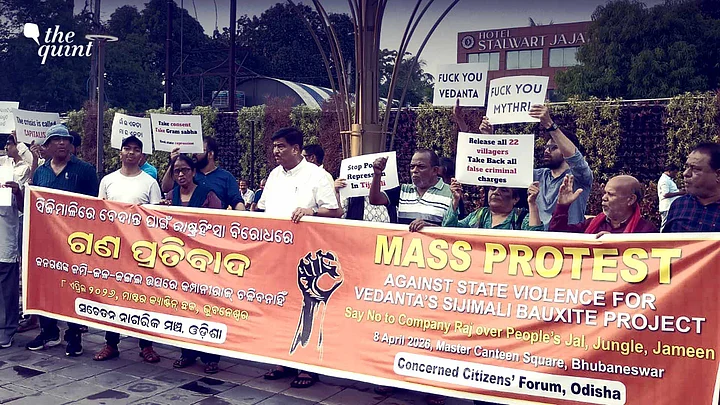
Ranendra Pratap Swain, former minister and BJD MLA from Athgarh, is the only politician who was openly condemned the police excesses.

He also participated in the protest against the police action organised in Bhubaneswar and visited Kantamal to express solidarity with the protesters.

“I strongly condemn the brutal mistreatment and demonic repression of the local people, especially the tribal mothers and sisters, sponsored by the police, district administration, and Vedanta-Maitri company,” he said.

Significantly, he was not part of the fact-finding mission sent by the BJD to Kantamal.

(The author is a senior Bhubaneswar-based journalist and has reported for the BBC for the last 20 years. He tweets @geminianguddu.)

Speaking truth to power requires allies like you.
Become a Member
Monthly
6-Monthly
Annual
Check Member Benefits
×
×