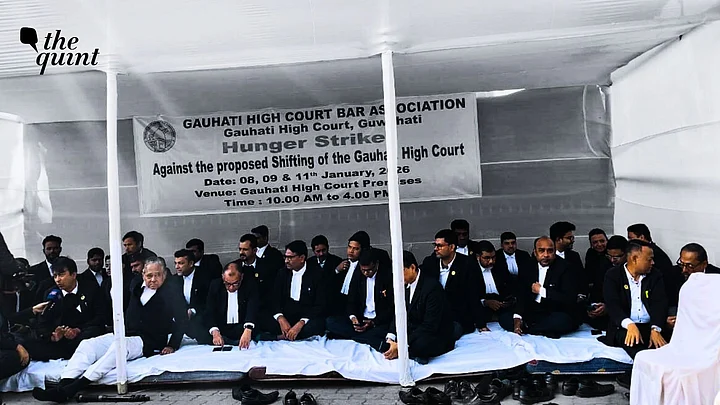
The proposed relocation of the Gauhati High Court from its central location in Guwahati to a new judicial complex in North Guwahati has lawyers and civil society groups in Assam at loggerheads with the state government.
The government’s push for the move has triggered widespread protests, with the Gauhati High Court Bar Association (GHCBA) leading the charge in opposition. At the heart of the controversy is not just the practicality of relocating a judicial institution but also concerns around justice accessibility, economic burdens, and the silencing of dissent in the face of powerful commercial interests.
The High Court’s Historic Significance
The Gauhati High Court, which serves Assam, Arunachal Pradesh, Mizoram, and Nagaland, was established in 1951.
Despite recent attempts to address space issues, such as the 2013 annex building and a 20-crore underground tunnel, the Assam government has proposed a Judicial City in North Guwahati as a permanent solution to perceived space constraints.
This complex, to be constructed at the cost of Rs 1,000 crores, is positioned in Rang Mahal on the northern bank of the Brahmaputra — 30 km from the current location.
Opposition From the Legal Community
The GHCBA, which represents hundreds of lawyers who rely on the current location, has firmly rejected the idea of moving the High Court.
Despite clear opposition from the Bar, which recently conducted a referendum with overwhelming results against the shift, the state government has refused to halt its plans. As per results of the referendum, seen by The Quint, out of 1,358 lawyers who cast their vote, 1,164 were against the shifting of the High Court.
Further an unofficial message sent to junior lawyers allegedly by a senior law officer in the state reveals the alarming level of state coercion: lawyers representing the government were explicitly ordered to attend the groundbreaking event on 11 January 2026, with the added threat of being barred from their department if they failed to appear.
The message, sent to government lawyers, reads: "All are requested to attend the function on 11/01/2026, otherwise not to appear for the Department from 19/01." This message, members of the Bar Association say, highlights the state's blatant attempt to quash dissent.
The Quint spoke to Kamal Narayan Choudhury, President of the Gauhati High Court Bar Association about this issue.
He said, "The message from the government's side is quite clear. They want everyone to fall in line. That's why they are using these tactics. If you go by the constitutional scheme of things, they're not even the competent authority to order this relocation. The President of India — based on the recommendations and, in some cases, with the involvement of the Parliament of India and a state-level committee, decides the location of a High Court."
Accessibility Concerns: A Step Backwards for Justice?
The GHCBA argues that the move to North Guwahati would impose severe accessibility challenges on lawyers, litigants, and staff. For lawyers residing within a 5 km radius of the current site, the daily commute to North Guwahati could take over two hours each way, adding unnecessary time and financial costs to their already demanding schedules.
With public transport infrastructure severely lacking in the proposed area, many lawyers without private transport would find it virtually impossible to maintain their practice. The economic impact would be particularly harsh on young lawyers and women professionals, who already face substantial barriers in the legal profession.
Compounding these issues is the lack of transparency surrounding the overall judicial plan. While the state government insists that the new Judicial City will resolve space constraints, critics have raised serious doubts about the feasibility of such a grand project.
The GHCBA has pointed out that the original proposal for the site in Rangmahal suggested a plot of 240 bighas, but only 100 bighas is now available for development.
Adding to the uncertainty, it’s still unclear whether the lower courts will also be relocated, which could create a fragmented judicial system where lawyers are forced to shuttle between multiple locations, further complicating their work.
Moreover, the GHCBA has raised suspicions about the real motive behind the relocation, particularly the construction of a Convention Centre near the current site. Critics argue that the proposed judicial shift may be more about accommodating commercial interests than meeting the needs of the legal system.
The Road Ahead
As the state government moves ahead with the groundbreaking ceremony on 11 January 2026, the GHCBA has announced its boycott of the event.
The GHCBA’s hunger strike planned for January 8-11 is a final attempt to resist what they see as an "undemocratic decision that will harm the accessibility and efficiency of the region’s judiciary."
Lawyers across the state demanding that the government halt the relocation, insisting that alternative solutions can resolve the current issues without disrupting the court’s function.