
Kerala now faces the ravages of the worst monsoon floods in 94 years, with 373 dead and more than 1.2 million in relief camps. The state received 2,378 millimetres (mm) of rain over 81 days between 1 June and 20 August 2018 – 42 percent above normal or three times more than the Indian average for that period – according to data from the India Meteorological Department (IMD).
With extreme weather events and variability increasing in urban and rural India, as IndiaSpend has previously reported, flooding is likely to become more common, the outcomes attributable as much to poor planning as climate change. In Kerala, the monsoons have generally decreased, and that was a reason the state was unprepared for such a ferocious monsoon, an IMD official told the Times of India on 21 August 2018.
Idukki, epicentre of the flooding where 51 died, recorded the highest rainfall in Kerala and second-highest rainfall (3,521 mm) of any Indian district over these 81 days, 93 percent above normal, IMD data said. The highest rainfall in India was recorded over this period in Karnataka’s Udupi district (3,663 mm), which, however, was no more than 18 percent above its normal.
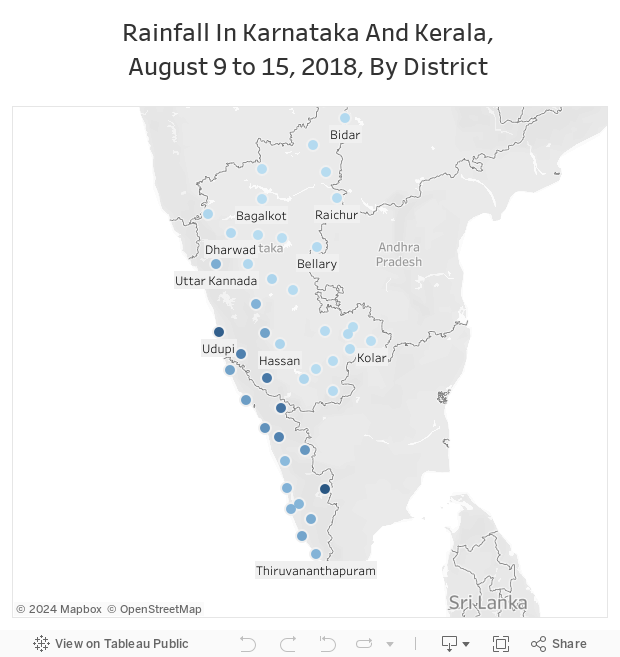
Kodagu in Karnataka, where 12 died after the district was ravaged by floods, faced the heaviest rainfall in 64 years, 290 percent above normal, between 9 August and 15 August 2018, according to IMD data.
Kerala received 255 percent excess or above-normal rainfall (98.4 mm) between 9 August and 15 August 2018, five times more than India’s average for that period, while Karnataka received 80 percent above-normal rainfall (50.3 mm) over the same period, 54 percent above India’s average, IMD data show.
)/PdfPageImage.aspx?imgUrl=PRODUCTS/Rainfall_Maps/Weekly/State_Rainfall_Map/STATE_RAINFALL_MAP_COUNTRY_INDIA_w.JPG&landingpage=landing)
In Kerala, 776 villages in 14 districts were flooded, with 1,398 houses “fully damaged” and 20,148 “partially damaged”, according to the government.
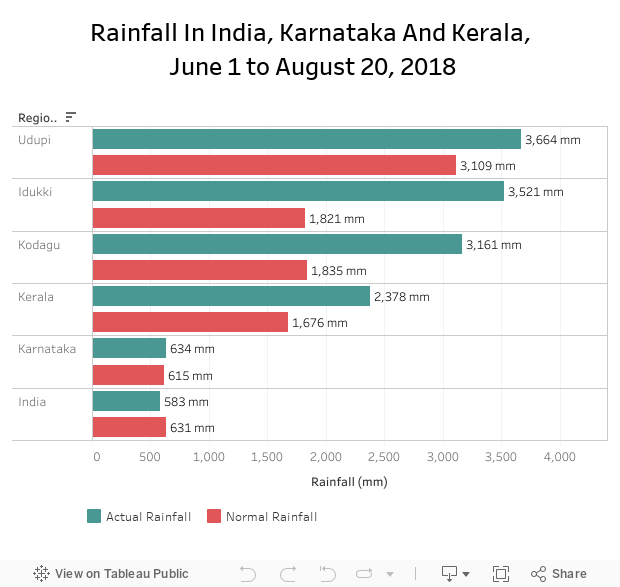
In 1924, Kerala received 3,368 mm of rainfall over 21 days, a deluge that appears to have been more intense than the 2,378 mm over 81 days in 2018. While there is no direct causal link between the latest floods and climate change, deforestation and human transformation of flood plains and mountain tops have been implicated.
Climate change, however, is the larger backdrop against which recent floods in India have been playing out, with more intense, more uncertain rainfall.
Heavier, More Uncertain Rainfall
Rain events in greater than 100 mm in urban India have increased over the past 100 years, there is an overall increasing trend of events exceeding 100, 150 and 200 mm since the 1900s, and an increasing variability in recent decades, IndiaSpend reported on 29 August 2017.
India accounts for a fifth of deaths globally due to floods and heavy rain, with 1,07,487 people dying nationwide over 64 years between 1953 and 2017, according to Central Water Commission data presented to the Rajya Sabha (Parliament’s upper house) on 19 March 2018. Damage to crops, houses and public utilities was reported to be Rs 365,860 crore – or as much as 3 percent of India’s current gross domestic product –the data show.
On average, more than 1,600 people die every year in floods, which disrupt the lives of nearly 32 million people, the data show. More than 92,000 cattle are lost every year, seven million hectares of land – or nearly twice the size of Kerala – is affected and damage estimated at about Rs 5,600 crore.
India could see a six-fold increase in population exposed to a risk of severe floods by 2040, according to study published in Science Advances, a peer-reviewed journal, IndiaSpend reported on 10 February 2018, and a 2018 World Bank study has warned that climate change could lower the standards of living of nearly half of India’s population by 2050.
Extreme rainfall events in central India, the core of the monsoon system, are increasing and moderate rainfall is decreasing – as a part of complex changes in local and world weather – according to a clutch of Indian and global studies reviewed in 2015 by IndiaSpend.
The damage caused by such heavy rains and floods are exacerbated, as we said, by poor planning. “The main reasons of floods have been assessed as high intensity rainfall in short duration, poor or inadequate drainage capacity, unplanned reservoir regulation and failure of flood control structures,” said a March 2018 reply from the government to the Rajya Sabha, Parliament’s upper house.
The average total rainfall during the peak monsoon season of July and August has declined since 1951, but the variability of rain during these months has increased –deluges are more severe, and dry spells more frequent, as evidence from Karnataka indicates. As August rainfall in the southern Malnad districts has raised groundwater levels by more than 4 metres, other districts to the west and north report similar declines, the result of three years of drought.
The August Deluge in Karnataka
Despite floods in Kodagu, Chikmagaluru, Dakshina Kannada and Udupi districts during the monsoon of 2018, Karnataka received 634 mm of rainfall, no more than 3 percent above normal (615 mm) between 1 June and 20 August 2018, according to official data, and 9 percent above India’s average for that period.
The coastal district of Udupi received, as we said, India’s highest rainfall for 2018, 3,663 mm or 18 percent above the normal (3,108 mm) over the 81 days in question. Between 9 August and 15 August 2018, Udupi received 640 mm, 167 percent above normal, followed by Kodagu (508.2 mm) and Dakshina Kannada (465 mm).
As many as 161 people are reported to have died in Karnataka; 12 dead in Kodagu, as on 20 August 2018, according to an official release.
About 64 houses were damaged in Udupi on 14 August 2018, due to heavy rains and wind, amounting to a loss of Rs 35.8 lakh.
Kodagu, which endured the most flood damage, recorded 290 percent more rainfall than normal (130.3 mm) between 9 August and 15 August 2018.
Idukki Worst Affected But Most Excess Rain in Thiruvananthapuram
While Idukki recorded 679 mm of rain between 9-15 August 2018, 438 percent or four times above normal, it was the capital, Thiruvananthapuram, that recorded 617 percent or six times more rain than normal, the most excess rainfall in any Kerala district.
In the first 20 days of August 2018, Kerala received the highest rainfall for the entire month in 87 years, with Idukki district breaking a 111-year record for highest rainfall in a month, the Times of India reported on 21 August 2018.
Thrissur received the least excess rainfall –180.3 mm in actual terms, 76 percent above normal, between 9 August and 15 August 2018.
(This story was originally published on Indiaspend and has been republished by The Quint with permission)