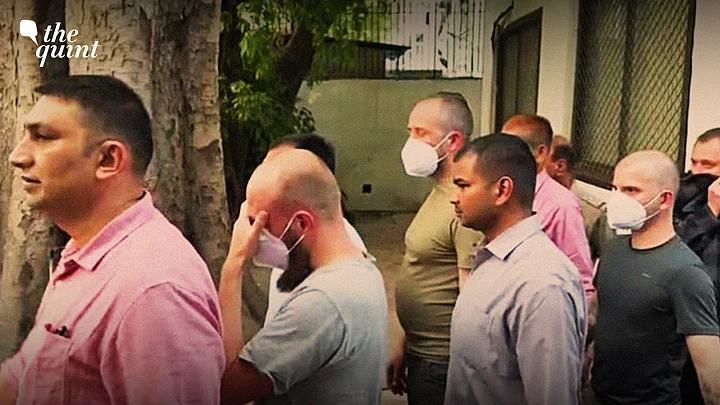
When the National Investigation Agency (NIA) arrested American national Matthew VanDyke and six Ukrainians at three airports on the night of 13 March, the official account framed the case as a counter-terrorism operation: foreign nationals had illegally entered Mizoram, crossed into Myanmar, trained ethnic armed groups in drone warfare, and smuggled large consignments of European drones into the conflict zone.
Charges were filed under Section 18 of the Unlawful Activities (Prevention) Act, carrying a maximum penalty of life imprisonment. VanDyke was detained at Kolkata Airport; the six Ukrainians—Hurba Petro, Slyviak Taras, Ivan Sukmanovskyi, Stefankiv Marian, Honcharuk Maksim, and Kaminskyi Viktor—were detained in Delhi and Lucknow. A Delhi court remanded all seven to NIA custody until 27 March.
That is the surface. The Quint has learned that beneath it lies a network that connects a Chin rebel vice-president’s drug empire, American evangelical church funding, Ukrainian war veterans repurposed from the Russia front, Russian intelligence hubs inside Myanmar, and a narcotics pipeline running from Chin State through Manipur into India. At the centre of this network, multiple sources familiar with the investigation have confirmed, is one man.
Peter Thang: Drug Runner and Arms Procurer
Peter Thang is the vice-president of the Chin National Defence Force (CNDF), the armed wing of the Chin National Organisation (CNO), established in 2021 in Falam, Chin State. It is one of the principal factions fighting Myanmar’s military junta in western Chin State.
Before the 2021 coup, Thang ran a travel agency in Yangon. Now, according to sources, he operates in three capacities simultaneously: he runs CNDF’s drug-trafficking operations, which finance the outfit’s armed struggle against the Tatmadaw; he serves as its chief arms procurer; and he is the person who organised the drone smuggling operation in which VanDyke and the six Ukrainians were involved.
The CNDF is not a fringe militia. Chin resistance forces, including the CNDF, have expelled the military from most of rural Chin State and over half its townships. In late 2024, the CNDF launched “Mission Jerusalem”—an offensive to capture the town of Falam, Chin State’s former capital. The operation encircled the junta’s last garrison in a hilltop base, costing about 50 CNDF fighters in the first six weeks, many killed by airstrikes from Russian and Chinese jets. Thang told Al Jazeera in January 2025: “The military has so much technology. We have limited weapons.” The drones sourced through India were intended to change that equation.
The CNDF operates under the umbrella of the Chin Brotherhood, the mothership organisation for Chin armed resistance. The Brotherhood’s two principal affiliates are the CNDF and the Chin National Army (CNA). Both fight the junta. But they are funded through starkly different channels. The CNDF is supported significantly by American missionary networks. The drones and arms smuggled through Mizoram were meant for Thang’s outfit.
The Drug Pipeline: Chin State to Manipur
CNDF’s armed struggle is financed primarily through narcotics. The drug-running network extends into India through a specific conduit: rebel groups operating in the Chin State and Manipur. These groups are known producers and exporters of narcotics to India. Thang is the principal connector between the CNDF and such outfits, working closely on this axis.
The relationship is not merely transactional. It is filial. The Zomi, Chin, and Mizo communities share deep ethnic, linguistic, and kinship ties that predate colonial-era borders. These connections provide the social infrastructure for networks that move fighters, weapons, narcotics, and now drones across a 510-kilometre border running through some of the most remote jungle terrain in South Asia.
The same networks that moved European drones into Chin State are moving narcotics out of it—and into India’s northeast. This is what transforms the case from a Myanmar civil war story into an Indian national security story.
The American Connection: Evangelicals, SOLI, and Church Money
Matthew VanDyke, born in Baltimore, holds a Master’s in Security Studies from Georgetown University and a second Master’s in War Studies from King’s College London. He is the founder of Sons of Liberty International (SOLI), a 501(c)(3) non-profit security contracting firm whose stated mission is to provide military training to forces fighting authoritarian regimes.
VanDyke fought in Libya’s 2011 civil war, spent six months as a prisoner of war in Muammar Gaddafi’s prisons, filmed an award-winning documentary in Syria, founded SOLI after ISIS (Islamic State) beheaded his journalist friends James Foley and Steven Sotloff, trained Iraqi Christians to fight ISIS, and trained Ukrainian civilians against Russia from 2022 onward.
His operational footprint spans Libya, Syria, Iraq, Afghanistan, Ukraine, the Philippines, Venezuela—and now Myanmar. NIA officials suspect VanDyke was the architect behind recruiting Ukrainian war veterans for Chin State, and one official told media he appears to be acting “at the behest of Western intelligence.”
What has not been previously reported is VanDyke’s connection to evangelical church groups in the US.
According to sources, these church networks are a funding channel for the CNDF. The connection is rooted in history: Chin State has one of the highest concentrations of Christians in Myanmar, a legacy of American Baptist missionary activity dating to the late 19th century. The Chin Christian community maintains active links with American evangelical congregations, and these links, sources say, have been leveraged to channel financial support to the CNDF’s armed struggle.
The evangelical-CNDF nexus runs deeper than funding. The CNDF’s defence secretary, Olivia Thawng Luai, a former national karate champion and erstwhile Assistant Director in Myanmar’s Ministry of Health and Sports, is married to an American national. Sources confirm this as indicative of the depth of the US evangelical-military network embedded within the CNDF’s leadership.
NIA officials have told the court that VanDyke admitted to conducting training sessions for ethnic armed groups on multiple occasions. NIA teams had been tracking the suspects in the northeast for several months before the coordinated arrests. Investigators believe the group had been making repeated trips since 2024. Eight more Ukrainian nationals, part of a larger group of 14 who entered India on tourist visas, remain untraceable.
The Russian Intelligence Dimension
The arrests did not happen by accident. According to multiple sources, it was Russian intelligence that provided India with the information that enabled the NIA to act.
Russia’s interest is not altruistic. Moscow maintains several operational intelligence hubs inside Myanmar, established to support the junta’s operations against rebel groups. Russia and China are the Tatmadaw’s two principal external patrons: Russia supplies helicopters, fighter jets, armoured vehicles, and artillery; China provides military equipment and exercises leverage through its influence over ethnic armed groups along the China-Myanmar border.
The intelligence tip-off has a dual logic: it serves India’s national security interest—drones transiting Indian territory and narcotics flowing into Manipur are genuine threats—but it also serves Russia’s geopolitical interest in protecting the junta by dismantling the rebel drone supply chain.
That supply chain has produced battlefield results. Sources say one of the several thousand drones sourced by Thang brought down a Myanmar military fighter aircraft—a claim that, if confirmed, would represent a significant escalation in rebel capability and explain the urgency of Russia’s intelligence-sharing with India. Kachin rebels separately used drones in February 2026 to severely damage an ATR-72 aircraft at Myitkina airport.
Updated on 24 March: Thang, however, has denied these allegations to The Quint. In a written statement on WhatsApp, he said, “I am not related to the seven people arrested by the NIA. I've never contacted them or have seen them. Most importantly, I've never engaged in drug dealing.”
He further stated: “The characterisation of me as a ‘drug lord’ is factually wrong and highly damaging to the organisations I lead. As a public figure, I take these false allegations very seriously."
The Mizoram Corridor
Mizoram has become a mercenary corridor for the Myanmar civil war.
Mizoram’s Chief Minister Lalduhoma, a former IPS officer with extensive intelligence contacts, told the state Assembly on 10 March 2025 that he had “specific intelligence that Ukraine war veterans travelled to Myanmar’s Chin State via Mizoram to train rebel outfits fighting the military junta.”
Between June and December 2024, nearly 2,000 foreigners entered Mizoram, many bypassing tourist activities to enter the Chin Hills for military training. Sources now confirm the number is far larger. Several hundred Ukrainians and Americans have visited Chin State via Mizoram, some as “battlefield tourists,” others as trainers and arms suppliers. The phenomenon has acquired a name in the region: conflict tourism with a purpose.
The precedents were there. British national Daniel Newey was arrested at Aizawl airport on 19 June 2024 with ammunition, returning from Chin rebel groups. Belgian national Simon Clemente was arrested at Aizawl airport in March 2025, again with ammunition. Both were caught on the way out, not the way in. The corridor was identified. It was not closed.
India’s deeper challenge is structural. The Chin Brotherhood’s two affiliates present two entirely different border realities along the same frontier. Along the CNA-controlled stretch, the situation is relatively stable; narcotics smuggling is negligible. The CNDF-controlled stretch is a different country: this is where the drugs originate, where the drone consignments transited, where the American and Ukrainian trainers crossed, and where the “battlefield tourists” gravitate.
These are not two separate borders. They are the same border, controlled by two arms of the same organisation. The Brotherhood is not even internally cohesive: in July 2025, the CNA attacked and captured the CNDF’s Camp Rihli, a vital India-Myanmar border trade post, escalating into open armed conflict between the two affiliates. Even when the two arms fight each other, the border complexity persists. And the kinship ties that connect Chin, Zomi, and Mizo communities mean the human networks on both sides are often the same families.
Lalduhoma himself illustrated the impossibility when he brokered a unity agreement between warring Chin factions in Aizawl—an act of mediation the Centre reprimanded him for, because he had not sought clearance. The Chief Minister of Mizoram was mediating a foreign civil war from his own capital, because the people fighting that war are his people’s kin. No fence resolves that.
The Questions That Remain
The NIA investigation is at an early stage. But the contours of the case raise questions that will shape India’s northeast security policy for years. How did thousands of drones move from Europe through Indian territory without detection until a Russian tip-off? Who in the logistics chain enabled the consignments? What is the full scale of Peter Thang’s narcotics operation, and how deeply has it penetrated Manipur? Are the eight untraceable Ukrainians still in Myanmar? And what is the institutional relationship between SOLI, the evangelical funding networks, and the US government—freelance operation, or something more?
The US Embassy has said only that it is “aware of the situation” and cannot comment for privacy reasons. Ukraine has lodged a formal protest, demanding immediate release and consular access; Ukrainian diplomats who attended the 16 March court hearing were denied direct communication with the detainees. Kyiv pushed back sharply, saying certain publications “contain distorted interpretations of the available facts, are manipulative in nature, and put forward unfounded allegations.” Neither Washington nor Kyiv has addressed the substance.
India’s northeast border has become a theatre where Myanmar’s civil war, Ukraine’s drone expertise, American evangelical money, Russian intelligence operations, and a Chin drug lord’s ambitions have all converged. The NIA arrested seven people at three airports on a March night. The network they were part of is still operating. The corridor is still open. And the drones are still flying.
(VK Shashikumar set up the investigations team at CNN-IBN, now News18.)