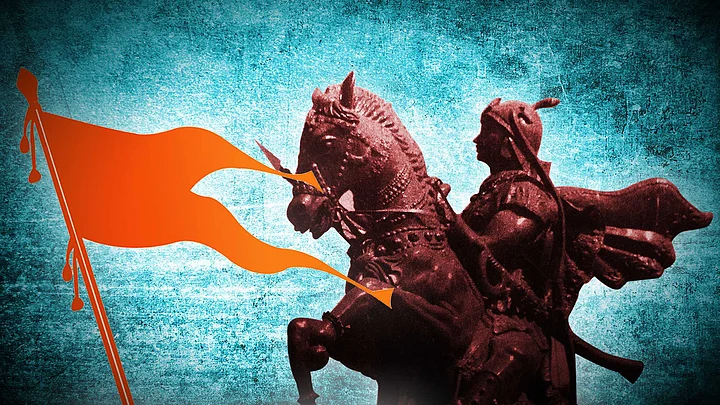
What purpose do legends serve?
Do they help a civilisation understand its place in history? Are they a way for a culture to gain some insight – what it fears and what it cherishes? Are they handy fodder for bedtime stories for restless kids?
While they are all of these benevolent things, and more, they are also instruments of manipulation, since their oral fluidity leaves a lot of space for different interpretations.
On that note, let’s talk about the Rashtriya Swayamsevak Sangh (RSS).
The RSS has a long tradition of appropriating iconic figures from history and legends to serve the purpose of their propaganda. Whether it is ‘revisiting’ Bhimrao Ambedkar’s legacy to emphasise his critique of Nehru’s foreign policy, or writing books that claim Jesus Christ was a Tamil Hindu, RSS has been there, done that. Today marks the anniversary of a figure– Maharaja Suhaldev–who has met the same fate at their hands.
Suhaldev is a semi-legendary Indian king from Shravasti, Uttar Pradesh, who is said to have defeated and killed the Ghaznavid general Ghazi Saiyyad Masud in the early 11th century. Masud was then buried in Bahraich, where BJP chief Amit Shah will be present today to commemorate Suhaldev.
Why Suhaldev?
Maharaja Suhaldev exists somewhere between the boundaries of fiction and history. The only surviving account of him is the Mirat-i-Masudi, a historical romance written in Persian. Legends can barely agree upon his name, alternating between Sakardev, Suhirdadhwaj, Suhridil, Suhridal-dhaj, Rai Suhrid Dev, Susaj, Suhardal etc, much less on his caste or religious identity.
At the end of the day, what we have is a king with a Hindu-sounding name and a historically unverifiable personal identity who defeated a Muslim invader. He is ripe for the picking.
‘Rang De Mohe Gerua’
In 1940, a local schoolteacher of Bahraich, influenced by the Arya Samaj, composed a long poem where he projected Suhaldev as a Jain king and a saviour of the Hindu culture. The poem, popular locally until the partition, appeared in print for the first time in 1950 when Arya Samaj, Ram Rajya Parishad & Hindu Mahasabha Sangathan planned a fair at the dargah of Salar Masud, to commemorate Suhaldev. A member of the dargah committee appealed to the district administration to ban the proposed fair, in order to avoid communal tensions.
Accordingly, prohibitory orders were issued under Section 144 which prohibits ‘unlawful assembly’. A group of local Hindus organised a march against the order, and were arrested for rioting. To protest their arrest, Hindus shut down local markets for a week. Congress leaders joined the protest, and around 2000 people went to jail before the administration relented and lifted the prohibitory orders.
As a result of this agitation, there is now not only an annual fair in Suhaldev’s memory, but also a temple covering 500 bighas of land, along with several paintings and sculptures.
Enter RSS, BJP
In the 1950s and 60s, local politicians laid the ground for employing Suhaldev in service of politics by projecting Suhaldev as a Pasi king to influence the Pasis, a Dalit community and an important vote-bank around Bahraich.
In early 1980s, the BJP-VHP-RSS joined the fray, organising fairs and nautankis to celebrate the Suhaldev myth, characterising him as a Hindu Dalit who fought against Islamic invasion. He is often painted as a cow-protector, patron of saints and benefactor of Hindus. In fact, in one of the saffronised narratives of the Battle of Bahraich, Salar Masud plans to place a herd of cows in front of his army, so that Suhaldev cannot attack him but the latter comes to know about this plan, and cuts the cows loose on the night before the battle.
In 2001, Hindu nationalist activists formed the Maharaja Suhaldev Sewa Samiti, which has ever since been organising various programmes to commemorate Suhaldev as a defender of the Hindu faith.