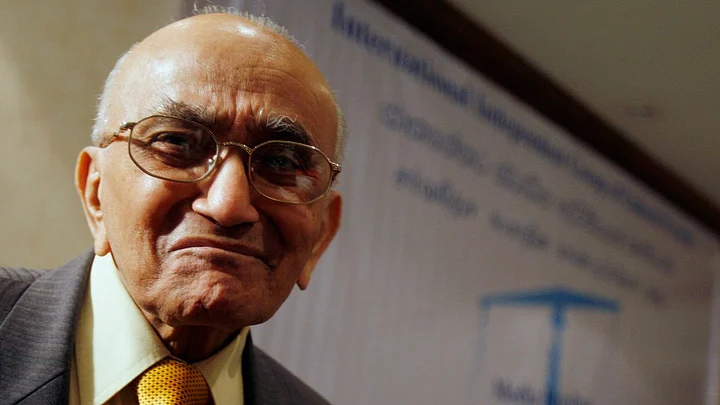
Former Chief Justice of India (CJI) Prafulchandra Natwarlal Bhagwati passed away on Thursday at the age of 95. Hailing from Gujarat, he served as the CJI from 12 July 1985 to 20 December 1986.
Boasting an accomplished judicial career, Bhagwati is best known for introducing Public Interest Litigation (PIL) in 1986 – an instrument formulated with objective of protecting the interests of underprivileged and marginalised sections of the society. That has eventually become an integral part of the Indian judicial system and given an impetus to judicial activism in the country.
He is also the brother of reputed economist Jagdish Bhagwati.
Modi, Swaraj Express Condolences
Prime Minister Modi and External Affairs Minister Sushma Swaraj took to Twitter to express condolences over PN Bhagwati’s demise.
Bhagwati and The Habeas Corpus Case
Having graduated from Mumbai's Elphinstone College with a degree in Economics, Bhagwati was also active in India's freedom struggle in his young age. His profile on the Supreme Court of India website mentions that "he courted arrest during the National Freedom Movement in 1942 and went underground for four months".
However, the former Chief Justice is also associated with the infamous Habeas Corpus case. The case was heard in 1976 in the context of the Emergency. What was under question was whether a person could file Habeas Corpus writ if he has been subjected to unlawful detention. The bench comprising Bhagwati said that he/she could not in the judgement, which was interpreted by many as undermining a Fundamental Right.
Notably, Habeas Corpus is one of the six writs that comes under the Right to Constitutional Remedies – a Fundamental Right.
However, Bhagwati called this judgement "an act of weakness" 30 years later, adding that "it was against my conscience... That judgement is not Justice Bhagwati's."