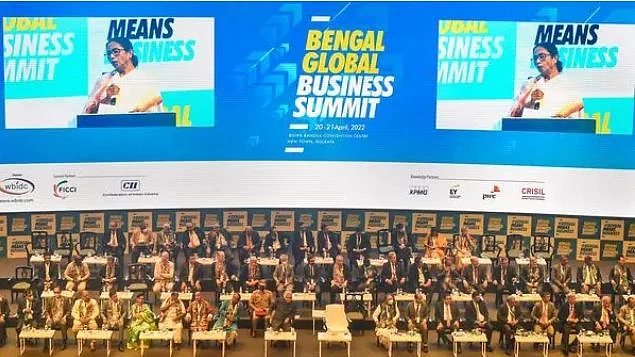
The Bengal Global Business Summit is an event that is very close to West Bengal Chief Minister Mamata Banerjee's heart. That’s probably why she goes all out in the preparation and promotion of this event.
The sixth edition of the summit was hosted on 20 and 21 April after a hiatus of two years due to the COVID pandemic. In the chief minister’s words itself, the summit was attended by 4,300 participants from 42 countries, including private investors and foreign dignitaries.
As the event concludes, we look at all the investment prospects and other developmental projects that were promised over the course of two days.
Private Investors and Big Promises
The list of guests attending the summit included some big names from the who’s who of India’s industrial sector. They reaffirmed their confidence in the state and the Mamata Banerjee government for industrial development.
The biggest name on that list was Gautam Adani, who alone committed Rs 10,000 crore in investment over the next decade in port infrastructure, data centres, undersea cables, centres of excellence in digital innovation, fulfilment centres, warehouses and logistics parks.
Adani Wilmar, a joint venture of the Adani group already has built a significant presence in Bengal over the years especially in terms of edible oil.
It must also be noted here that the Adani Ports and Special Economic Zone (APSEZ) is the highest bidder for the Tajpur port, although it has not been officially announced yet.
Sajjan Jindal, the chairman of JSW, announced that he will be building a 900 MW pumped storage hydel project, which can attract an investment of close to 7000 crore rupees.
Hindustan Unilever Limited or HUL, which already has four factories in Bengal, plans to invest more in physical infrastructure and market, although no detailed plans or finances were disclosed in public.
Tata Steel MD and CEO T V Narendran too promised to invest 600 crore rupees for expansion in the state while Hiranandani group chairman Niranjan Hiranandani promised an investment of 1500 crore rupees towards the construction of a data centre and an industrial logistics park.
Wipro Chairman Rishad Premji promised an investment of a few hundred crore rupees for the building of the company’s second campus in Bengal, the construction of which will ‘commence soon’.
ITC too said that they will commence their 20th Manufacturing unit in Howrah’s Uluberia and is in the process of commissioning a green building in Rajarhat. This building will house ITC Infotech, the group’s IT wing. ITC has been investing in Bengal for decades now and enjoys a prominent presence amongst in elite investors in Bengal.
According to ITC Chairman Sanjiv Puri, the company has invested nearly 4500 crore rupees in the state, most of which have already been implemented.
Purnendu Chatterjee, veteran businessman and the head of The Chatterjee Group (TCG), announced that he is planning to set up an ‘one-of-a-kind' university in Kolkata. What will set the university apart is the presence of a quantum computer, which will be used for collaborative research on a global scale.
Expanding Global Reach
Coming to universities, a significant chunk of the event focused on education and global outreach through varsity programmes.
Over 15 MoUs were signed between several universities in West Bengal and foreign universities. Jadavpur university has signed five MoUs, Calcutta University signed three. Some private universities also joined the bandwagon.
It is expected that an approximate investment of Rs 2000 crore is being looked at in the education sector.
But the global reach at the summit went beyond just the education sector. The summit saw representatives from countries including US, South Korea, Australia, New Zealand, Vietnam, Netherlands, Finland, Morocco, Bangladesh and Bhutan.
Delegations from Japan and UK both promised to invest further in Bengal. Japan and Italy specifically wanted to invest in the MSME sector. Kenya proposed organising a world-class marathon in Bengal. It also wanted to invest in wildlife. The Netherlands meanwhile promised to help Bengal in the de-silting of its waterbodies.
Two senior ministers from Bhutan and Bangladesh were also present at the summit and heaped praises about CM Banerjee.
Does Bengal Mean Business?
While all the announcements and promises are like music to the ears for the state, the reality of the situation might not be as hunky dory. Over the years, opposition leaders have heavily criticised the Mamata Banerjee government for failing to bring investment in Bengal.
As of now, there are two major projects which are currently in the pipeline – The Tajpur port and the Deocha Panchami coal block. Both these projects are yet to commence.
Not too long ago, WB Governor Jagdeep Dhankar demanded a breakdown of investments that were made successful through the business summits over the years.
Ex-finance minister Amit Mitra wrote a four-page letter to Dhankar claiming that the state had received investment worth Rs 12,32,603 crore through the business summits between 2015 and 2019.
Between BGBS 2015 and BGBS 2018, 50.27 per cent of the proposals went into the implementation mode. For BGBS 2019, already 71,646 crore rupees is under implementation. The employment generated through these investments is to the tune of 28 lakh rupees already.Amit Mitra in his letter to the governor
However, a quick look at the data shows that in the last three financial years, West Bengal’s State Domestic Product (SDP) rate went down from 13.09 to 7.72 percent. Here it must be noted that the pandemic and the subsequent lockdown could have played an important role in this decline as this was a country-wide phenomenon
An investigation by The Print’s Madhuparna Das showed that the records maintained by the Department of Promotion of Industry and Internal Trade (DPIIT), opposed the government’s claims. The accessed documents showed that between 2015 and 2019, the state has received investment proposals worth 37, 051 crore rupees out of which projects worth 15,625 crore rupees have been implemented.
For 2019, investment proposals worth Rs 5,844 crore were received out of which projects worth Rs 2,361 crore were initiated.
The report also showed that while the WB government claimed that the two agencies maintain different sets of data, the WB government in fact uses the DPIIT data in their records.
The WB government has not yet disclosed a breakdown of the investments that have come in through the BGBS over the years.