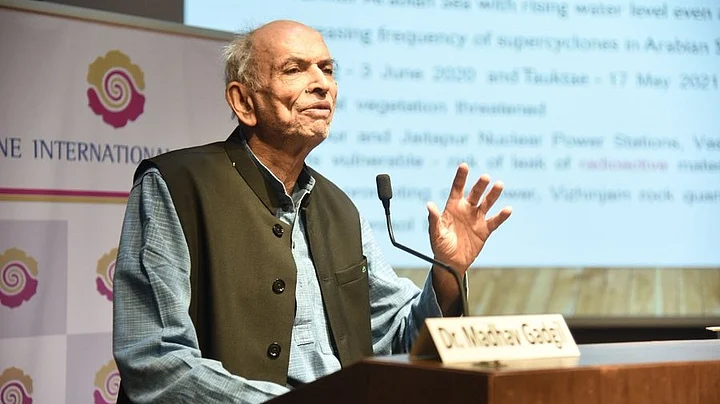
Veteran ecologist and environmental scholar Madhav Gadgil died in Pune on the night of 7 January 2026 after a brief illness. He was 84 years old. Gadgil was widely recognised for his pioneering work in ecology, his leadership of the Western Ghats Ecology Expert Panel, and his advocacy for community-driven conservation. His death was confirmed by his son, Siddhartha Gadgil.
According to The News Minute, Madhav Gadgil was regarded as the father of modern Indian ecology and played a central role in shaping India’s environmental policy over five decades.
He chaired the Western Ghats Ecology Expert Panel (WGEEP) in 2010, whose 2011 report warned of ecological disasters in the Western Ghats due to unchecked development activities. The report’s recommendations gained renewed attention after severe floods and landslides in Kerala, Kodagu, and Maharashtra in later years.
As reported by Deccan Herald, Gadgil was born in Pune in 1942 and completed his education at Fergusson College, Harvard University, and later returned to India to work at the Agharkar Research Institute and the Indian Institute of Science, Bengaluru.
He founded the Centre for Ecological Sciences at IISc in 1983, which became a leading institution for ecological research and policy.
Gadgil’s academic work covered population biology, human ecology, ecological history, and biodiversity conservation. Coverage revealed that he authored or co-authored seven books and over 225 scientific papers, including influential works such as "This Fissured Land" and his autobiography "A Walk Up the Hill."
He was also a key architect of India’s Biological Diversity Act, 2002, and pioneered the concept of People’s Biodiversity Registers to empower local communities in conservation efforts.
Gadgil’s 2011 report recommended that 75 percent of the Western Ghats be declared environmentally sensitive, a proposal that was later scaled down by subsequent panels. Analysis showed that the original recommendations remain only partially implemented, with eco-sensitive areas yet to be formally notified by the central government.
“I have the satisfaction that as a scientist, empathetic to the people, I have been able to do various things which have helped in changing the direction of what is happening. I’m a durable optimist – and hopeful that this progress will continue to gather pace,” Gadgil told UNEP, as cited in his final interviews.
Gadgil’s work was recognised with numerous national and international honours, including the Padma Shri (1981), Padma Bhushan (2006), Tyler Prize for Environmental Achievement (2015), and the Volvo Environment Prize. Reporting indicated that in 2024, the United Nations Environment Programme named him one of its Champions of the Earth, describing him as a “people’s scientist.”
Gadgil’s research highlighted the importance of sacred groves and traditional ecological knowledge long before these concepts gained wider recognition. Further details confirm that he collaborated with tribals, farmers, herders, and fisherfolk, and influenced policy at the highest levels, including serving on the Scientific Advisory Council to the Prime Minister and chairing international scientific panels.
His wife, Sulochana Gadgil, a noted monsoon scientist, passed away in July 2025. As details emerged, tributes have highlighted his lifelong commitment to scientific rigour, social justice, and the empowerment of local communities in environmental governance.
Note: This article is produced using AI-assisted tools and is based on publicly available information. It has been reviewed by The Quint's editorial team before publishing.