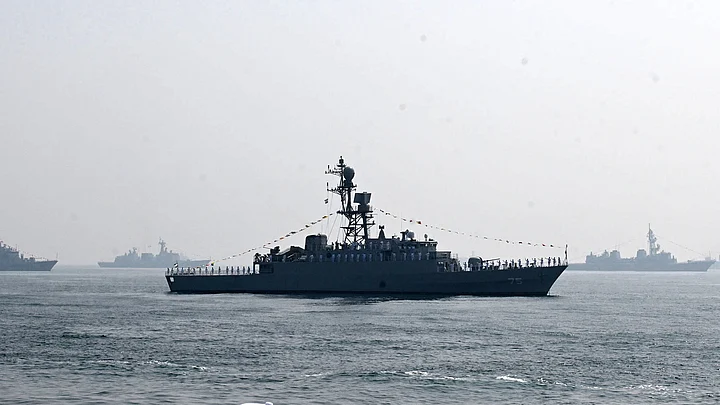
The Iranian warship IRIS Dena was sunk by a United States submarine in the Indian Ocean off the coast of Sri Lanka on 4 March 2026. The incident resulted in significant loss of life, with at least 87 bodies recovered and 32 sailors rescued. The vessel was returning from participating in the International Fleet Review in Visakhapatnam, India, and was operating in international waters at the time of the attack. Search and rescue operations for missing crew members are ongoing.
According to Deccan Herald, the IRIS Dena was a Moudge-class frigate with nearly 180 crew members on board. The US Department of Defense confirmed the strike, stating it was the first sinking of an enemy warship by a torpedo since World War II. The Pentagon released a video showing the vessel being struck and sinking rapidly.
As reported by Hindustan Times, Sri Lankan authorities responded to a distress call from the IRIS Dena and conducted rescue operations within their search and rescue zone. The incident occurred approximately 40 kilometres south of Galle, Sri Lanka. Sri Lankan Member of Parliament Namal Rajapaksa highlighted the broader security implications for the Indian Ocean region and called for increased regional dialogue.
As reported by Hindustan Times, Sri Lankan authorities responded to a distress call from the IRIS Dena and conducted rescue operations within their search and rescue zone. The incident occurred approximately 40 kilometres south of Galle, Sri Lanka. Sri Lankan Member of Parliament Namal Rajapaksa highlighted the broader security implications for the Indian Ocean region and called for increased regional dialogue.
As highlighted by The Hindu, the Sri Lankan Navy dispatched vessels promptly after receiving the distress call at 5:08 a.m. IST. The rescued sailors were taken to a hospital in Galle, where they are recovering from minor injuries. Authorities stated that search and rescue operations would continue for those still unaccounted for.
Analysis showed that the IRIS Dena had recently participated in the International Fleet Review in India before heading back to Iran. The vessel was equipped with anti-ship missiles, surface-to-air missiles, torpedoes, and a helicopter pad. The US Navy’s action was seen as a significant escalation in the ongoing conflict with Iran, with implications for regional maritime security and India’s diplomatic positioning.
The US Department of Defense released dramatic footage of the attack as coverage revealed, showing the torpedo striking the IRIS Dena and causing a large explosion. The video confirmed the rapid sinking of the vessel and the scale of the incident. The US described the IRIS Dena as a “prize ship” and stated that decimating the Iranian Navy was a key objective of its ongoing military operations.
“An American submarine sank an Iranian warship that thought it was safe in international waters. Instead, it was sunk by a torpedo,” US Defense Secretary Pete Hegseth said at a Pentagon briefing.
Further details about the survivors’ condition emerged following reports from hospital authorities in Galle. The 32 rescued sailors were being treated for minor injuries and were expected to be released soon. Security was heightened at the hospital, and Sri Lankan officials continued to coordinate with Iranian representatives regarding the survivors.
Regional security concerns intensified as details emerged about other Iranian naval assets in the area, including the military tanker Busheir anchored near Colombo. The incident has prompted discussions about the safety of international shipping lanes and the potential for further escalation in the Indian Ocean region.
Background information on the IRIS Dena’s recent activities was provided in ongoing coverage, noting the vessel’s participation in multinational naval exercises and its route through several international ports before the incident. The attack has drawn attention to the risks faced by neutral countries and the importance of respecting international maritime laws.
Note: This article is produced using AI-assisted tools and is based on publicly available information. It has been reviewed by The Quint's editorial team before publishing.