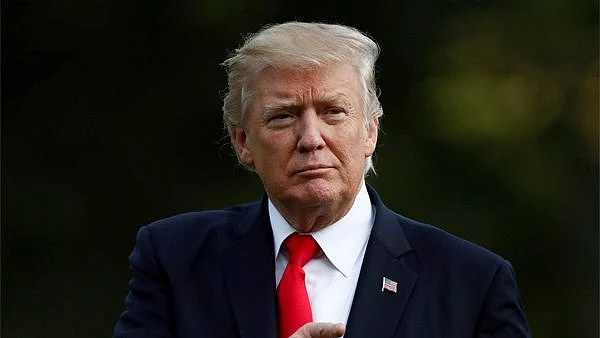
United States President Donald Trump has called for an expanded version of the Abraham Accords, urging additional Muslim-majority countries, including Pakistan and Saudi Arabia, to normalise relations with Israel as part of a broader diplomatic effort to resolve the ongoing US-Iran conflict.
Despite this push, both Pakistan and Saudi Arabia have publicly rejected participation in the proposed agreement, citing longstanding policy positions and ideological concerns.
According to Hindustan Times, US Republican Senator Lindsey Graham questioned Pakistan’s credibility as a mediator in the Iran-US conflict and directly sought a response from Islamabad regarding Trump’s call to join the Abraham Accords.
Graham described Pakistan’s role as “problematic” and highlighted the country’s historical animosity towards Israel.
Pakistan’s Defence Minister Khawaja Asif, in a televised interview, reiterated that joining the Abraham Accords would contradict Pakistan’s “fundamental ideologies.” He stated, “Personally, I don’t think we should join any such accord that clashes with our fundamental ideologies,” and further clarified that Islamabad’s position on Israel remains unchanged. This stance was echoed by other senior officials, who emphasised that recognition of Israel is contingent on the establishment of a viable Palestinian state as coverage revealed.
As noted in an article by The Hindu, Senator Graham’s remarks followed Defence Minister Asif’s public rejection of the Accords, where Asif cited Pakistan’s longstanding policy of not recognising Israel until a Palestinian state is established with East Jerusalem as its capital. Graham insisted that Pakistan provide a clear answer to Trump’s invitation, stating, “It is imperative that Pakistan give an answer now to President Trump’s call to join the Abraham Accords.”
Saudi Arabia has also maintained its position of not joining the Abraham Accords, aligning with its previous statements that normalisation with Israel is not possible without progress on the Palestinian issue. The country’s officials have repeatedly stated that their policy remains unchanged, despite international pressure as reporting indicated.
The Abraham Accords, initially brokered by Trump in 2020, established diplomatic, economic, and security relations between Israel and several Arab nations, including the United Arab Emirates, Bahrain, Morocco, and Sudan.
Trump’s recent proposal seeks to expand this framework to include additional countries as part of a broader settlement to the US-Iran conflict. In a Truth Social post, Trump stated that it should be “mandatory” for countries to sign on to the Accords, though he acknowledged that some may have reasons for not participating at the end of his statement.
“We have a very clear stance that this is not acceptable to us,” Defence Minister Khawaja Asif said, reinforcing Pakistan’s rejection of the Abraham Accords.
Further analysis showed that Pakistan’s refusal is rooted in its historical policy, dating back to its founder Muhammad Ali Jinnah’s explicit rejection of the UN partition of Palestine in 1947–48. The country’s foreign minister, Ishaq Dar, recently reiterated that Pakistan is not ready to recognise Israel until a two-state solution is accepted, and clarified that participation in any US-led peace board does not equate to joining the Abraham Accords as analysis showed.
Senator Graham also raised concerns about reports of Iranian military aircraft being housed on Pakistani air bases, suggesting that such actions further complicate Pakistan’s role as a neutral mediator. He stated that if these reports are accurate, a reevaluation of Pakistan’s mediation role would be necessary as details emerged.
“If they actually do have Iranian aircraft parked in Pakistan bases to protect Iranian military assets, that tells me we should be looking maybe for somebody else to mediate,” Senator Graham commented.
Despite Trump’s efforts to position himself as a peacemaker and expand the Abraham Accords, both Pakistan and Saudi Arabia have reaffirmed their longstanding policies, making the prospect of their participation in the agreement highly unlikely as further coverage revealed.
Note: This article is produced using AI-assisted tools and is based on publicly available information. It has been reviewed by The Quint's editorial team before publishing.