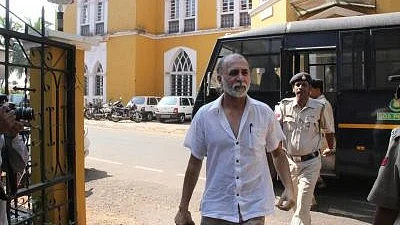
On 6 August 2026, the Bombay High Court sentenced former Tehelka editor-in-chief Tarun Tejpal to 10 years of rigorous imprisonment for the rape and sexual harassment of a junior colleague in 2013. The court overturned his 2021 acquittal, following an appeal by the Goa government. Tejpal was present in court during the pronouncement and was granted two weeks to surrender before jail authorities.
According to Bar and Bench, the division bench of Justices Neela Gokhale and Amit Jamsandekar imposed a fine of over ₹10 lakh on Tejpal in addition to the prison sentence. The court found him guilty under sections 376(2)(f) and 376(2)(k) (rape by a person in a position of trust or authority), as well as sections 354A and 354B of the Indian Penal Code.
As reported by Live Law, the High Court criticised the trial court’s earlier acquittal, stating that it had improperly focused on the victim’s post-incident behaviour and background rather than the conduct of the accused. The bench noted that the trial court had ignored material evidence, including an apology email sent by Tejpal to the survivor after the incident.
As highlighted by Deccan Herald, the case originated from allegations that Tejpal sexually assaulted his junior colleague in a hotel elevator in Goa on 7 and 8 November 2013. The Goa Police registered an FIR on 23 November 2013, and Tejpal was arrested on 30 November 2013 after his anticipatory bail plea was rejected.
Details of the legal timeline were outlined, showing that Tejpal was released on bail by the Supreme Court in July 2014 after spending several months in custody. The trial began in 2017, and in May 2021, the sessions court acquitted Tejpal, citing lack of corroborative evidence and inconsistencies in the survivor’s testimony.
"All I can say is I am 62. I believe I am a political victim. I am a father of two daughters. I have a wife. All we can say is we will go up and appeal. My lawyer wants me to request you to be lenient," Tejpal told the court, as quoted in the proceedings.
Further coverage revealed that Solicitor General Tushar Mehta, representing the State of Goa, urged the court to impose the maximum sentence, emphasising the need for a strong deterrent in cases involving persons in positions of power. The High Court agreed, stating that the relationship of trust and authority was a significant factor in determining the sentence.
The sequence of events was documented over nearly 13 years, including the initial complaint, arrest, bail, trial, acquittal, and eventual conviction. The High Court’s decision marked a major reversal in the protracted legal battle.
Arguments from both sides were presented in detail, with the prosecution asserting that the trial court’s focus on the survivor’s character and behaviour was misplaced, while the defence maintained that the acquittal was justified based on inconsistencies and lack of objective evidence.
"This court must give a clear message to society that when a girl says no, it means no. A no means a no," Solicitor General Tushar Mehta stated during the sentencing hearing.
At the end of the proceedings, analysis showed that the High Court’s judgment was based on a reappreciation of evidence and a rejection of the trial court’s reasoning. Tejpal’s legal team indicated plans to appeal the conviction in the Supreme Court.
Note: This article is produced using AI-assisted tools and is based on publicly available information. It has been reviewed by The Quint's editorial team before publishing.