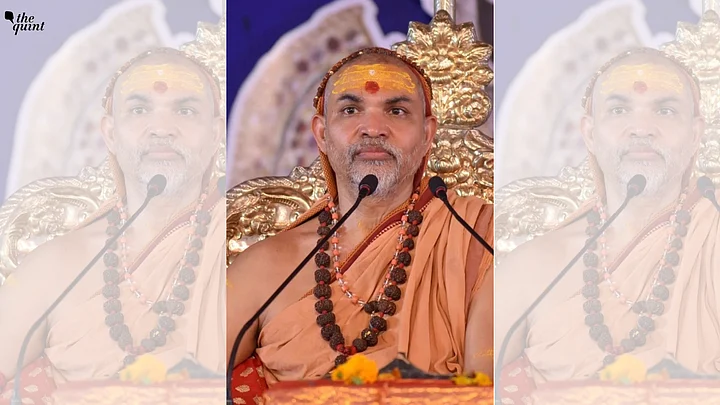
Swami Avimukteshwaranand Saraswati has publicly questioned the first information report (FIR) registered in the alleged embezzlement of donations at the Ram temple in Ayodhya. He stated that only lower-level employees were named in the FIR, while those allegedly responsible for larger wrongdoing were not included. The controversy follows the arrest of eight individuals associated with the counting of cash and valuables donated at the temple, as part of an ongoing investigation by a Special Investigation Team (SIT) constituted by the Uttar Pradesh government.
According to Deccan Herald, Swami Avimukteshwaranand Saraswati criticised the composition of the Shri Ram Janmabhoomi Teerth Kshetra Trust, stating that it was formed with individuals chosen by political leaders rather than religious authorities. He argued that the trust should have included the four Shankaracharyas, Ramanandacharya, and other religious leaders, instead of political associates.
During his remarks, Swami Avimukteshwaranand Saraswati said, "We have heard that the FIR has been registered against those who counted the currency notes. They merely straightened the notes, counted them and bundled them. Tell us about the larger theft that happened afterwards. A person engaged in counting notes, even if he were to steal, could at best take a few notes. Large-scale thefts are committed by influential people. There is no FIR against them."
As reported by Scroll, the FIR was registered after the SIT submitted its preliminary report, and eight individuals involved in counting donations were arrested. The accused were booked under provisions related to theft by a clerk or servant, criminal breach of trust, receiving stolen property, and criminal conspiracy.
Swami Avimukteshwaranand Saraswati further stated that the opposition had not raised the issue without basis, asserting that the delay in filing the FIR indicated there was substance to the allegations. He said, "If there was substance in the allegations, an FIR should have been registered on the very first day, even against unknown persons. The fact that an FIR has eventually been lodged after an inquiry itself shows that there was something to investigate. The opposition is only doing its duty by highlighting irregularities."
Midway through the investigation, officials confirmed that all eight individuals named in the FIR were arrested and were being questioned. The accused were associated with the process of counting cash and valuables received as donations at the temple, and the case was registered under relevant sections of the Bharatiya Nyaya Sanhita.
"Had everything been intended to be fair, the trust could have been entrusted to the four Shankaracharyas, Ramanandacharya and other religious leaders. Instead, trusted political associates were appointed, which showed the intention from the beginning," Swami Avimukteshwaranand Saraswati said.
Further coverage revealed that criticism of the FIR was not limited to religious leaders. Political figures, including Arvind Kejriwal, also alleged that the FIR targeted only junior employees while protecting more influential individuals. The FIR was lodged at the instance of a trust member and followed recommendations from the SIT’s preliminary report.
In addition, reporting indicated that the Congress party demanded a Supreme Court-monitored probe and the dissolution of the trust, arguing that the current investigation failed to address the involvement of senior officials. The party claimed that only low-level employees were being targeted, while those truly responsible remained unaccountable.
At the end of the week, further developments included the resignation of trust general secretary Champat Rai and trustee Anil Mishra on moral grounds. However, neither of their names appeared in the FIR, and the investigation continued to focus on lower-level staff.
"Large-scale thefts are committed by influential people. There is no FIR against them," Swami Avimukteshwaranand Saraswati reiterated, underscoring his concerns about the scope and direction of the investigation.
By the time the SIT submitted its interim report, analysis showed that the controversy had led to resignations and arrests, but questions remained regarding the exclusion of senior trust members from the FIR and the broader implications for governance and accountability at the Ram temple.
Note: This article is produced using AI-assisted tools and is based on publicly available information. It has been reviewed by The Quint's editorial team before publishing.