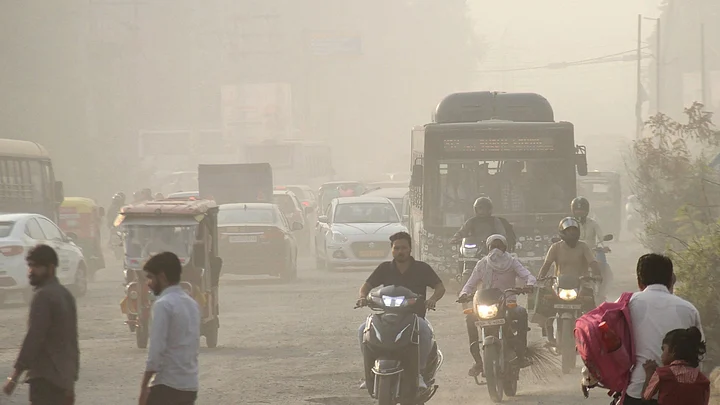
The Supreme Court has strongly criticised the Commission for Air Quality Management (CAQM) for failing to promptly identify the main causes of worsening air quality in Delhi-NCR and for not formulating long-term solutions.
The court directed CAQM to convene a meeting of experts within two weeks and submit a comprehensive report, emphasising the urgency of addressing the persistent air pollution crisis in the region.
According to The Indian Express, the Supreme Court bench led by Chief Justice of India Surya Kant and Justice Joymalya Bagchi observed that CAQM appeared to be in no hurry to identify the definite causes of the worsening Air Quality Index (AQI) or to plan long-term solutions.
The court criticised CAQM for seeking two more months to address issues such as traffic congestion at toll plazas, which contribute to pollution, and insisted that the biggest causes must be addressed on priority.
As reported by The Hindu, the court noted that even victims of poor air quality in Delhi-NCR indirectly contribute to the problem. The bench highlighted the lack of clarity regarding the exact causes of pollution, with conflicting claims about the roles of stubble burning, vehicular emissions, and construction activities. The court called for a transparent, issue-wise examination of each perceived source of pollution.
As highlighted by Live Law, the Supreme Court described CAQM’s approach as “unserious” and directed the body to urgently coordinate with domain experts. The court noted that expert institutions, including the Indian Institute of Technology, had attributed widely varying percentages to different emission sectors, with transport and construction cited as major contributors. The court emphasised that CAQM must bring all relevant experts together to arrive at a uniform identification of causes.
“CAQM appears to be in no hurry either in identifying the definite causes of worsening AQI or their long-term solution,” the bench observed, adding that “inordinate delay in finding out solutions will lead to further complications.”
As noted in an article by Deccan Herald, the court instructed CAQM to adopt a graded approach and cautioned against rigid mathematical quantifications of responsibility. The bench questioned how issues such as heavy vehicle emissions and construction could be addressed without disrupting essential services or housing needs, and stressed that policy responses must be based on scientific evidence.
This report highlighted that the court found CAQM’s status note silent on most issues raised and lacking seriousness. The court reiterated that CAQM is obligated to bring all domain experts under one umbrella and arrive at a uniform set of causes based on available data, with the resulting report to be made public for awareness and participation.
This article added that the court expressed strong disapproval of CAQM’s request for two months’ time, stating that the body could not keep deferring the issue while the region continued to suffer. The court noted that vehicular pollution alone now contributed to nearly 40 percent of Delhi’s AQI problem, and called for practical solutions such as a faster transition to electric vehicles and stronger public transport systems.
This report mentioned that the Supreme Court directed CAQM to start considering long-term solutions in a phased manner and to address the toll plaza issue independently of stakeholder positions. The court made it clear that it would not grant long adjournments and intended to monitor the matter continuously.
Note: This article is produced using AI-assisted tools and is based on publicly available information. It has been reviewed by The Quint's editorial team before publishing.