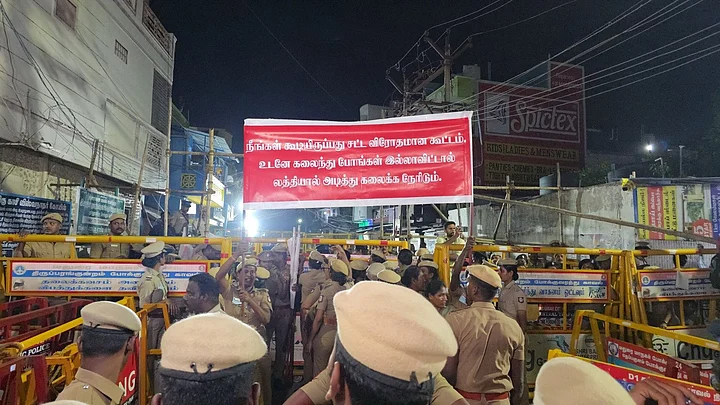
The Supreme Court of India ordered the lighting of the Karthigai Deepam lamp at the disputed Deepathoon stone pillar atop Thiruparankundram hill in Madurai on 28 November 2026. The court suspended the temple’s Board of Trustees, appointed two retired judges as receivers, and directed the Central Reserve Police Force (CRPF) to take over security of the temple and hill. The order followed non-compliance with an earlier directive to light the lamp at the specified location during the Karthigai festival.
According to The Hindu, the Supreme Court found that the Tamil Nadu government and temple trustees had engaged in “wilful disobedience” of its 20 November order, describing the actions as a “pre-meditated conspiracy.” The court’s bench, comprising Justices Aravind Kumar and Vipul M. Pancholi, issued contempt notices to senior state officials, including the Chief Secretary and Director General of Police, requiring their personal appearance at the next hearing.
As reported by The Indian Express, the court suspended the temple board after it resolved to light the lamp at the customary Deepa Mandapam location rather than the court-mandated Deepathoon pillar. The bench stated, “When this court speaks through an order, it speaks with authority of the Constitution. Its orders command obedience and Article 144 expressly enjoins all authorities… to act in aid of this court.”
In the middle of the controversy, coverage revealed that the Supreme Court’s intervention was prompted by what it termed a “complete failure” of the authorities to implement its earlier order. The court appointed Justices S Vaidyanathan and V Parthiban as joint receivers to oversee the temple’s administration and ensure the lamp was lit at the specified site, in consultation with hereditary priests.
The court also directed the CRPF to secure the temple and hill, citing the inability of state police to enforce its orders as details emerged. The CRPF was tasked with maintaining peace and ensuring that devotees of both the temple and the nearby Sikandar Badusha Dargah could perform their rituals without obstruction.
“Wilful defiance by officers entrusted with implementing judicial orders constitutes a flagrant breach of constitutional duty. It obstructs the administration of justice and strikes at the very root of the rule of law,” the Supreme Court observed.
As highlighted by Maktoob Media, the court’s order modified previous restrictions, allowing all devotees to light lamps at the disputed site, provided they remained at least 50 metres from the dargah. The CRPF was also instructed to protect the dargah and ensure Muslim devotees’ access was not impeded.
In response to the Supreme Court’s actions, analysis showed that the People’s Union for Civil Liberties (PUCL) criticised the order, arguing it could set a precedent for judicial intervention in religious practices and potentially affect social harmony. PUCL urged the Tamil Nadu government to seek a review before a Constitution Bench, citing concerns over separation of powers and the impact on community relations.
On the ground, reporting indicated that the dispute had mobilised political and religious groups, with thousands of BJP workers gathering at the temple. The court’s decision to appoint receivers and enforce the lamp lighting was seen as a significant intervention in a longstanding conflict over religious customs and site ownership.
“The chain of events that has unfolded in the instant case would indicate that the executive authorities seem to have acted at the dictates of their political bosses,” the Supreme Court stated.
Further, official statements confirmed that the temple’s Board of Trustees had cited historical documents and priestly opinions to justify their adherence to the traditional lamp site. However, the Supreme Court found this insufficient and emphasised the need for compliance with its directives to uphold constitutional order.
Note: This article is produced using AI-assisted tools and is based on publicly available information. It has been reviewed by The Quint's editorial team before publishing.