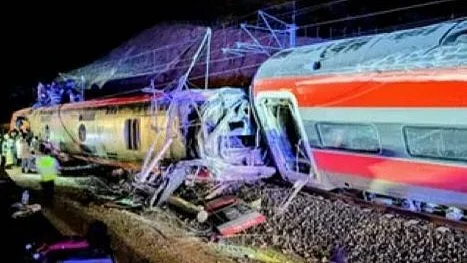
On 19 January 2026, two high-speed trains derailed and collided near Adamuz in Cordoba province, southern Spain. The incident resulted in 39 confirmed deaths and approximately 100 injuries, with at least 25 people reported to be seriously hurt. The crash led to the suspension of all rail services between Madrid and Andalusia, and emergency services responded immediately to the scene.
According to Deccan Herald, the accident occurred when a high-speed Iryo train traveling from Malaga to Madrid derailed near Adamuz and crashed onto an adjacent track, where it was struck by a Renfe train coming from Madrid to Huelva. The Iryo train had over 300 passengers, while the Renfe train carried around 100. The collision caused severe damage to the carriages, with some passengers trapped and rescue operations ongoing late into the night.
As reported by Hindustan Times, Spain’s Transport Minister Oscar Puente confirmed the death toll at 21 and stated that all survivors had been removed from the wreckage. He described the incident as "very strange," noting that the section of track had been renovated recently and the derailed train was less than four years old. The cause of the crash remains under investigation.
As highlighted by BBC, Andalusian emergency services reported at least 73 people were seriously injured, and rescue crews continued to extract individuals trapped in the derailed carriages. The crash happened at approximately 18:40 local time, about ten minutes after the Iryo train departed from Cordoba. The company set up support spaces for relatives at major train stations, and Spain’s royal family and Prime Minister Pedro Sánchez expressed condolences and support for the victims.
As noted in an article by The Indian Express, the impact was described by passengers as feeling "like an earthquake." Some passengers used emergency hammers to break windows and evacuate the carriages. Footage from the scene showed emergency workers assisting passengers and providing aid throughout the night.
"There was a moment when it felt like an earthquake and the train had indeed derailed," said Salvador Jimenez, a journalist traveling on one of the trains.
As further details emerged, the Iryo train was operated by an Italian group, and the Renfe train was part of Spain’s public rail network. The Andalusian regional president, Juanma Moreno, and other officials visited the site and coordinated with emergency services to support those affected. Medical teams and fire services worked at the scene, and local residents provided food and blankets to survivors.
Rescue operations continued into the following day, with 73 injured passengers taken to six different hospitals. The regional Civil Protection chief noted that the accident site was difficult to access, complicating rescue efforts. Local people assisted by bringing blankets and water to the scene.
Emergency services responded quickly as initial reports indicated that several people were trapped and required urgent medical attention. The rail operator Adif confirmed that high-speed services between Madrid and Andalusia would remain suspended while investigations and recovery operations continued.
"We have to remove the bodies to reach anyone who is still alive. It is proving to be a complicated task," said Paco Carmona, Cordoba fire chief.
Note: This article is produced using AI-assisted tools and is based on publicly available information. It has been reviewed by The Quint's editorial team before publishing.