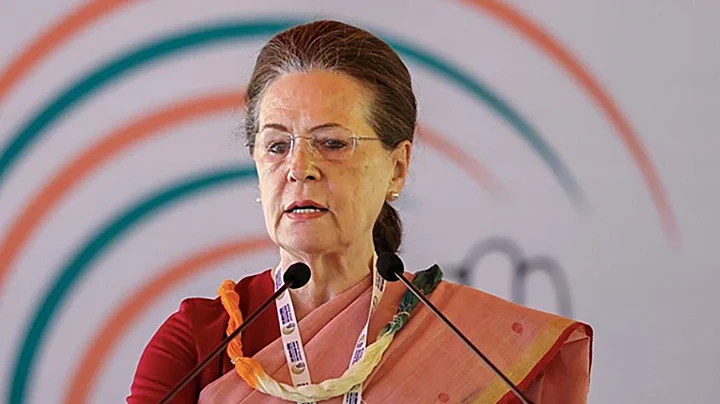
Sonia Gandhi has publicly criticised the Indian government’s continued silence regarding the humanitarian crisis in Gaza. She highlighted the findings of recent international investigations into Israeli actions, the scale of civilian casualties, and the destruction of infrastructure in Gaza. Gandhi argued that India’s lack of response stands in contrast to the growing global condemnation of Israeli policies and actions in the region.
According to The Indian Express, Sonia Gandhi referenced the June 2026 report by the UN Independent International Commission of Inquiry on the Occupied Palestinian Territory, led by Justice (retired) S. Muralidhar. The report concluded that Israeli authorities were committing genocide against Palestinians in Gaza, with a particular focus on the targeting of children and the destruction of essential infrastructure.
Gandhi cited the report’s findings that at least 20,000 children have been killed and another 44,000 wounded, many with lifelong injuries. She noted that the destruction of 97% of Gaza’s schools and the collapse of healthcare infrastructure have resulted in a significant increase in miscarriage and childbirth complications as detailed in the op-ed.
Internationally, Gandhi observed that several countries, including France, the UK, Canada, and Australia, have recognised Palestinian statehood, while South Africa has brought a case against Israel at the International Court of Justice. She also mentioned that the International Criminal Court has issued arrest warrants for Israeli political leaders, and that multiple European and Latin American states have restricted or severed ties with Israel according to the coverage.
“Amidst the growing public backlash against Israel and the international community’s cognisance of the unjustifiable brutality unleashed on Gaza, India remains a lone voice of silence,” Gandhi wrote.
Gandhi criticised the Narendra Modi government for not responding to the UN report or to the broader international condemnation of Israeli actions. She argued that India’s silence is inconsistent with its historical commitment to postcolonial solidarity and international peace, and that it has resulted in diplomatic isolation from traditional allies in the Middle East as analysis showed.
She further highlighted the story of Hind Rajab, a five-year-old Palestinian girl killed in Gaza, as emblematic of the humanitarian crisis. Gandhi noted that the film about Rajab’s story was initially blocked in India, only being cleared after significant public pressure as reporting indicated.
Gandhi argued that India’s current foreign policy has distanced the country from global public opinion and allowed other nations, including Pakistan, to claim a mediating role in the conflict. She stated that the government’s approach has not yielded strategic benefits and has instead resulted in closer alignment with Israel at a time when international sentiment is shifting as details emerged.
“The spirit of Indian nationhood demands that we speak up for our Palestinian brothers and sisters whose children have been so brutally targeted,” Gandhi asserted in her op-ed.
She concluded by urging the Indian government to reconsider its position, emphasising both moral responsibility and national interest in responding to the crisis in Gaza as highlighted in the commentary.
Note: This article is produced using AI-assisted tools and is based on publicly available information. It has been reviewed by The Quint's editorial team before publishing.