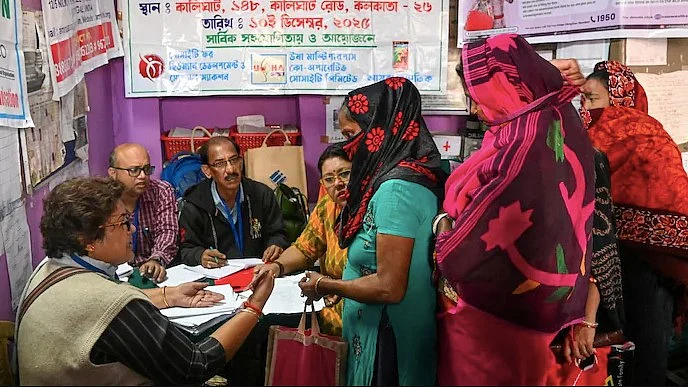
The Special Intensive Revision (SIR) of electoral rolls in West Bengal is currently underway, with the Election Commission of India deploying thousands of micro observers to scrutinise entries. The process has led to public warnings for officials, legal petitions in the Supreme Court, and concerns raised by political leaders and citizens about the fairness and transparency of the exercise. Hearings for voters flagged with discrepancies are ongoing across the state.
According to The Indian Express, the West Bengal Chief Electoral Officer has issued a strict directive to approximately 4,000 micro observers overseeing the SIR process, warning of disciplinary action for negligence. These observers, drawn from central government offices and nationalised banks, are tasked with verifying hearing proceedings, checking documents, and ensuring the accuracy of electoral roll entries. The CEO’s office emphasised that proper verification and documentation are essential for a flawless final roll.
As noted in an article by The Indian Express, Chief Minister Mamata Banerjee has written to the Chief Election Commissioner, criticising the SIR process as “mechanical” and “arbitrary.” She highlighted issues such as the lack of receipts for submitted documents and errors caused by artificial intelligence tools, which have led to genuine voters being categorised as having “logical discrepancies.” Banerjee also raised concerns about the treatment of women voters and the summoning of prominent citizens for hearings.
As reported by Live Law, the Supreme Court has sought a response from the Election Commission of India on petitions filed by Trinamool Congress MPs Derek O’Brien and Dola Sen. The MPs allege that instructions for the SIR are being issued informally via WhatsApp, without written orders, and challenge the categorisation of 1.36 crore voters as having “logical discrepancies.” The court has granted the ECI a week to respond, with the matter scheduled for further hearing next Monday.
“Such administrative lapses are being unfairly forced upon citizens, causing severe harassment of common citizens and also resulting in the denial of their constitutional rights,” Mamata Banerjee wrote in her letter to the CEC.
Coverage revealed that the ECI has signalled possible disciplinary action against an Assistant Electoral Registration Officer who publicly questioned the SIR process. The CEO’s office stated that grievances should be raised through formal channels, and public criticism amounts to indiscipline and violation of service rules. The official in question had raised concerns about discrepancies dating back to 2002, which he claimed had already been corrected by voters in accordance with ECI rules.
Voter experiences during the SIR process have varied widely as detailed in interviews. Some, like a single mother in Kolkata, described the process as stressful and emotionally taxing, especially when required to revisit family histories to prove eligibility. Others, including a BJP MLA and long-term residents, reported confusion and frustration over being summoned despite having voted for decades. The SIR has also affected prominent individuals, with elderly and ailing citizens being called for hearings due to missing records from 2002.
Analysis showed that the use of AI in digitising old voter lists has led to significant errors, resulting in many genuine voters being flagged for discrepancies. The lack of proper acknowledgment for submitted documents has further complicated the process for those seeking to prove their eligibility.
“Such scrutiny does not strengthen democracy. It exposes a profound insecurity within it,” said the daughter of a 72-year-old poet who was summoned for a hearing.
At the start of the SIR, the Election Commission cited concerns about the mass inclusion of ineligible voters as a reason for the exercise as background information indicated. However, the process has drawn criticism for its impact on vulnerable groups, including migrants, refugees, and women who have changed surnames after marriage. The ongoing hearings and legal proceedings continue to shape the future of the SIR in West Bengal.
Note: This article is produced using AI-assisted tools and is based on publicly available information. It has been reviewed by The Quint's editorial team before publishing.