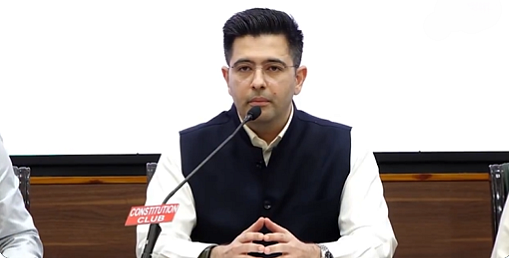
Rajya Sabha Member of Parliament Raghav Chadha’s name was deleted from the draft voter list in Punjab during the Special Intensive Revision (SIR) of electoral rolls. The draft roll, published on 13 August 2026, marked Chadha as “permanently shifted” from his registered address in Mohali. Chadha, who joined the Bharatiya Janata Party in April after leaving the Aam Aadmi Party, has alleged that the deletion is an act of political vendetta, saying that AAP leadership is "burning with anger." The final electoral roll is scheduled for release on 12 October 2026.
According to Scroll, Chadha stated that the Election Commission classified him as “shifted” and accused the Aam Aadmi Party government in Punjab of orchestrating the removal. He argued that, as a sitting MP from Punjab, guidelines require his name to be included in the draft rolls to allow for document collection during the claims and objections period.
As reported by The Indian Express, Chadha described the deletion as a “clear case of political vendetta” and said he is utilising the remedies available under SIR guidelines to correct the record before the final roll is published. He emphasised that the draft status allows for claims and objections until 12 September 2026, and he intends to ensure his inclusion in the final list.
As coverage revealed, Chadha questioned the process by which he was marked as “shifted,” alleging that Punjab government officials were involved in the classification. He stated, “This does not seem like a mere clerical mistake. This is a clear case of political vendetta.”
“The AAP government in Punjab has now taken its politics of revenge to the draft electoral rolls. I am a sitting Rajya Sabha MP from Punjab, with my voter ID registered in Mohali, Punjab. Yet my name has been classified as ‘shifted’ in the draft electoral rolls,” Chadha said.
At the same time, analysis showed that similar issues have been reported elsewhere, with voters in Delhi and Punjab finding their names marked as “shifted” or “absent” despite submitting required forms. In several cases, enumeration forms were verified and digitised, yet names appeared on the ASDD (absent, shifted, dead, duplicate) list, raising concerns about the accuracy of the revision process.
In response to Chadha’s allegations, officials stated that the SIR is conducted by the Election Commission of India, not the state government, and that the Punjab government has no role in deciding whose name is included or deleted. A spokesperson for the Aam Aadmi Party said Chadha’s voter registration maintenance was his own responsibility, especially if he no longer resides in Punjab.
Further, reporting indicated that the AAP accused Chadha of attempting to transfer his voter registration to Delhi through a backdated process, calling for an investigation into the matter. The party maintained that the revision exercise is managed by the Election Commission and not influenced by the state government.
“It is a matter of public record that Raghav Chadha has been living in Delhi, and not in Punjab. If he no longer resides in Punjab, maintaining or shifting his voter registration was his own responsibility. He cannot now blame the AAP or the Punjab government for the deletion of a voter entry,” an AAP spokesperson said.
Across Punjab, details emerged that 20.66 lakh names, or 9.7% of the pre-SIR electorate, were deleted at the draft stage. The SIR process, now in its third phase, is being conducted in 16 states, with the final rolls expected in October. The Election Commission’s guidelines specify that public representatives and other flagged individuals should be included in the draft rolls to facilitate document collection and verification.
In the context of the ongoing SIR, further scrutiny has been directed at the process, as concerns persist about the potential exclusion of genuine voters and the impact on electoral outcomes. Chadha’s case has intensified the debate over the transparency and accountability of the voter roll revision exercise.
Note: This article is produced using AI-assisted tools and is based on publicly available information. It has been reviewed by The Quint's editorial team before publishing.