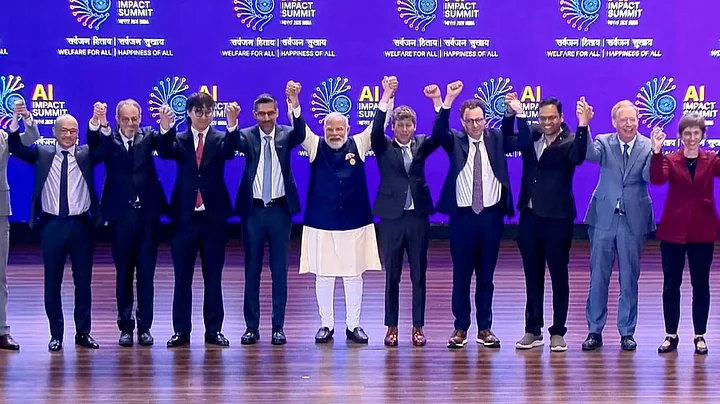
Prime Minister Narendra Modi addressed the India AI Impact Summit 2026 in New Delhi on 19 February 2026, highlighting India’s leadership in artificial intelligence and unveiling the MANAV vision for AI. The summit was attended by global leaders, technology executives, and featured live demonstrations of AI capabilities, including real-time sign language translation of Modi’s speech. The event marked a significant moment for India’s role in shaping the global AI landscape.
According to The Hindu, Prime Minister Modi emphasised that artificial intelligence must be democratised and serve as a tool for inclusion and empowerment, particularly for the Global South. He stated that India is not just participating in the AI revolution but is actively leading and shaping it, citing the country’s large youth population and robust technology talent pool.
As reported by Financial Express, Modi called for AI to be directed towards human welfare, warning that without proper guidance, it could become a disruptive force. He introduced the principle “Jiska data, uska adhikaar” (whose data, his right), and outlined the MANAV vision: moral and ethical systems, accountable governance, national sovereignty, accessibility and inclusivity, and validity and legitimacy. Modi stated, “The future of work will be inclusive, trusted, and human-centric. If we move forward together, artificial intelligence will elevate the potential of humanity.”
As highlighted by The Indian Express, the MANAV vision was presented as a framework to ensure AI development remains transparent, inclusive, and responsible. Modi stressed that AI should enhance human capabilities and be guided by ethical values, with transparent rules and robust oversight to protect national sovereignty and individual rights.
During the summit, a demonstration showcased AI translating Modi’s speech into sign language in real time, underlining the technology’s potential for accessibility. Modi reiterated that India possesses the talent, energy, and policy clarity to drive AI innovation, and invited global stakeholders to design and develop AI solutions in India for the benefit of humanity.
“Today at the New Delhi AI Impact Summit, I present the MANAV Vision for AI. MANAV means human, and MANAV Vision says M- moral and ethical systems: AI should be based on ethical guidance. A- accountable governance means transparent rules, robust oversight; N- national sovereignty means whose data, his right. A- accessible and inclusive means AI should be a multiplier, not a monopoly. V- valid and legitimate means AI should be lawful and verifiable.”
Coverage revealed that the summit was attended by world leaders including French President Emmanuel Macron, Brazil President Luiz Inacio Lula da Silva, and other heads of state, as well as CEOs from leading technology companies. The event was positioned as India’s flagship AI gathering, following similar summits in the UK, France, and South Korea.
Global participation was further emphasised in reporting that keynote speakers included OpenAI CEO Sam Altman, Google DeepMind CEO Dennis Hassabis, Reliance Industries Chairman Mukesh Ambani, and Gates Foundation Chair Bill Gates. The summit’s plenary session was closed to the public to accommodate security for the high-profile attendees.
Strong attendance and interest in the summit were noted as details emerged, with over 400 exhibitors from startups, corporates, and government entities participating. The expo was extended by a day to allow more visitors, reflecting the high level of engagement from students, professionals, and the broader technology community.
International attention was also drawn following reports that Bill Gates, initially scheduled to deliver a keynote address, withdrew from the event. The Gates Foundation was instead represented by Ankur Vora, with the foundation reaffirming its commitment to India’s health and development goals.
Note: This article is produced using AI-assisted tools and is based on publicly available information. It has been reviewed by The Quint's editorial team before publishing.