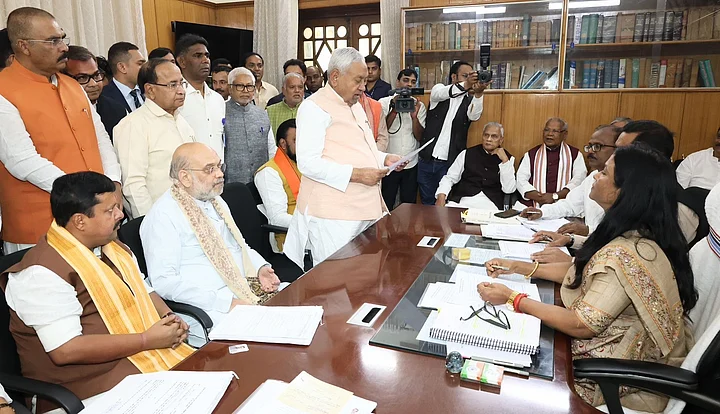
Bihar Chief Minister Nitish Kumar filed his nomination for the Rajya Sabha on 5 March 2026, confirming his decision to vacate the chief minister’s post. The move comes after over two decades of leading the state, and is expected to result in a change of leadership in Bihar.
The Rajya Sabha elections for five seats from Bihar are scheduled for 16 March 2026, with the ruling National Democratic Alliance (NDA) poised to secure all seats.
Nitish Kumar and Bharatiya Janata Party (BJP) national president Nitin Nabin submitted their nominations in Patna, in the presence of Union Home Minister Amit Shah. Nitish Kumar assured that his commitment to Bihar would remain unchanged, promising “full cooperation and guidance” to the incoming government.
The chief minister’s seat will be vacated, with Samrat Choudhary and Nityanand Rai emerging as key contenders for the position.
Nitish Kumar stated that it had long been his wish to serve in all four legislative bodies of the country. He expressed gratitude to the people of Bihar for their support over more than two decades and assured that his relationship with the state would continue.
The Congress party described the development as a “huge betrayal” of the people’s mandate, while other alliance leaders indicated that the next chief minister would likely be from the BJP.
Nitish Kumar reiterated his aspiration to become a member of both Houses of Parliament and both Houses of the Bihar Legislature. He wrote, “Since the beginning of my parliamentary career, I had aspired to become a member of both Houses of the Bihar legislature and both Houses of Parliament. In this regard, I am seeking to become a member of the Rajya Sabha in this election.”
“I want to assure you with complete sincerity that this relationship with you will continue, and my resolve to work together to build a developed Bihar will remain intact. The new government that is formed will have my full support and guidance,” Nitish Kumar stated.
As noted in an article by The Hindu, speculation has intensified regarding the next chief minister and the future role of Nitish Kumar’s son, Nishant Kumar. Party sources suggested that the BJP may appoint a chief minister from the Other Backward or Extremely Backward Class, and that Nishant Kumar could join the party and potentially serve as deputy chief minister. Security was heightened outside the chief minister’s residence as party workers gathered, raising slogans in support of Nitish Kumar.
Protests erupted outside Nitish Kumar’s residence, with supporters expressing opposition to his move to the Rajya Sabha. Some JD(U) leaders and legislators voiced concerns, stating that Bihar had voted in Nitish Kumar’s name and urging that his son Nishant be considered for the Rajya Sabha instead. However, party leaders maintained that the decision ultimately rests with Nitish Kumar.
Political developments continued as the nomination process progressed, with the BJP expected to take over the chief minister’s post. The NDA’s recent electoral victory in Bihar has positioned the alliance to secure all five Rajya Sabha seats, and the BJP’s Nitin Nabin and Shivesh Kumar have also filed nominations. Discussions within the JD(U) indicated that Nishant Kumar would be given a larger role in the party.
“He will be given a bigger responsibility in the party. What responsibility he is going to get will be decided in a day or two,” a JD(U) minister was quoted as saying.
Union Home Minister Amit Shah praised Nitish Kumar’s tenure, describing it as a “golden period for Bihar” during the nomination event. Shah highlighted Kumar’s contributions to the state’s development, including improvements in road connectivity and electricity, and commended his clean record in public life. The NDA’s strength in the Bihar assembly ensures a comfortable majority for its Rajya Sabha candidates.
Further updates confirmed that Nitish Kumar filed his nomination papers before the Secretary of the Bihar Legislative Assembly Office Cell, accompanied by senior NDA leaders. The process marks the end of Nitish Kumar’s tenure as Bihar’s longest-serving chief minister and signals a significant shift in the state’s political landscape.
Note: This article is produced using AI-assisted tools and is based on publicly available information. It has been reviewed by The Quint's editorial team before publishing.