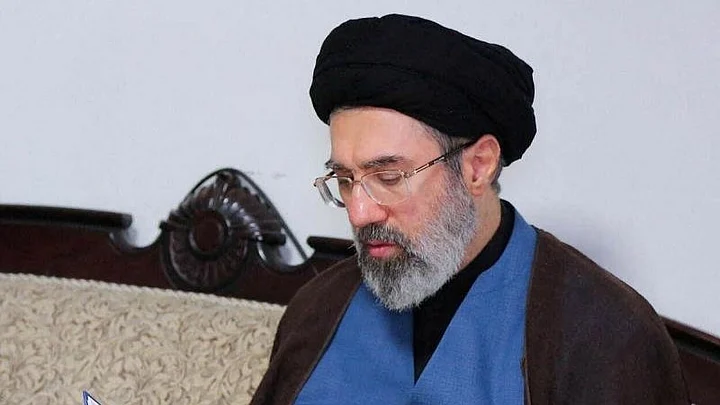
Mojtaba Khamenei, the son of Iran’s late Supreme Leader Ayatollah Ali Khamenei, has been elected as the new Supreme Leader by Iran’s Assembly of Experts. His appointment follows the death of his father in a targeted airstrike during the recent escalation between Iran, the United States, and Israel. Mojtaba, aged 56, is now set to lead Iran at a time of significant internal and external challenges, with much of the country’s top leadership also killed in the attacks.
According to Hindustan Times, Mojtaba Khamenei was chosen by the Assembly of Experts after days of speculation and was reportedly elected under pressure from the Iranian Revolutionary Guard Corps (IRGC). His selection is notable as Iran’s political system has historically opposed hereditary succession, and Mojtaba himself has never held formal government office.
As reported by The Indian Express, Mojtaba Khamenei is not considered a high-ranking cleric and has no official government position, but he is widely believed to wield significant influence behind the scenes, particularly through his close ties with the IRGC. He fought in the Iran-Iraq war and has been involved in managing aspects of his father’s office.
As highlighted by Hindustan Times, Mojtaba is married to Zahra Haddad-Adel, daughter of conservative politician Gholam-Ali Haddad-Adel. The couple reportedly has three children. Zahra was reported to have been killed in the same strikes that claimed the lives of several Khamenei family members. Mojtaba’s financial dealings have drawn international scrutiny, with reports indicating he oversees a substantial investment empire.
Coverage revealed that the death of Ayatollah Ali Khamenei occurred during a joint US-Israeli military operation targeting Iranian leadership compounds. The strikes resulted in the deaths of several senior officials and family members, leaving Mojtaba among the few surviving close relatives. The Assembly of Experts, an 88-member body, is constitutionally responsible for appointing the Supreme Leader, and this marks only the second such succession in the Islamic Republic’s history.
"His selection, however, may raise questions, as the Islamic Republic has often criticised hereditary rule and presented itself as a fairer system. Khamenei himself reportedly did not include him in a list of possible successors he prepared last year."
In the middle of the ongoing conflict, analysis showed that India has maintained silence on the killing of Khamenei and his family, reflecting the complex geopolitical considerations at play. The Indian government’s response has been shaped by its relationships with both Iran and Israel, as well as broader regional and international dynamics.
Further details about Mojtaba’s background indicate that reporting indicated he was sanctioned by the United States in 2019 for acting on behalf of his father in an official capacity, despite never being elected or appointed to a government position. His influence is attributed to his connections with the IRGC and his role in managing his father’s affairs.
The succession comes at a time when Iran is facing significant instability, both domestically and internationally. As details emerged, the Iranian leadership has been largely decimated, and Mojtaba’s appointment is seen as a move to maintain continuity amid crisis. The Assembly of Experts’ decision is expected to have lasting implications for Iran’s political trajectory and its relations with the wider world.
"Mojtaba is not a high-ranking cleric. He's never held office and does not have an official role in the regime. However, he's believed to wield considerable influence behind the scenes."
While Mojtaba’s elevation consolidates power within the Khamenei family, further examination suggests that his leadership may signal a shift towards a more hardline stance, given his close ties to the IRGC. The move has drawn both support and criticism within Iran, with some viewing it as a continuation of his father’s legacy and others as a departure from the republic’s anti-dynastic principles.
Note: This article is produced using AI-assisted tools and is based on publicly available information. It has been reviewed by The Quint's editorial team before publishing.