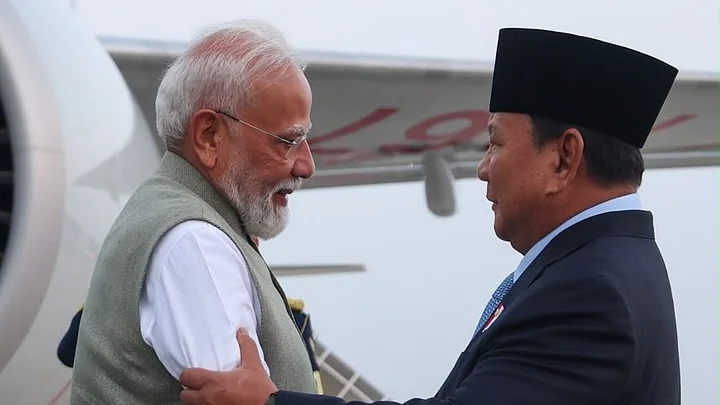
Prime Minister Narendra Modi arrived in Jakarta on 6 July 2026, marking the first leg of a six-day Indo-Pacific tour that includes visits to Auckland and Melbourne. The visit aims to strengthen India’s strategic partnership with Indonesia, focusing on maritime security, critical mineral supply chains, and economic cooperation. Indonesia, as the world’s largest archipelagic nation, plays a pivotal role in regional trade and security, making it a key partner for India’s Act East policy and Indo-Pacific vision.
According to The Indian Express, Jakarta is considered the lynchpin of India’s Indo-Pacific strategy due to its strategic location and abundant natural resources. The bilateral trade between India and Indonesia has reached nearly $30 billion annually, surpassing India’s trade with the United Kingdom and closely matching Indo-German trade. The partnership is expected to expand further with the upgradation of India’s free trade agreement with ASEAN, particularly in marine logistics, technology, and financial services.
As highlighted by The Indian Express, Modi’s Jakarta visit is not a routine diplomatic engagement but a strategic move to co-architect a new Indo-Pacific security order with Indonesia. The two countries have elevated their relationship to a Comprehensive Strategic Partnership, with mechanisms such as Defence Cooperation Agreements and Joint Commission Meetings. The visit follows a series of high-level exchanges, including Indonesian President Prabowo Subianto’s participation as Republic Day chief guest in January 2025 and recent foreign ministerial meetings.
Coverage revealed that a key agenda for the visit is securing India’s access to Indonesia’s nickel reserves, which are critical for electric mobility and clean energy transitions. Indonesia holds the world’s largest nickel reserves, while India has minimal domestic supply. The two governments are exploring joint ventures and mineral-processing partnerships to integrate India into Indonesia’s nickel value chain, aiming to enhance supply-chain resilience and reduce dependence on Chinese-controlled processing facilities.
Defence cooperation is another significant focus, with discussions on the potential acquisition and co-production of BrahMos supersonic cruise missiles. Analysis showed that such agreements could strengthen Indonesia’s deterrence capabilities and align with both nations’ goals of military-industry indigenisation. The Andaman-Nicobar-Sabang corridor is also under consideration for joint maritime surveillance and counter-piracy operations, leveraging the proximity of India’s Andaman and Nicobar Islands to Indonesia’s Sabang Port.
“India and Indonesia are, collectively, home to nearly two billion people and are among the world’s most consequential maritime nations,” the analysis noted.
Economic ties, while robust, remain below potential. Reporting indicated that India runs a trade deficit of approximately $20 billion with Indonesia, and both governments have set a target to expand bilateral trade to $100 billion by 2030. Initiatives to improve connectivity, such as direct flights and shipping links between the Andaman and Nicobar Islands and Indonesia’s Aceh Province, are being discussed to facilitate greater economic and people-to-people exchanges.
India’s approach to the Indo-Pacific, as described in recent analysis, seeks to establish a collaborative framework led by regional powers rather than external superpowers. The “arc of trust” envisioned by Modi extends from India through Indonesia, Australia, and New Zealand, aiming to create a resilient and inclusive regional order. This strategy emphasises autonomy, development, and security cooperation among Indo-Pacific nations.
“The geographical centre of the Indo-Pacific is resetting and redrawing an emerging order so that those who share this oceanic domain write the rules instead of just inheriting them,” the analysis stated.
While the visit’s primary focus is on strategic and economic cooperation, it also underscores the importance of institutionalising joint mechanisms for defence, trade, and digital infrastructure. Further details emerged that both sides are considering technology transfer provisions in defence contracts and the revival of the long-delayed Comprehensive Economic Cooperation Agreement to unlock the full potential of bilateral trade.
India and Indonesia’s shared interests in maritime security, critical minerals, and regional stability are expected to drive the outcomes of Modi’s Jakarta visit. As discussions continue, both countries aim to deepen their partnership and play a central role in shaping the Indo-Pacific’s future.
Note: This article is produced using AI-assisted tools and is based on publicly available information. It has been reviewed by The Quint's editorial team before publishing.