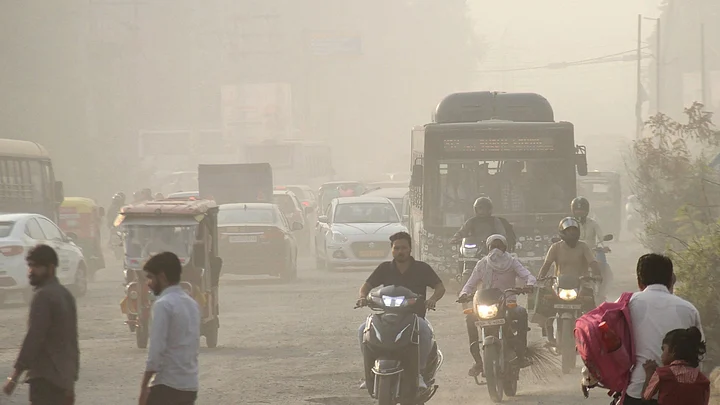
On 2 January, Kolkata’s air quality index (AQI) reached the “very poor to hazardous” range, with readings between 330 and 350. Mumbai’s AQI was recorded at approximately 220, while Delhi’s stood at around 200.
A Public Interest Litigation (PIL) was filed in the Calcutta High Court seeking urgent state intervention to address the deteriorating air quality in Kolkata and Howrah. The PIL requests enforceable measures to protect public health and ensure the right to clean air.
According to Live Law, the PIL was filed by Advocate Akash Sharma, who highlighted that Kolkata’s AQI was among the worst in the country on the specified date. The petition documents a prior representation to state authorities in November 2025, warning of predictable winter pollution and urging the implementation of a Graded Response Action Plan (GRAP).
The report further said that the West Bengal Pollution Control Board responded by stating it was conducting research and preliminary testing for a software-based GRAP, but did not commit to any time-bound or legally enforceable actions.
The PIL in Kolkata seeks judicial directions for the notification of a GRAP, creation of an expert airshed task force, prohibition of open waste burning, industrial pollution audits, vehicular emission controls, and binding public health advisories for high-AQI days. The matter is expected to be listed before the Calcutta High Court in the coming week.
As per Hindustan Times, Mumbai’s air quality has also deteriorated, with the city’s AQI rising to 140, placing it in the ‘moderate’ category. Residents, including public figures, have reported health impacts such as coughing and breathlessness, and have been advised to limit outdoor activities due to the pollution.
“What is happening? Can’t ever breathe, yaaa. Makes me reduce my outdoor activities. Constant coughing. It’s so bad in the morning as well,” actor Hina Khan shared on her Instagram regarding Mumbai’s air quality.
A different Hindustan Times article said that the increase in Mumbai’s AQI was observed across most monitoring stations, indicating a citywide accumulation of pollutants.
Byculla recorded an AQI of 194, with other areas such as Mazgaon, the airport, and Deonar also reporting high levels. The lack of wind dispersion was identified as a key factor in the accumulation of pollutants.
The above report further carried statements from civic officials attributing the situation to stagnant winds rather than new emissions. Medical professionals in Mumbai have reported an increase in respiratory cases, with patients experiencing prolonged coughs and illnesses due to the persistent pollution.
Note: This article is produced using AI-assisted tools and is based on publicly available information. It has been reviewed by The Quint's editorial team before publishing.