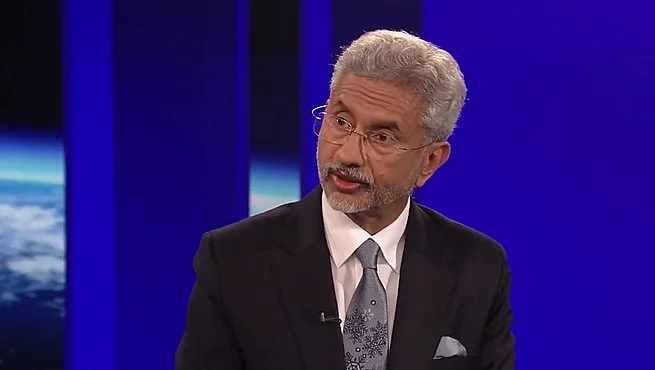
India’s External Affairs Minister S Jaishankar delivered the country’s National Statement at the United Nations General Assembly on 26 September 2026.
He addressed issues of terrorism, the impact of global conflicts on developing nations, and called for reforms to the United Nations Security Council.
Jaishankar also responded to remarks made by Pakistan’s Prime Minister regarding terrorism and the Indus Waters Treaty, reiterating India’s right to defend itself and highlighting the need for accountability in cases of state-sponsored terrorism.
According to Hindustan Times, Jaishankar stated that the world is witnessing the “weaponisation of everything,” including finance, supply chains, and technology.
He described the situation as a “4F crisis” affecting food, fuel, fertiliser, and finance, particularly for the Global South. He warned that the world was “living on the edge of an abyss” and called for strengthening stability, security, and predictability to ensure peace.
As reported by The Hindu, Jaishankar directly addressed Pakistan’s accusations, stating that arguments by a “serial practitioner of terrorism” would not stand.
He emphasised that India would exercise its right to defend itself against terrorism and asserted that “friendship and goodwill cannot coexist with terrorism.” He also responded to claims about the Indus Waters Treaty, clarifying India’s position and reiterating that understandings premised on terrorism would be called into question.
Coverage revealed that Russia’s Foreign Minister Sergey Lavrov reaffirmed support for India’s bid for a permanent seat on the UN Security Council.
Lavrov stated at the UNGA that reforms should not result in additional seats for Western nations, but should instead broaden representation for Asia, Africa, and Latin America. He specifically named India and Brazil as candidates for permanent membership, emphasising the need for a more inclusive and geographically balanced global architecture.
Analysis showed that Russia’s position aligns with India’s call for reformed multilateralism. Lavrov reiterated that any changes to the Security Council must not weaken the authority of its current permanent members, while supporting greater representation for the Global South. The BRICS grouping, which includes both India and Russia, has previously expressed support for India’s aspirations in the UN system.
“Our right to defend ourselves against terrorism will be exercised,” Jaishankar said, adding, “Friendship and goodwill cannot coexist with terrorism. And understandings premised on that will naturally be called into question.”
In the middle of the debate, further details emerged about Jaishankar’s emphasis on the disproportionate impact of global conflicts on countries far from the conflict zones. He highlighted that developing nations are often penalised despite having little influence over such crises, and called for the Assembly to address these realities. Jaishankar also referenced India’s humanitarian efforts in West Asia and its support for a two-state solution in the Israel-Palestine conflict.
Diplomatic exchanges continued as Jaishankar underscored India’s contributions to global development, citing major projects in 78 countries and India’s role in international initiatives such as the International Solar Alliance and the Global Biofuels Alliance. He also addressed the misuse of artificial intelligence and advocated for each nation’s right to shape its own AI ecosystem.
Key points were reiterated at the end of the session, with Jaishankar calling for a multipolar world and a more democratic future. He stated that the post-1945 order must adapt to new realities, and that the case for reformed multilateralism is stronger than ever. India’s position at the UNGA was marked by a focus on accountability, inclusivity, and the need for structural reforms in global governance.
Note: This article is produced using AI-assisted tools and is based on publicly available information. It has been reviewed by The Quint's editorial team before publishing.