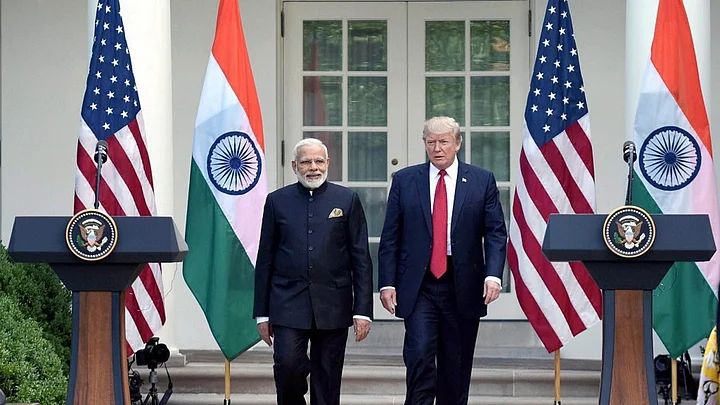
India has decided to postpone the signing of a trade agreement with the United States until the US government finalises its new tariff architecture and clarifies country-specific tariff rates. This decision follows recent legal and policy changes in the US, including the Supreme Court’s invalidation of previous reciprocal tariffs and the imposition of new temporary tariffs under Section 122 of the Trade Act, 1974.
According to The Hindu, Commerce Secretary Rajesh Agrawal confirmed that India remains engaged with the US on a trade deal but will only proceed once the US clarifies its tariff structure. The US has imposed 10% tariffs on certain products from all countries for 150 days, following the Supreme Court’s ruling against the International Emergency Economic Powers Act (IEEPA) tariffs.
As reported by The Indian Express, the United States Trade Representative (USTR) is developing a new tariff structure, with Section 301 investigations launched into several countries, including India. These investigations focus on issues such as structural excess capacity and the use of forced labour in manufacturing sectors. The USTR aims to establish a new legal basis for tariffs before the current Section 122 tariffs expire in July 2026.
India’s approach is influenced by the uncertainty surrounding the US tariff regime, as several trade partners have reconsidered their agreements. Coverage revealed that Malaysia has declared its trade deal with the US null and void, and the European Union has put its own negotiations on hold, pending clarity on the new US tariff framework.
Officials in the Indian Commerce Ministry have stated that any future trade deal will be evaluated based on the comparative advantage India receives in the US market. The final agreement will depend on the tariff rates the US sets for India and its competitors. “Any deal that we finalise and sign has to be seen against the tariff structure or comparative advantage that India gets in the US market,” an official was quoted as saying. The official further explained, “Depending on how their tariff architecture settles, that will determine where India will land.”
“Now with the Supreme Court judgement on IEEPA tariffs, the tariffs per se don’t exist,” a senior Commerce Ministry official stated, highlighting the legal uncertainty affecting the timing of the trade deal.
In March 2026, the US initiated two Section 301 investigations that could result in additional tariffs on specific countries, including India. Analysis showed that these investigations are proceeding rapidly, with hearings scheduled for early May and the possibility of new measures being implemented by July 2026.
The US has also removed certain tariffs on Indian exports that were previously linked to India’s import of Russian oil. Reporting indicated that the 25% additional ad-valorem tariffs imposed on some Indian goods were lifted in February 2026, following a US Treasury Department order allowing India to continue importing oil from Russia.
India’s trade surplus with the US remains significant, with the USTR noting a $58 billion surplus in 2025. The US has cited excess capacity in Indian sectors such as solar modules, petrochemicals, steel, and automotive goods as part of its justification for the ongoing investigations. Details emerged that the USTR considers Section 301 a stronger legal basis for imposing long-term tariffs, as it empowers the executive branch to modify or reopen cases as needed.
“The USTR’s goal is to replace these Section 122 tariffs with new measures by July,” said Deborah Elms, Head of Trade Policy at the Hinrich Foundation, as cited in recent analysis.
While the framework for the India-US trade deal was announced in February 2026, the final signing is now contingent on the outcome of the US tariff investigations and the establishment of a stable tariff regime. Further updates indicate that Indian officials are closely monitoring developments and will determine the timing of the agreement based on the evolving US policy landscape.
Note: This article is produced using AI-assisted tools and is based on publicly available information. It has been reviewed by The Quint's editorial team before publishing.