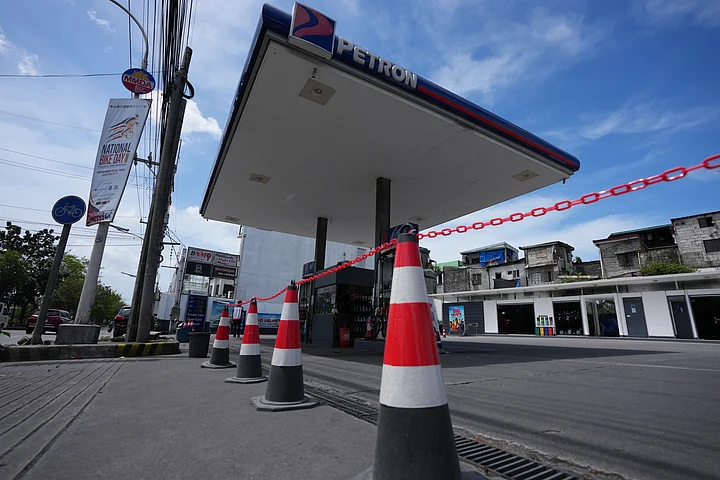
Oil prices surged above $100 per barrel as the US-Iran war escalated, disrupting supplies through the Strait of Hormuz and prompting major oil producers to cut output. The resulting supply shock has triggered significant volatility in global energy markets, with G7 countries facing heightened risks to their oil imports and economic stability.
According to Hindustan Times, Brent crude prices spiked as much as 28% to $118.73 per barrel, while West Texas Intermediate jumped 31%. The closure of the Strait of Hormuz, a critical chokepoint for global oil shipments, has forced Kuwait, the United Arab Emirates, and Iraq to reduce output as storage facilities reach capacity. The US government has acknowledged the price shock, with President Donald Trump stating that the market movements are a “very small price to pay” for security objectives.
As highlighted by The Hindu, roughly 15 million barrels of crude oil—about 20% of the world’s supply—are typically shipped daily through the Strait of Hormuz. The threat of missile and drone attacks has nearly halted tanker traffic, impacting exports from Saudi Arabia, Kuwait, Iraq, Qatar, Bahrain, the UAE, and Iran. Major producers have begun cutting production as export routes remain blocked, further tightening global supply.
As reported by The Indian Express, oil prices surged about 20% in early trading, reaching their highest levels since July 2022. Brent crude futures rose as much as $18.35 to $111.04 a barrel, while US WTI crude climbed to $111.24. The ongoing conflict has left nearly 400 people dead and damaged key energy infrastructure, with Saudi Arabia attempting to reroute shipments via the Red Sea, though these volumes are insufficient to offset the shortfall from the Strait of Hormuz.
Reporting indicated that the Strait of Hormuz’s closure has raised fears of prolonged disruptions, as about one-fifth of global petroleum liquids consumption passes through this maritime chokepoint. Iran’s threats to target vessels attempting passage have further heightened supply concerns for G7 importers.
“Right now, the biggest fear is still disruption to flows through Hormuz. Production shut-ins matter, but the market really worries about barrels not being able to move,” said Haris Khurshid, chief investment officer at Karobaar Capital LP, as cited in the coverage.
Market analysis showed that global financial markets have come under heavy pressure as oil prices surged, triggering a broad sell-off in equities across Asia and raising fears of a fresh inflation shock. The spike in energy costs is complicating central banks’ efforts to support economic growth, with Asian and Western stock futures falling sharply in response to the crisis.
In the middle of the turmoil, analysis showed that India’s stock market is bracing for a sharp plunge, with the Nifty 50 and Sensex both down nearly 3%. The surge in oil prices threatens to widen fiscal deficits and weaken currencies in major importing nations, including several G7 economies.
Stock market data revealed that Japan’s Nikkei 225 and South Korea’s Kospi experienced steep declines, falling more than 6% and 7.4% respectively, as oil prices soared past $100 per barrel. The disruptions in oil production and movement, including Iran’s strategic blockade of the Strait of Hormuz, have sent shockwaves through Asian and G7 markets.
“The market is not dealing with a headline shock. It is dealing with a physical disruption of oil molecules,” said Stephen Innes of SPI Asset Management, highlighting the direct impact on energy flows.
Further coverage revealed that Bahrain’s state oil company declared force majeure after an Iranian attack set its refinery ablaze, underscoring the vulnerability of regional infrastructure. The ongoing conflict has led to attacks on oil and gas facilities in Iran, Israel, and the US, exacerbating supply concerns for G7 countries reliant on Middle Eastern energy.
Note: This article is produced using AI-assisted tools and is based on publicly available information. It has been reviewed by The Quint's editorial team before publishing.