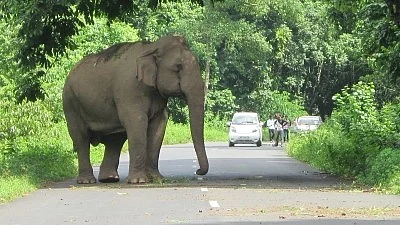
Since the beginning of January 2026, a single-tusked elephant has killed at least 22 people in Jharkhand’s West Singhbhum district.
The attacks have occurred mostly at night, targeting villages and resulting in widespread panic.
Authorities have deployed over 100 personnel and wildlife specialists from multiple states to track the animal, but efforts to locate and tranquillise it have so far been unsuccessful. Residents have been advised to avoid forested areas and remain vigilant.
According to The Guardian, the elephant’s rampage began on 1 January 2026, with victims including entire families and a forest department official.
The animal has been described as extremely violent, possibly due to separation from its herd. Attempts to subdue the elephant have failed, and its erratic movements have complicated the search operation.
As reported by The Indian Express, the attacks have left villages deserted, with many residents fleeing or constructing elevated platforms for safety.
Forest officials have activated local networks to report sightings, but the elephant’s location remains uncertain.
The region has a history of human-elephant conflict, with over 1,270 deaths from elephant attacks in Jharkhand in the past 18 years.
Coverage revealed that the animal’s behaviour is considered highly unusual, as it has been moving directly into human settlements rather than avoiding them. Experts attribute the rise in such conflicts to habitat fragmentation caused by deforestation, mining, and urbanisation, which disrupt traditional elephant corridors and force animals into closer contact with people.
In a related context, The Hindu stated in an article that a woman was killed by a wild elephant in Karnataka’s Hassan district on 13 January 2026. The incident led to local protests and renewed calls for long-term solutions to human-elephant conflict. The state’s Forest Minister announced compensation for the victim’s family and directed officials to take preventive measures.
“Every life is precious. However, we cannot bring the departed soul back. In order to extend a helping hand to the bereaved family, the department will offer ex-gratia,” the minister said.
In recent years, analysis showed that India has experienced a significant increase in human-elephant conflict, with over 2,800 people killed by elephants nationwide in the past five years. Efforts such as early warning systems have been introduced in some regions to mitigate risks, but challenges persist due to ongoing habitat loss and resource scarcity.
“The degradation of elephant habitats in Jharkhand has far-reaching consequences for both elephants and humans. Elephants that are unable to access traditional migratory routes are forced into fragmented habitats, increasing the likelihood of inbreeding and reducing genetic diversity within populations,” a recent research paper noted.
Efforts to address the crisis continue, with authorities focusing on both immediate safety measures and long-term strategies to restore elephant corridors and reduce encounters between humans and wildlife. The situation remains tense in affected areas, as communities and officials work to prevent further casualties as details emerged.
Note: This article is produced using AI-assisted tools and is based on publicly available information. It has been reviewed by The Quint's editorial team before publishing.