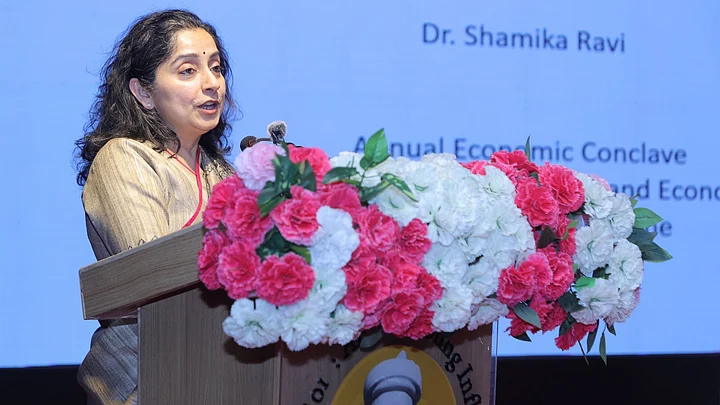
Shamika Ravi, a member of Prime Minister Narendra Modi’s Economic Advisory Council, recently addressed concerns about the Indian rupee potentially weakening to 100 against the United States dollar. She stated that the currency should be allowed to discover its own true value and described the figure of 100 as “just a number.” Ravi made these comments during an interview on the ANI podcast, emphasising that market forces should determine the rupee’s exchange rate.
According to Scroll, Ravi compared the exchange rate mechanism to a pressure cooker valve, explaining that the rupee’s value acts as a release for economic pressures. She argued that intervention to maintain the currency at a specific level could lead to inflationary pressures and other negative impacts on the economy.
Ravi further stated that the government should avoid intervening in a market that is functioning properly, highlighting the importance of allowing the rupee to adjust naturally. She said, “At the end of the day, what you do not want is to jump into this, try to keep the value at a certain level, which leads to inflationary pressures, which is going to have all kinds of other chaotic impacts.”
Recent coverage revealed that Ravi also addressed the broader economic context, noting that rising costs in India are primarily the result of external supply shocks. She explained that these pressures are not due to domestic factors, and that India is already drawing down its foreign exchange reserves to manage the situation.
In the same interview, Ravi rejected suggestions that India’s economic growth is slowing, asserting that the country is experiencing a phase of sustained high growth. She expressed confidence that this trajectory would continue despite current challenges. The rupee, meanwhile, has been the worst-performing Asian currency in 2026, declining by about 5.5% since the onset of the conflict in West Asia.
“So what if the rupee touches 100 to a dollar? It’s just a number,” Ravi said, underscoring her view that the exchange rate should be market-determined.
Additional analysis showed that India imports 88% of its crude oil needs and about half of its natural gas requirement, with much of this supply affected by disruptions in the Strait of Hormuz due to the conflict in West Asia. As of 9.30 am on 5 June 2026, the rupee was trading at 95.6 against the US dollar.
Ravi also referenced recent government measures aimed at promoting responsible consumption, such as reviving work-from-home practices, reducing non-essential foreign travel, and cutting edible oil consumption. These steps were proposed by Prime Minister Narendra Modi in response to the ongoing supply crunch and are intended to mitigate inflationary pressures as details emerged.
Note: This article is produced using AI-assisted tools and is based on publicly available information. It has been reviewed by The Quint's editorial team before publishing.