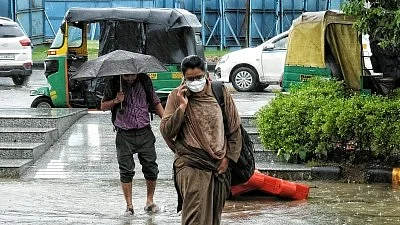
Delhi experienced rainfall and thunderstorms on 23 January 2026, resulting in a drop in temperatures and a marginal improvement in air quality. The Air Quality Index (AQI) was recorded at 297 at 7 am, remaining in the "poor" category.
The India Meteorological Department (IMD) forecasted additional spells of light to moderate rain throughout the day, with gusty winds and cloudy skies expected to persist.
According to The Indian Express, the IMD attributed the weather changes to an ongoing western disturbance, predicting thunderstorms and further rainfall in the afternoon or evening.
The IMD also cautioned that shallow fog could develop during the morning hours, advising residents to exercise caution while commuting.
As reported by Hindustan Times, an orange alert was issued for Delhi, warning of light to moderate rainfall, thunderstorms, and wind speeds between 40 and 60 kmph. The IMD’s forecast indicated unstable weather conditions throughout the day, with multiple spells of rain and gusty winds. A yellow alert was also in place, advising residents and authorities to stay updated on weather developments.
As highlighted by Financial Express, the IMD’s nowcast alert covered several areas in Delhi and the National Capital Region, including Narela, Alipur, Rohini, and Dwarka. The weather outlook for the day included maximum temperatures of 18-20°C and minimums of 11-13°C, with cloudy skies and two spells of light rain. The IMD also warned of dense fog in the coming days, which could reduce visibility during morning and night hours.
“Generally cloudy sky with one or two spells of light rain accompanied by thunderstorm, lightning and gusty winds, with wind speeds reaching 30–40 kmph likely during the early to forenoon hours,” the IMD forecast stated.
Recent developments included the Commission for Air Quality Management (CAQM) revoking stage-3 of the Graded Response Action Plan (GRAP) due to a downward trend in AQI and forecasts for “moderate” air quality. The city’s 24-hour average AQI stood at 322 on Thursday, down from 330 the previous day. The easing of restrictions allows construction, demolition, and certain vehicular activities to resume in the National Capital Region.
Forecasts indicated that Delhi’s AQI would remain in the “moderate” to “poor” category in the coming days, with the Air Quality Early Warning System predicting “moderate” AQI on Friday and Saturday. Analysis showed that wind speeds were expected to increase, which could help disperse pollutants and further improve air quality.
Temperature fluctuations were also noted, with Thursday recording a maximum of 27.1°C, the highest January temperature in seven years. Coverage revealed that the minimum temperature was expected to be between 11-13°C on Friday, with the maximum ranging from 18-20°C. The IMD forecasted that the minimum temperature would rise by 2-4°C over the next two days, followed by a subsequent drop.
“Delhi’s average AQI on Thursday was recorded at 322 (very poor), as per the daily AQI Bulletin provided by the Central Pollution Control Board (CPCB), clearly indicating a downward trend,” CAQM stated.
In Gurugram and adjoining areas, the IMD issued a yellow alert for light to moderate rainfall, thunderstorms, and gusty winds. Reporting indicated that while rainfall brought some relief, water supply issues persisted in parts of Delhi due to high ammonia levels in the Yamuna and ongoing canal repairs, affecting several water treatment plants.
Efforts to address water shortages included rationalising supply from the Ganga and requests to Haryana for increased water release. Further updates noted that environmental projects, such as the Barapullah Greenway, are underway to improve water management and urban infrastructure in the city.
Note: This article is produced using AI-assisted tools and is based on publicly available information. It has been reviewed by The Quint's editorial team before publishing.