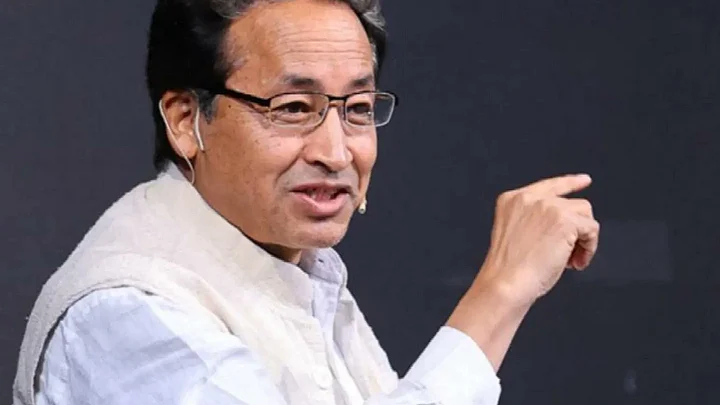
Delhi High Court has directed the central government to ensure that activist Sonam Wangchuk’s health is medically examined every day by government doctors. The court stated that every citizen’s life is precious and instructed authorities to provide necessary medical intervention if his condition deteriorates. Wangchuk has been on an indefinite hunger strike at Jantar Mantar for nearly 20 days, protesting examination irregularities and demanding reforms.
According to Hindustan Times, the bench of Chief Justice DK Upadhyaya and Justice Tejas Karia issued these directions after Solicitor General Tushar Mehta assured the court that Wangchuk’s health would be monitored daily by government doctors and medical experts. The court emphasised that all possible medical efforts must be made to protect Wangchuk’s life.
As noted in an article by The News Minute, a public interest litigation was filed seeking urgent medical intervention, including hospitalisation and force-feeding of Wangchuk. The petition argued that the state has a constitutional duty to protect his life and cannot remain passive while his health deteriorates. The plea specifically requested that Wangchuk be shifted to a government hospital and provided with a liquid diet if necessary.
Medical updates indicate that Wangchuk has lost over 9 kg since the start of his fast, with his weight now at 57.15 kg. Doctors monitoring his condition report that his vital parameters remain stable, but caution that the coming days could be critical. Dr Satish Lamba, who is part of the medical team, stated that intravenous support would be the safer option over tube feeding if intervention becomes unavoidable.
“The simple thing to be done is to take him to a government hospital and force feed him the necessary nutrients, vitamins and minerals by way of a liquid diet which are necessary for the human body to survive,” the petition submitted to the court stated.
Court proceedings on 17 July 2026 included a directive for the presence of law officers from both the Centre and Delhi government to respond to the plea. The petition highlighted that Wangchuk’s health had deteriorated significantly and alleged that the government had not engaged with the protesters for over 20 days.
As coverage revealed, Wangchuk has publicly stated that he will not end his fast, arguing that doing so without a government response would undermine the seriousness of the protest. He has urged supporters to join a peaceful march to Parliament rather than asking him to break his fast.
“If I eat, what message will go? The message to the government will be that there is no need for accountability,” Wangchuk said in a video message.
Legal experts following the case noted that any medical intervention, including force-feeding, would require Wangchuk’s consent unless his condition becomes life-threatening. The court has not issued any order for force-feeding as of the latest hearing, but has reiterated the need for daily medical supervision and timely intervention if his health worsens.
Public appeals from civil society and international groups have urged the government to engage in dialogue with Wangchuk and ensure his health and rights are protected. The court’s directions remain focused on safeguarding his life while respecting his autonomy as the hunger strike continues.
Note: This article is produced using AI-assisted tools and is based on publicly available information. It has been reviewed by The Quint's editorial team before publishing.