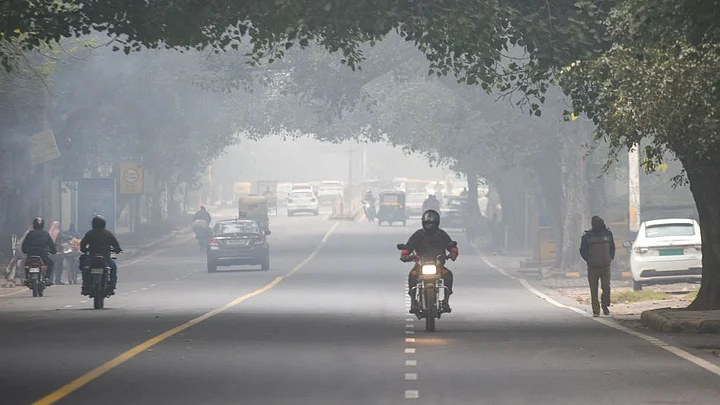
Delhi authorities revoked Stage III of the Graded Response Action Plan (GRAP) after air quality improved from ‘Severe’ to ‘Moderate’ and ‘Poor’ categories. As a result, schools are no longer required to conduct hybrid classes up to Class V, and restrictions on BS-III petrol and BS-IV diesel light motor vehicles in Delhi and select NCR districts have been withdrawn. However, officials caution that the improvement may be temporary due to forecasted changes in meteorological conditions.
According to The Indian Express, the Commission for Air Quality Management (CAQM) announced the revocation on 18 November 2026, following a sustained drop in the Air Quality Index (AQI). Delhi’s AQI stood at 198 at 9 pm, categorised as ‘Moderate’, while Noida and Ghaziabad also recorded ‘Moderate’ levels. Gurugram and Faridabad remained in the ‘Poor’ category, with AQI readings of 278 and 222 respectively.
All measures under GRAP Stages I and II remain in force, including bans on burning coal and firewood, curbs on diesel generator use, higher parking fees, and penalties for vehicles without valid Pollution Under Control Certificates. Coverage revealed that restrictions on major dust-generating construction and demolition activities continue across the National Capital Region (NCR).
With the revocation of Stage III, schools are permitted to resume regular classes for students up to Class V. Additionally, the withdrawal of restrictions on BS-III petrol and BS-IV diesel light motor vehicles applies to Delhi and high-density districts in Gurugram, Faridabad, Sonipat, Ghaziabad, and Gautam Buddha Nagar. However, private and government offices must still ensure that 50% of their workforce works from home as details emerged.
Favourable meteorological conditions, including stronger surface winds and a higher mixing depth, contributed to the recent improvement in air quality. The India Meteorological Department (IMD) reported a ventilation index of 6,200 m²/s and surface winds up to 20 kmph from the southwest, which aided pollutant dispersion. Analysis showed that these winds also reduced Delhi’s exposure to stubble burning emissions from neighbouring states.
“The relief, however, may be short-lived, with the India Meteorological Department forecasting a decline in wind speed to around 10 kmph over the next few days,” an official stated, as cited in the source.
Forecasts indicate that meteorological conditions are expected to become less favourable, with wind speeds likely to drop and the ventilation index projected to decrease from 6,200 m²/s to 1,200 m²/s by Friday. The mixing depth is also expected to decline, increasing the risk of pollutant accumulation near the surface according to recent updates.
As highlighted by The Indian Express, experts emphasise that while meteorological factors can provide temporary relief, long-term solutions require reducing emission sources and sustained policy interventions. The persistence of air pollution in North India is attributed to multiple sources, including transport, industry, and household fuels, and cannot be addressed by technical fixes alone.
Broader analysis indicated that effective interventions must consider institutional attention, political commitment, and investment in cleaner transport, energy, and waste management. Experts caution that without these measures, improvements in air quality are likely to be temporary and episodic.
“The solutions we need are often not those for which we lack expertise; they are those that lack institutional attention, political commitment, and sustained investment,” an expert noted in the referenced analysis.
Recent meteorological data and expert commentary reinforced that while the current regulatory relaxations offer immediate relief to residents and commuters, vigilance and proactive policy measures remain essential to prevent a resurgence of hazardous air quality episodes in the coming weeks.
Note: This article is produced using AI-assisted tools and is based on publicly available information. It has been reviewed by The Quint's editorial team before publishing.