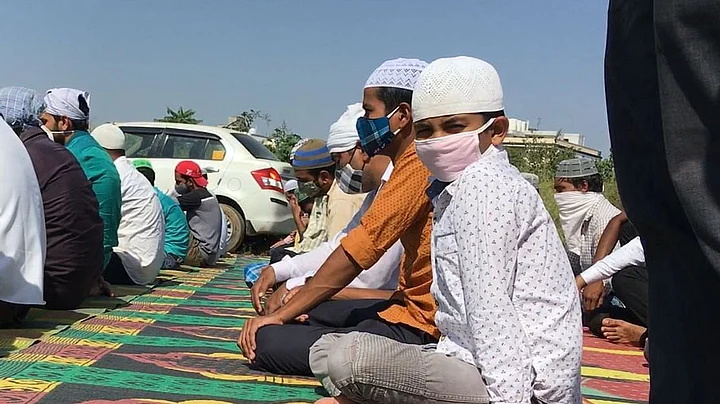
The Allahabad High Court has rejected the Uttar Pradesh administration’s decision to restrict the number of worshippers offering namaz at a mosque in Sambhal district during Ramzan.
The court stated that maintaining law and order is the responsibility of the state and directed that if the Superintendent of Police or District Collector feels unable to enforce the rule of law, they should resign or seek transfer. The matter was listed for further hearing on 16 March 2026.
According to Live Law, the bench of Justice Atul Sreedharan and Justice Siddharth Nandan made these observations while hearing a petition by Munazir Khan, who alleged he was prevented from conducting prayers at a mosque on Gata No. 291.
The authorities had limited the number of worshippers to twenty, citing law and order concerns, but the court outrightly rejected this justification.
As reported by Hindustan Times, the court emphasised that every community must be able to worship peacefully at designated places, and that state permission is only required when religious activities are held on public land or spill over into public property. The state’s argument regarding ownership of the property was also noted, with the court asking the petitioner to submit photographs and revenue records.
As highlighted by Siasat, the bench stated, “If the local authorities, i.e., Superintendent of Police and Collector, feel that the law and order situation could arise because of which they want to limit the number of worshippers within the premises, they should either resign from their post or seek transfer outside Sambhal if they feel they are not competent enough to enforce the rule of law.”
“It is the duty of the State to ensure that the rule of law prevails under every circumstance,” the court observed, reiterating the responsibility of the administration to protect the right to worship.
As noted in an article by Maktoob Media, the controversy in Sambhal was further heightened by remarks from a local police officer during a peace committee meeting, which drew criticism from political leaders and community representatives. The officer warned against protests or slogans related to international conflicts and threatened legal action if prayers were offered on roads due to lack of space in mosques.
Court records show that the petitioner was asked to provide additional evidence regarding the mosque’s existence, while the state was directed to seek further instructions. The next hearing is scheduled for 16 March 2026.
In a related development, recent orders from the Allahabad High Court also restrained authorities in Budaun from interfering with prayers in a mosque located on private property, reaffirming that there is no legal prohibition against religious prayer meetings in private premises.
“Direct the respondent-authorities not to interfere in any manner with regard to the prayers being offered within the premises of the petitioners,” the court stated in the Budaun case, aligning with its stance in Sambhal.
Further analysis indicated that the court’s position is consistent: state intervention is only warranted when religious activities extend onto public land or disrupt public order, not when they are confined to private property.
Recent statements by police officials in other districts, such as Meerut, have also drawn attention, with warnings of strict action, including passport cancellation, against those offering prayers on public roads. These administrative measures have sparked debate about the uniform application of law and the protection of constitutional rights.
Note: This article is produced using AI-assisted tools and is based on publicly available information. It has been reviewed by The Quint's editorial team before publishing.