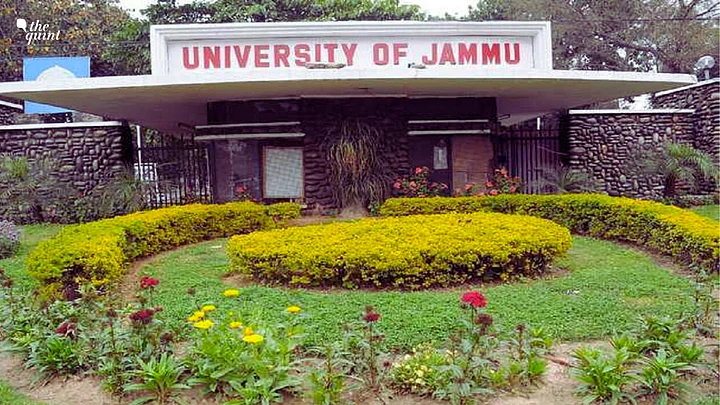
The University of Jammu has convened a committee to review its postgraduate Political Science syllabus following protests over the inclusion of a chapter on Muhammad Ali Jinnah. The committee has recommended removing topics related to Jinnah, Syed Ahmad Khan, and Mohammad Iqbal from the syllabus. The recommendation has been forwarded to the Board of Studies for further discussion. The protests were led by the Akhil Bharatiya Vidyarthi Parishad (ABVP), which objected to the portrayal of Jinnah in the curriculum.
According to Scroll, the committee was established after ABVP demonstrations on campus against the inclusion of Jinnah’s political thought. The panel, headed by Professor Naresh Padha, recommended the removal of content related to Jinnah, Syed Ahmad Khan, and Mohammad Iqbal from the MA Political Science syllabus. The Board of Studies is scheduled to meet to deliberate on the committee’s recommendations.
As reported by Maktoob Media, the revised syllabus had placed Jinnah under the unit “Minorities and the Nation” in the Modern Indian Political Thought module. Previously, Jinnah was discussed mainly in the context of the two-nation theory and Partition. The new framing, which included Jinnah alongside Sir Syed Ahmad Khan, prompted objections from the ABVP, which argued that such inclusion disregards national sentiments.
The ABVP’s Jammu and Kashmir State Secretary, Sannak Shrivats, led the protests and stated that Jinnah was portrayed as a leader of minorities in India. Coverage revealed that Shrivats claimed this portrayal was insensitive and misrepresented historical facts, particularly given Jinnah’s association with the two-nation theory and Partition.
The university administration has defended the inclusion of Jinnah and other thinkers, stating that it aligns with University Grants Commission guidelines and academic standards. The head of the Political Science Department, Baljit Singh Mann, explained that the syllabus was designed to present diverse viewpoints for critical evaluation. He stated, “Our objective is to present different perspectives so that students can distinguish between right and wrong. This is an academic exercise, not advocacy.” Analysis showed that similar content is present in syllabuses of other Indian universities and in NCERT textbooks at the school level.
“Our objective is to present different perspectives so that students can distinguish between right and wrong. This is an academic exercise, not advocacy,” said Baljit Singh Mann, head of the Political Science Department.
Despite the university’s stance, the ABVP maintained that academic freedom should not override national sensitivities. The student group warned of further agitation if the chapter was not withdrawn. Reporting indicated that the committee’s recommendation is now pending a final decision by the Board of Studies, which will determine the future of the syllabus content.
In the broader academic context, Jinnah is typically studied within frameworks of modern Indian political thought, the two-nation theory, Partition, and minority or Muslim political ideologies. Further details noted that such discussions are common in higher education curricula across India, where the focus is on critical engagement rather than endorsement of any particular ideology.
“Academic freedom cannot ignore national sentiments and historical integrity,” stated ABVP Jammu University in its protest communication.
Note: This article is produced using AI-assisted tools and is based on publicly available information. It has been reviewed by The Quint's editorial team before publishing.