This article has been authored by a member of The Quint. Our membership programme allows those who are not full-time journalists or our regular contributors to get published on The Quint under our exclusive 'Member's Opinion' section, along with many other benefits. Our membership is open and available to any reader of The Quint. Become a member today and send us your articles on TQmembersonly@thequint.com.
In the age of AI-driven digitalisation, Gen Alpha consumes far more information through digital platforms than through traditional media like newspapers and books. Today, a child not exposed to the internet risks missing out on learning, awareness, and opportunities. Social media has evolved beyond entertainment—it is now a primary space for interaction, information exchange, self-expression, and creativity.
The scale of this shift is significant. According to a survey, 95 percent of teens aged between 13 and 17 report using at least one social media platform, and nearly two-thirds use it daily. Much of their everyday interaction happens through chats and online communities, helping them stay socially connected and build networks. A survey by the Pew Research Centre shows that a majority of teens credit social media with helping them form connections and express creativity.
Platforms like YouTube have become household staples, serving as hubs for entertainment, education, and skill-building through tutorials and podcasts.
Similar fears existed when the internet itself was introduced, about whether teenagers should be exposed to it. Decades later, the internet has become indispensable. Social media appears to be following the same trajectory.
Growing Concerns about Teens' Mental Health
As a parent, the concern is real. Ensuring safe exposure, content filtering, and digital discipline is an ongoing challenge. The Pew Research survey indicates that 55 percent of parents are extremely or very concerned about teen mental health, compared to 35 percent of teens themselves. Among concerned parents, 44 percent identify social media as the biggest negative influence. These concerns, ranging from screen addiction to anxiety and exposure to harmful content, are valid and growing.
However, social media is also becoming a source of support.
According to the survey, around 34 percent of teens report that they sometimes access mental health information through social platforms, indicating that these spaces are not just sources of risk but also avenues for awareness and help.
This is why some argue a complete ban on social media is not a solution, but it is an overreach. The focus should instead be on building guardrails, not imposing blanket restrictions.
Social Media Skills are Real, Relevant, and Now Essential
In today’s world, where companies increasingly value skills over degrees, a strong digital presence has become critical, especially in fields like media, marketing, arts, and entertainment. Personal branding and online engagement can open doors that traditional credentials may not.
Many young creators have built careers through digital platforms, demonstrating that social media, when used responsibly, can be a powerful equaliser.
The story of Gauri Moore, a 19-year-old content creator, is a compelling example of how strong social media skills can open doors, earning her a marketing role at BMW, a position that typically requires an MBA.
Ten-year-old Sean with 1.5 million followers on Instagram shares content related to science education.
Ban Implementation Challenges
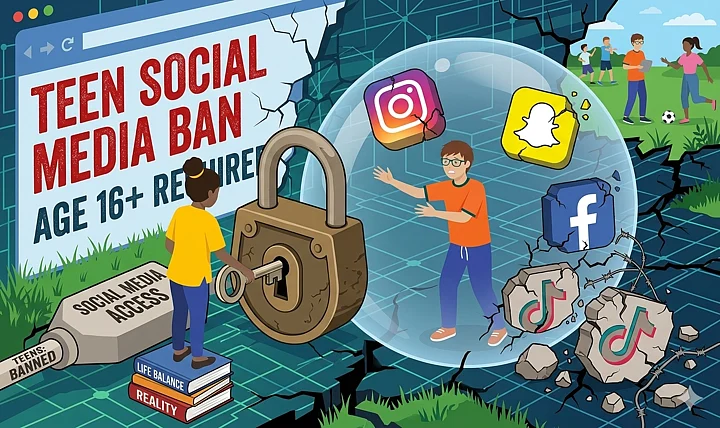
Globally, countries like Australia have implemented a social media ban on teens under 16. Others like the UK and France are exploring similar bans. However, early signals from Australia highlight serious implementation challenges, including age verification and enforcement in a decentralised digital ecosystem.
In India, states such as Karnataka and Andhra Pradesh have proposed similar restrictions. Yet, these measures raise constitutional questions. Under Entry 31 of the Union List, regulation of telecommunications and digital platforms falls under the Central government’s jurisdiction. Laws such as Section 69A of IT Act, 2000 and the IT Rules, 2021 govern digital intermediaries, making unilateral state-level bans legally contentious.
Judicial precedent further complicates blanket prohibitions. In All India Gaming Federation v State of Karnataka (2022), the court struck down a state ban on online games, ruling that excessive restrictions violate fundamental rights under Article 19. Similarly, the right to freedom of speech and expression under Article 19(1)(a) extends to digital platforms, making outright bans constitutionally vulnerable.
Balanced Approach
This is not to dismiss the concerns. There is growing evidence from health professionals and social organisations about the negative impact of excessive social media use. Some argue these risks must be addressed urgently but through smarter policy, not outright prohibition.
A balanced approach should focus on: Age-appropriate content filters; digital literacy for both children and parents; and effective parental controls and usage guidelines.
Several of these social media apps already have built-in supervision tools like TikTok Family Pairing, Instagram Family Center, Snapchat Family Center, and Youtube Supervised Accounts.
Even as the ban on teens may seem protective for some, it risks isolating them from the very ecosystem that defines modern learning and opportunity. The real challenge is not to eliminate access, but to shape responsible usage.
(Dheeraj Pola is an NRI living in the US, and a Senior Solution Architect by profession. This is an opinion piece, and the views expressed above are the author’s own. The Quint neither endorses nor is responsible for the same.)