This article has been authored by a member of The Quint. Our membership programme allows those who are not full-time journalists or our regular contributors to get published on The Quint under our exclusive 'Member's Opinion' section, along with many other benefits. Our membership is open and available to any reader of The Quint. Become a member today and send us your articles on membership@thequint.com.
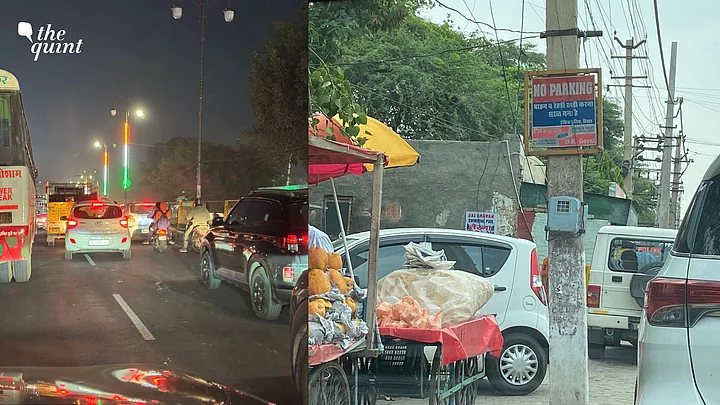
Every time you step outside and glance at the roads, often irrespective of which big or small city you are in, a familiar scene greets you: three people squeezed onto a two-wheeler meant for two, a vehicle confidently cruising in the wrong lane, or an electric scooter piloted by a child whose feet barely touch the ground. Yes, this is India—the country where traffic rules exist, but “road sense” seems to have applied for permanent leave.
Numbers have a way of making reality harder to ignore. According to the Ministry of Road Transport & Highways (MoRTH), India recorded 412,432 road accidents in 2021, resulting in 153,972 deaths and 384,448 injuries — roughly 422 deaths a day, as per data released by the Ministry of Road Transport and Highways (MoRTH), titled Road Accidents in India 2021.
Over speeding alone accounted for 69.6 percent of these fatalities, while wrong-lane or wrong-side driving contributed 5.2 percent, as per MoRTH, 2021 data.
And here’s the part that stings: around 50,000 out of approximately 75,000 two-wheeler deaths involved people who were not wearing helmets, as per statistics collected by Data for India for the year 2022.
So when you see four people precariously balancing on a scooter, what you’re witnessing isn’t a “quirk of Indian life” — it’s a live display of reckless behaviour, bravado and a complete absence of road sense.
Road Sense: How We Fail Spectacularly At The Basics
1. Lane Discipline: A 'Myth' We’ve Proudly Debunked
“Stay in your lane” appears to be a foreign concept to Indian drivers. Wrong-side driving, sudden lane-cutting, overtaking from impossible angles—all feature in our daily traffic circus.
2. Helmets & Overloading: A Deadly Combo
The rule is simple. Wear a helmet. Our interpretation? “Bas gali ke aage hi toh jaana hai” (I just have to go to the next lane)". With nearly half of the two-wheeler deaths linked to helmet non-use, we clearly trust fate more than protective gear.
3. Underage Riding & EV Scooters
Electric scooters have become the new toys of choice. Children — often barely in their teens — glide across main roads with astonishing confidence and absolutely no skill.
4. Distraction: The New Normal
Taking snaps while riding, filming reels at traffic signals, messaging mid-turn — these have become unofficial Indian driving rituals. And yet we cry foul when a Porsche driver “got off easy” for writing an essay. Meanwhile, our own day-to-day stunts continue to outdo themselves.
The Hypocrisy Problem: Education ≠ Road Sense
It’s easy to assume only the uneducated break rules. But stand outside any school on a national highway and reality will surprise you. Watch the principal’s official car glide proudly in the wrong lane — sometimes even on a flyover. Then, as if straight out of a satire, these same institutions post “Road Safety Week” banners with hashtags lecturing the public on discipline.
This isn’t an illiteracy problem. It’s a mindset problem.
The Parking Paradox: No Parking Means “Park Here”
Parking in India is a daily survival game. With shrinking spaces and expanding confidence, finding a legal spot feels like winning a national award. So what do we do? We innovate — and park exactly under the “NO PARKING” signboard, right below it; sometimes blocking it, sometimes treating it like a decorative umbrella for the vehicle.
But it’s Not Just the Roads… It’s Us
Yes, infrastructure has flaws — potholes, waterlogging, faded lane markings. But here’s a fact nobody enjoys hearing: 67.5 percent of all accidents in 2021 happened on straight roads, not dangerous curves, as per MoRTH, 2021.
Which means the biggest threat isn’t the road.
It’s the person driving on it.
The Real Cost of This Behaviour
It’s not just fatalities — though India loses thousands every month. It’s the emotional trauma, long-term disability, broken families, and economic losses. The 18–45 age group — the backbone of our workforce — accounts for nearly 67 percent of all road accident deaths.
We may joke about traffic chaos, but its consequences are devastating.
What Needs to Change
· Lane discipline must become non-negotiable.
· Helmets for both riders and pillions, always.
· Underage riding must be stopped, not encouraged.
· Overloading must stop being normalised.
· Phone use while driving must be treated as seriously as drunk driving.
And most importantly: the educated must stop behaving like the rules don’t apply to them.
The Joke Has Gone Too Far
India has one of the largest road networks in the world, but when it comes to road sense, we’re miles behind.
Broken roads don’t justify broken behaviour.
Traffic rules aren’t suggestions.
Road sense isn’t optional.
Until we accept that the biggest menace on Indian roads isn’t the pothole but the mindset, nothing will change. The day road sense becomes our default — not our dream — is the day India will finally have roads that are safe, not surprising.
(Juhi is a psychologist and educator from Hisar with over nine years of experience. She is the founder of Peace Point, and writes passionately about mental health and education, drawing from her professional journey to inspire awareness and change. This is an opinion piece, and the views expressed above are the author’s own. The Quint neither endorses nor is responsible for the same.)