This article has been authored by a member of The Quint. Our membership programme allows those who are not full-time journalists or our regular contributors to get published on The Quint under our exclusive 'Member's Opinion' section, along with many other benefits. Our membership is open and available to any reader of The Quint. Become a member today and send us your articles on membership@thequint.com.
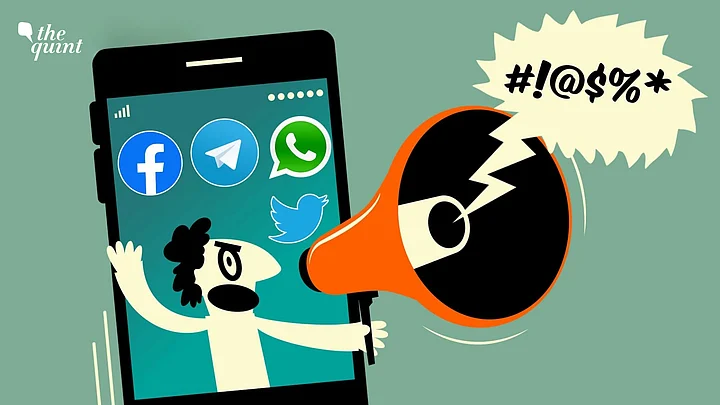
Social media platforms have become a major conduit for the spread of hateful content, particularly targeting Muslims in India. Its impact on society is deeply concerning. More alarming is the influence such content has on children. As some of the most active users of these platforms, they are increasingly exposed to a constant stream of hate that risks shaping their values and worldview in harmful ways.
A few days ago, while scrolling Facebook, I came across a video where a child, perhaps 13 or 15 years old, was speaking to a journalist. Shockingly, the child stated that after winning the Uttar Pradesh Assembly elections in 2027, the government should demolish a nearby mosque.
When the interviewer further asked what does he like about the current regime, he replied “Bataya to bohot acha kaam kar rahe hain, bas ye masjid t##t jaye, maza ajayega.”
Similarly, another interview featured three children in the ages of 12 and 14 who used abusive language when referring to a Muslim man who had allegedly built a mosque in their area using donations.
These videos left me stunned. What kind of malevolent human beings are they growing into? I found it shocking not only because of their perceptions of Muslims and their places of worship, but also because of the extent of toxicity being fed into people’s minds across all age groups.
Parental Blind Spots Leave Kids Vulnerable Online
Children’s sources to information and learning include family and society, with social media emerging as a powerful influence.
In 2025, the Annual Status of Education Report (ASER) revealed that 76 percent of children aged between 14 and 16 in rural areas use smartphones to access social media. Likewise, LocalCircles, an organisation working on citizen engagement, governance, urban issues, causes and interests in its survey last year reflected that approximately 60 percent of parents in urban areas, said that their children in the age group of 9-17 are addicted to social media.
These reports provide insights into the increasing integration of digital technology into the lives of young people. However, we lack sufficient data on the type of content they access, whether parents monitor their online activity, or whether they are aware of built-in parental controls, content restrictions, or privacy settings. As a result, children are exposed to all kinds of content on social media, which is negatively affecting their cognitive development.
Among the many impacts of social media on children, experts have highlighted issues such as anxiety, depression, cyber-bullying, lowered self-esteem, FOMO, and so on. When Australia banned social media platforms for users under 16, it cited risks of children being exposed to harmful content. France, too, passed a bill banning social media for those under 15, and Italy is considering new laws to regulate minors’ access to digital spaces and curb harmful trends. In India, states such as Andhra Pradesh and Goa are also exploring measures to restrict social media use for children under the age of 16.
Shielding Children from Online Hate
In the Indian context, isn’t the growing hostility toward minorities, in both digital and real-world spaces, a sufficient reason to limit children’s access to social media across the country? Content consumed without critical thinking can nurture hatred in users of any age. They’re just kids, without the maturity or understanding to process this kind of content.
Dorothy Nolte’s famous poem Children Learn What They Live highlights it: “If children live with hostility, they learn to fight.”
If they continue to absorb the toxicity prevalent on social media, what sort of thinking will it shape in them? A mindset with no critical sense, full of hatred for others, focused on dividing society, and oddly satisfied by insulting people. Isn’t that reason enough to keep children away from platforms like Facebook and Instagram?
The clips mentioned above strongly suggest that these children have absorbed from social media the idea that minorities should be hated—and that their places of worship ought to be demolished.
Jonathan Haidt argues that the cons of using social media for minors are high. In his book The Anxious Generation: How the Great Rewiring of Childhood Is Causing an Epidemic of Mental Illness, he says that because of the delay in the development of frontal cortex, minors are more likely to act on impulse, take risks, and be influenced by temptations.
Since targeting a specific group with hateful content on social media has turned into a shortcut to popularity, even children are engaging in extreme behaviour to become influencers, drawn by how appealing it appears. And this phenomenon is not confined to social media alone.
When Online Hate Spills Over
There have been several real-world incidents in which children have been seen engaging in such acts. Recently, in Bihar, during the azaan at a mosque, some children outside were chanting Jai Shri Ram. Similar incidents have taken place in Uttar Pradesh and Madhya Pradesh earlier.
These incidents reveal that those who fostered anti-Muslim sentiment have not even spared children, poisoning their young minds. They fail to realise that hatred absorbed at such an impressionable age can later turn violent against anyone, without regard to religion.
It is high time for parents and society at large to reflect seriously on this issue. If it is not controlled now, it will result in irreparable harm.
Assuming that existing government regulations are sufficient to address this problem would be a mistake.
Information Technology (Intermediary Guidelines and Digital Media Ethics Code) Rules, 2021 directs social media intermediaries to exercise due diligence to not display and promote content that are hateful or harassing, and use automated tools to detect and limit the spread of such content.
But there are no signs of that happening, and the government hasn’t followed up with any action. This issue needs to be raised urgently, as it is as serious as pollution, unemployment, and other key concerns.
(Shafey Anwarul Haque is a Lucknow-based academic, researcher and translator. His work focuses on minority and human rights issues, media representations of Muslims, identity politics, and the role of media in shaping public discourse and so on. The views expressed above are the author’s own. The Quint neither endorses nor is responsible for the same)