This article has been authored by a member of The Quint. Our membership programme allows those who are not full-time journalists or our regular contributors to get published on The Quint under our exclusive 'Member's Opinion' section, along with many other benefits. Our membership is open and available to any reader of The Quint. Become a member today and send us your articles on TQmembersonly@thequint.com.
“We have evolved with time but we cannot do it alone anymore,” says Mohammad Iliyas, owner of Green Textile in Amroha, in western Uttar Pradesh.
Inside his modest unit, piles of discarded fabric, old sweaters, torn blankets, and factory scraps are sorted and fed into machines that transform waste into reusable fibre.
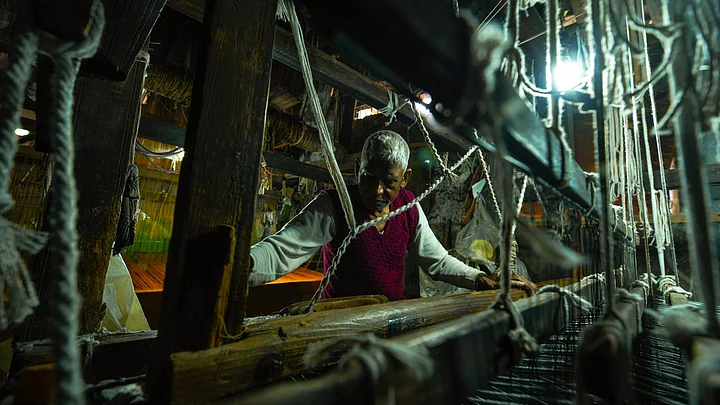
Iliyas explains how the cluster has continuously adapted to survive changing markets. “Earlier, we worked with wooden machines. Today, many of us have invested in Chinese machines to improve efficiency and output. We are ready to modernise to grow, but the returns are not matching the effort.”
For Iliyas, the issue is not a lack of enterprise. “Electricity costs are extremely high, and access to affordable finance is limited. If the government can support us through subsidies whether for power, machines, dying methods or solar, it will make a huge difference. We are already doing the work of recycling for the country. With the right support, we can do much more.”
His words reflect the reality of an entire cluster—resilient, adaptive, and quietly sustaining a circular economy, yet increasingly strained by structural constraints.
A Growing Crisis, An Invisible Solution
Every year, the world generates an estimated 92 million tonnes of textile waste. India alone contributes approximately 7.8 million tonnes, accounting for nearly 8.5 percent of global textile waste. With fast fashion accelerating consumption cycles, the volume of discarded fabric continues to rise.
Yet, recycling remains limited. Globally, only about 12 percent of textile waste is recycled. In India, around 34 percent is reused. Only a small fraction is recycled into yarn or new fabric.
Amid this challenge, India’s textile-waste recycling clusters perform a vital but largely invisible function. Informal, decentralised ecosystems divert enormous volumes of post-production and post-consumer waste away from landfills, keeping materials in circulation. Despite their environmental significance, these clusters remain under-recognised, under-supported, and structurally excluded from mainstream industrial policy.
Amroha illustrates both the strength and vulnerability of this system. Known historically for razai- and lihaf-making, the district built its economy on cotton processing skills passed down through generations. As traditional markets declined, these micro-units adapted organically, transitioning into textile-waste recycling.
Today, 250-300 micro-units and nearly 3,000 workers, around 70 percent of them women, process a wide range of textile waste using carding machines, garnets, and multi-roller lines. This ecosystem diverts significant volumes of waste from landfills and plays a quiet but indispensable role in India’s circular economy.
Stuck in a Low-Value, High-Cost Cycle
Despite its scale and relevance, Amroha’s recycling economy is struggling to remain viable. The constraints are structural.
Electricity costs often range from tens of thousands of rupees to over one lakh per machine each month. Access to affordable finance is limited, making it difficult for entrepreneurs to invest in better technology. Even where there is willingness to adopt clean energy, there is little clarity or handholding on rooftop solar and net-metering.
At the same time, most recycling units remain excluded from existing MSME and textile-sector schemes. These frameworks typically assume land ownership, formal registration, modern machinery, and institutional structures—conditions that informal recycling clusters rarely meet.
The result is a persistent value trap. Amroha processes large volumes of low-quality textile waste that cannot enter higher-end spinning systems. Most recyclers, therefore, are confined to producing low-value outputs such as fibre for mattresses or insulation. As cotton-based bedding declines and synthetic substitutes expand, margins have shrunk, idle capacity has increased, and many micro-units are gradually exiting the sector.
From Survival to a Scalable Circular Economy
What clusters like Amroha need is not just recognition, but a structured pathway for transition.
Reducing energy costs through targeted support for rooftop solarisation could significantly improve viability. Enabling local spinning and advanced fibre processing would help retain value within the cluster. Diversification into higher-value segments such as insulation materials, acoustic panels, and technical nonwovens aligned with green construction can open new markets.
Equally important are investments in safer sorting infrastructure, improved hygiene, and skill development, particularly for women workers who form the backbone of the recycling workforce but face the greatest occupational risks.
These interventions can transform recycling from a survival activity into a resilient, low-carbon, and market-linked economic system.
Bringing Recycling to the Centre of Policy
The scale of textile waste in India, combined with the critical role played by clusters like Amroha, makes a strong case for a dedicated national framework for textile-waste recycling MSMEs.
Such a framework must go beyond conventional industrial policy assumptions. It should enable simplified formalisation pathways, provide low-interest finance and subsidies for energy-efficient machinery and solar adoption, and support shared infrastructure for sorting, shredding, and fibre testing. Market linkages must be strengthened to help recyclers move up the value chain.
Crucially, policy must be grounded in accurate data that reflects the real scale of textile waste and the informal systems that currently manage it.
As Iliyas puts it, “We are already part of the solution. With the right support, we can become much bigger contributors.”
If India is serious about leading the global transition to a circular economy, it must recognise and strengthen what already exists on the ground. Clusters like Amroha are not remnants of the past, they are the foundation of a more sustainable industrial future.
(Priyanka Rai is a communication strategist and freelance journalist working at the intersection of policy, development, and MSME ecosystems. This is an opinion piece, and the views expressed above are the author’s own. The Quint neither endorses nor is responsible for the same.)