This article has been authored by a member of The Quint. Our membership programme allows those who are not full-time journalists or our regular contributors to get published on The Quint under our exclusive 'Member's Opinion' section, along with many other benefits. Our membership is open and available to any reader of The Quint. Become a member today and send us your articles on TQmembersonly@thequint.com.
India’s esports industry is growing at a remarkable pace. What was once seen as a niche hobby has now become a major part of India’s digital youth culture.
Recent industry figures show that India’s gaming market has crossed $1.5 billion, with around 555 million gamers and a 25 percent payer conversion rate. Another consumer report by Lumikai Fund highlights that 44 percent of gamers in India are women, 66 percent come from non-metro cities, and the average gamer spends nearly 13 hours a week playing games.
These numbers tell an important story. Gaming in India is no longer limited to big cities, male users, or casual entertainment. From college hostels in Delhi to small towns in Uttar Pradesh, Rajasthan, Maharashtra, Assam, and Tamil Nadu, young people are forming communities around games such as BGMI (Battlegrounds Mobile India), Valorant, Free Fire MAX, EA Sports FC, and other competitive titles.
However, behind this impressive growth lies a serious concern: India’s esports boom still has a gender problem.
The Double Standard Facing Women Gamers
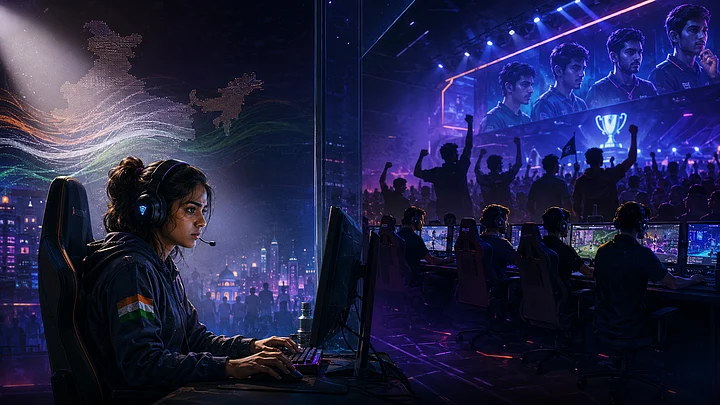
Women are increasingly entering gaming spaces as players, creators, streamers, commentators, and esports enthusiasts. Yet, their presence is still often treated as unusual.
The contradiction is visible: women are welcomed as consumers, but questioned as competitors.
They form a significant part of the gaming audience, but in ranked matches, voice chats, livestreams, Discord groups, and tournament spaces, many still have to prove that they “belong.”
This is not only about a few rude comments or isolated incidents. The problem is deeper and more structural.
Sylvia Walby’s idea of private patriarchy and public patriarchy helps us understand this better. Private patriarchy appears when families or social circles discourage women from taking gaming seriously because it is seen as “unfeminine,” unsafe, or a waste of time. Public patriarchy appears within platforms, tournaments, team houses, livestreams, sponsorship culture, fan communities, and online chats, where masculine behaviour often decides who is accepted as a “real gamer.”
In simple terms, women are not only fighting individual abuse. They are also fighting a culture that often questions their visibility, credibility, and right to participate.
An Invisible Cost
International studies show that this problem is widespread. A 2024 Bryter/Women in Games survey found that 59 percent of women and girls who play games had experienced toxicity from male gamers. Among those who faced abuse, 30 percent reported sexual harassment, 42 percent reported verbal abuse, and 34 percent avoided speaking in online games because they feared negative reactions.
Similarly, a 2024 Kinsey Institute study found that 56.6 percent of women gamers had experienced at least one form of sexual harassment.
Many did not even identify such behaviour as harassment because it had become so normal in gaming spaces.
These findings reflect the everyday experiences of many female gamers. They face sexist jokes, comments on their appearance, doubts about their skill, objectifying remarks, threats, doxing fears, and harassment during livestreams.
For many women, gaming is not just about winning or improving their rank. It is also about constantly managing safety, visibility, and judgement.
The microphone becomes a powerful symbol of this exclusion. For many male gamers, voice chat is simply a tool for coordination. For many women, switching on the mic can invite uncomfortable questions about their gender, appearance, relationship status, or gaming ability. As a result, some women use gender-neutral usernames, avoid voice chat, mute themselves, or play only with trusted friends.
This creates an invisible cost. Women may be present in the game, but absent from the public culture of gaming. Their silence should not be mistaken for lack of confidence. In many cases, it is a survival strategy.
Esports is More Than Casual Gaming
In December 2022, the Government of India formally recognised esports and brought competitive gaming under the Ministry of Youth Affairs and Sports. In February 2025, the ministry also extended its cash-incentive programme to include esports athletes and coaches.
This recognition is important because it separates esports from gambling-oriented online gaming and gives competitive players a clearer professional pathway.
But policy recognition alone is not enough. If women’s safety, participation, and leadership are not placed at the centre of the conversation, the growth of esports will remain incomplete.
The scale of Indian tournaments shows how quickly the ecosystem is becoming professional.
KRAFTON India’s 2025 esports roadmap announced major BGMI tournaments with large prize pools. The BMPS 2025 Grand Finals featured 16 of India’s top BGMI professional teams competing for a Rs 4 crore prize pool. NODWIN Gaming’s BGMS Season 4 in 2025 announced a Rs 1.5 crore prize pool and also introduced an expanded Challenger Series with four all-women teams.
This is a welcome step because it brings women into mainstream tournament structures rather than keeping them completely on the margins. However, an important question remains: will such inclusion become a regular part of Indian esports, or will it remain symbolic?
Indian female gamers have already shown that the issue is not talent, interest, or commitment. Creators such as Payal Dhare and Kaashvi Hiranandani have built large audiences through livestreaming, gaming content, and digital entertainment. Their success proves that women can shape gaming culture in powerful ways.
At the same time, their success also reveals another problem. Women in gaming are often celebrated as exceptions. They are labelled as “girl gamers,” “female streamers,” or “rare women in esports,” instead of simply being recognised as skilled professionals. This language may seem harmless, but it continues to place women outside the mainstream, even when they are already succeeding within it.
The future of Indian esports will not depend only on faster internet, bigger prize pools, brand sponsorships, or televised tournaments. It will depend on whether the industry can create safer, fairer, and more inclusive spaces.
Gaming platforms need stronger moderation systems, quicker reporting mechanisms, anti-harassment tools, and transparent penalties. Tournament organisers must introduce gender-sensitive codes of conduct, safe complaint channels, women’s participation targets, and equal visibility in casting, analysis, production, and team management. Brands and sponsors should support mixed-gender and women-led teams not as charity, but as a serious sporting and market opportunity.
India’s gaming boom is often presented as a story of youth, technology, and opportunity. But the real test of this boom is inclusion. A country with more than half a billion gamers cannot afford to build an esports culture where women participate silently, cautiously, or only in separate spaces.
Women are not guests in gaming culture. They are players, creators, professionals, and future champions. Indian esports will become truly global only when it recognises women not as exceptions, but as equal architects of its future.
(Dr Jyotika Teckchandani is an Assistant Professor at the Amity Institute of Social Sciences, Amity University ,Uttar Pradesh. Her areas of interest include Foreign Policy Analysis, Indian Politics, International Relations, Gender Studies and West Asian Politics, with a particular focus on Iran. This is an opinion piece, and the views expressed above are the author’s own. The Quint neither endorses nor is responsible for the same.)