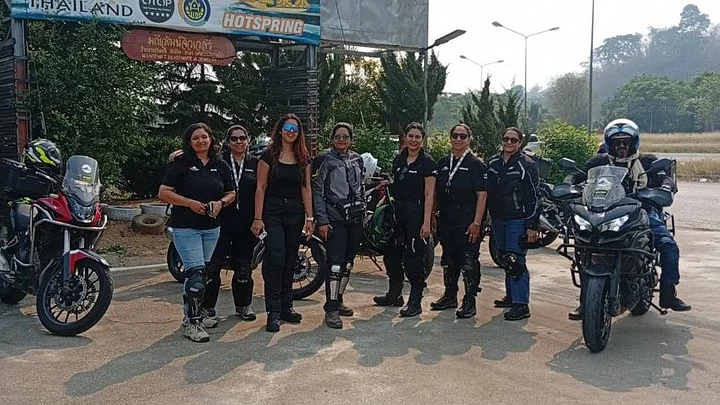
In April 2026, eight Indian women aged 40 to 56 quietly engineered a historic rupture: the first all-women group to conquer the Mae Hong Son Loop, serpent of 4066 curves and 1864 hairpin bends, snaking through Northern Thailand's mountains — a route that doesn't merely test riders but interrogates them.
What they reclaimed over those eight days had little to do with engines or asphalt. It was the self that Indian womanhood has deferred into ambient invisibility.
This wasn't riding as recreation. It was permission as praxis.
The fact that it was historic is not merely a ceremonial headline — it is structural. It tells us something about how identity is being renegotiated in India, one throttle at a time.
These weren't influencers scripting reels or twenty-somethings chasing novelty. Midlife arrives for women scripted into contraction: bodies catalogued as fading assets, selves conscripted into perpetual service.
Yet this loop proposed a counter-narrative — midlife not as diminishment but as second sovereignty, authority distilled from performance into a renewed self.
On two wheels, freedom isn't petitioned. It's throttled into being.
Indian womanhood's gold standard remains a masterpiece of containment: capable, composed, orbiting others' orbits. Last to bed, first erased from ambition's landscape. Metric-perfect success, yet starved of the simplest audit: What do I want?
Eight women, mirrors to that script, mounted machines across Thai highlands — only to discover, mid-curve, they'd redrawn a map.
Among them were homemakers commanding households like CEOs; a debutante beyond India’s borders, facing a language barrier; an empty-nester; a single mother and CEO; an AI savant and ex-yogi.
The full topography of the Indian gender spectrum, fused by tarmac, collectively torching the stereotype they embodied. They were masters of every arena — save the one arena of unambiguous self-claim.
Accomplished by any measure. And yet quietly running on a deficit no professional achievement had touched — not of competence or courage, but of permission. Permission to exist, unambiguously, for themselves.
And that deficit echoed in a rider's innocent query about my solo-high-stakes CEO life: "You don't need to take permission from someone." From lips still bartering for their own, it cut clean.
The genius lay in the logistics these women hacked to even arrive.
Ten-day family menus prepped. Clothes ironed into battle-readiness. ChatGPT glossaries for household help in absentia. One triaged a 12-year-old's first period via satellite composure worthy of EOD. Another rode through a daughter's fractured foot. Equilibrium amid domestic entropy and hairpin demands — a seminar in what I call "shadow command": the unclockable labour that powers worlds while erasing its architect.
The equanimity with which these women diffused conflict, created order, and still rode a route demanding utmost attention and balance was a masterclass in personalised and shadow leadership — and a quiet argument that the labour of being a woman never fully clocks out, even at altitude.
The motorcycle refuses abstraction. It demands balance, presence, judgment, and trust in the body — and it does not reward the loudest person in the room. It rewards the most awake.
For women, this distinction matters enormously. The road becomes a therapy of motion: a way to move through accumulated fatigue, unspoken anger, and the static that builds from years of carrying multiple lives at once. It does not ask women to pretend they are not fragile. It asks them to carry fragility without letting it define their capacity — and in doing so, turns what the world reads as weakness into a form of intelligence.
Indian culture has a sophisticated system for managing the ambitions of women past a certain age. It does not prohibit. It simply reframes. The woman in her forties who wants adventure is indulged, mildly. The woman in her fifties who wants to lead her own life is admired from a careful distance.
The underlying message — delivered through ambient social expectation rather than hostility — is consistent: your moment of selfhood had a timeline. The appropriate response now is grace. Containment. The performance of contentment.
This is precisely the life stage — 40 to 56, children grown, parents ageing — at which women are most capable of radical self-determination, and most systematically discouraged from exercising it. The machinery is efficient because it is invisible: it operates not through prohibition but through the slow, ambient narrowing of what seems possible, appropriate, permitted.
The leadership literature calls it the confidence gap. The therapy literature calls it suppressed agency. From the inside, it feels like something simpler and more exhausting — a life in which your needs are always the last item on a list that never quite gets finished.
This is a stark disconnect with male riding culture. The summit is a conquest. The route is a credential. The self arrives with a deficit of adventure and returns enlarged. The entire infrastructure of expedition riding has been engineered to serve this impulse.
Women arrive seeking something structurally different. They are not trying to add to the self — they are trying to recover it. To excavate an identity set aside, quietly and without drama, in service of everything and everyone around them. The road does not give them something new. It gives back something old.
Men ride to find themselves. Women ride to lose everyone else. These are not variations on the same journey and the industry's failure to understand this. This is precisely why women's riding has been treated as a subcategory of men's adventure rather than a phenomenon with its own logic and transformative power.
Leadership is the capacity to take responsibility for a direction and hold it — through uncertainty, discomfort, and every voice suggesting you turn back. By that definition, what these eight women did across almost 1200 kms of mountain road was one of the more consequential acts of leadership any of them had performed.
Not because the route was demanding, though it was. But because every kilometre required them to remain in a condition that decades of social conditioning had trained them to exit as quickly as possible: entirely, unapologetically, responsible for themselves.
Adventure? No. Ontology.
No fanfare marked it. Just a footnote in history.
Beyond leisure, it's a blueprint. Not a marker of machismo's lanes or Instagram’s spectacle, but parallel polity — that is not an adventure. That is identity.
Just like in industries and workplaces, women are not asking for a seat inside an existing masculine culture of riding. They are building a parallel culture with its own ethics and emotional range — where empowerment is not a slogan but an infrastructure of confidence. The right to travel without needing an excuse. To be older and still adventurous, fragile and still formidable, complex in public.
India has always produced extraordinary women. What it has not reliably produced is the infrastructure — physical, social, psychological — that allows those women, at the age of their greatest capability, to lead themselves.
That infrastructure is what a motorcycle on an open road provides, improbably and completely. The road asks for your full self and accepts nothing less. For eight women in April 2026, that ask was the most radical thing anyone had made of them in years. They answered it. All 1200 kms of it.
The ride was conducted by LetsRyde - one of India’s first women’s superbiking academies in collaboration with Victorians - a niche world exploration company in Delhi.