Commemorative postage stamps are more than miniature works of art. They are official acknowledgements of individuals and institutions whose contributions have enriched society. They also offer a glimpse into what a nation chooses to remember, celebrate, and honour.
So, when Royal Mail issued not one, not two, not 10, but 12 commemorative stamps in honour of Iron Maiden, the English heavy metal band, the tribute was significant. Not that the band needed any official endorsement. Nearly five decades of musical longevity, a devoted global following, record sales exceeding 130 million, more than 2,500 live performances across over 60 countries, and numerous industry accolades, including Grammy and Brit Awards, speak for themselves.
Yet, recognition by a venerable national institution carries its own significance. Particularly when Royal Mail had previously dedicated stamp issues to only four other bands: The Beatles in 2007, Pink Floyd in 2016, Queen in 2020 and The Rolling Stones in 2022. Iron Maiden had joined an exceptionally distinguished club.
Eight of the 12 stamps depicted the band performing and featured its current members. The remaining four celebrated Eddie, Iron Maiden's iconic mascot. As Royal Mail's Director of External Public Affairs and Policy observed:
“Few bands in the history of rock music can be called bona fide rock legends—Iron Maiden are just that—and more. With legions of devoted fans of all ages and from every corner of the globe, not only have they changed the way rock music sounds, but they have also changed the way it looks.”
This raises an interesting question closer to home: How has Indian philately treated its musicians? Does Indian music, in all its diversity, receive the recognition it deserves on the Indian postage stamp?
The answer lies in tracing the evolution of India's commemorative stamps over nearly seven decades. It is a story of cultural conservatism, changing official attitudes, long-overdue recognition and, ultimately, an expanding definition of what constitutes Indian music.
The Early Years: Classical Culture Takes Precedence
In the initial decades following Independence, India's cultural policy was deeply influenced by the desire to rediscover, preserve and project a distinct national identity. Within government circles, classical arts were accorded a status considerably higher than that of popular entertainment.
This cultural hierarchy was particularly evident in the policies of All India Radio (AIR), spearheaded by BV Keskar, India's longest-serving Minister of Information and Broadcasting (1952-1962).
Keskar was a staunch advocate of classical music. He believed that a newly independent India needed to reconnect with its traditional cultural roots to foster national regeneration. Hindi film music, in his view, was an undesirable cocktail of Western influences, vulgarity and commercialism. He feared that it was corrupting the younger generation and drawing it away from India's spiritual and cultural values.
Convinced that classical music was in danger of extinction, Keskar believed the state had a responsibility to familiarise citizens with it.
His disdain for film music translated into a series of restrictive measures. AIR initially imposed a limit on film music broadcasts, reportedly restricting them to around 10 percent of airtime, while requiring songs to undergo screening for their suitability. Following unsuccessful negotiations with the Film Producers Guild, AIR stopped broadcasting film music altogether for several years, beginning in 1952.
Even musical instruments were not spared. The harmonium was banned from AIR because Keskar considered it a foreign instrument unsuitable for reproducing the subtle microtonal nuances, or shrutis, of Indian classical music.
The policy, however, backfired spectacularly. Indian listeners simply turned their radio dials towards Radio Ceylon, which capitalised on the opportunity and popularised the legendary countdown programme Binaca Geetmala. AIR gradually lost a substantial section of its audience. Eventually, it had little choice but to acknowledge the immense popularity of film music and introduce Vividh Bharati, its own service dedicated to popular Indian music.
The episode was emblematic of a larger official attitude: classical music was considered worthy of cultural preservation, while popular music was treated with suspicion.
A similar hierarchy was visible in the Padma Awards.
The Padma Awards: Playback Singers Wait in the Wings
When the Padma Awards were instituted in 1954, classical musicians dominated the recognition extended to the country's musical fraternity. Playback singers from the Hindi film industry had to wait considerably longer to enter this prestigious circle.
Mohammed Rafi received the Padma Shri in 1967, becoming the first male playback singer to receive the honour. Lata Mangeshkar followed with the Padma Bhushan in 1969, subsequently receiving the Padma Vibhushan in 1999 and the Bharat Ratna, India's highest civilian honour, in 2001.
Pankaj Mullick, the veteran singer and composer of the early era, received the Padma Shri in 1970, while Mahendra Kapoor was honoured with the same award in 1972. These pioneers helped open the doors for subsequent generations of playback singers.
Yet, the omissions were remarkable. Kishore Kumar, Mukesh and Geeta Dutt never received a Padma Award. Hemant Kumar reportedly declined both the Padma Shri, offered in the 1970s, and the Padma Bhushan, offered in 1987, believing that the recognition had come too late.
Equally striking was the delay in recognising Asha Bhosle. Despite her extraordinary contribution to Indian music, she received the Padma Shri only in 1997, followed by the Padma Vibhushan in 2008. Shamshad Begum received the Padma Bhushan in 2009, while Talat Mahmood was honoured with the Padma Shri in 1992.
Meanwhile, classical musicians continued to feature prominently in the awards from their very inception.
Why should India's postal department have been any different?
The 1950s and 1960s: Constructing a National Cultural Pantheon
During the 1950s and 1960s, the process of nation-building involved an extensive search for a recognisable national culture. The government sought to identify and project individuals whose contributions could be presented as defining elements of India's civilisational and cultural heritage.
Postage stamps became one of the instruments through which this cultural identity was communicated. The saints, poets, painters, writers and other personalities commemorated on stamps offered the public a glimpse of whom the government considered important architects of India's cultural inheritance.
Yet, contemporary performers received virtually no attention. The emphasis was overwhelmingly on historical figures and established cultural traditions.
The resulting pantheon of Indian culture, as represented through postage stamps, had a conspicuous absence: musicians.
Even classical musicians, who were held in particularly high esteem by the cultural establishment, were largely excluded.
The 1952 Saints and Poets series included figures such as Meera Bai and Rabindranath Tagore. Both had made immense contributions to India's musical heritage, but neither was primarily commemorated as a musician.
There were, however, two notable exceptions towards the end of this period: Tyagaraja in 1961 and Purandara Dasa in 1964.
Tyagaraja was one of the celebrated members of the Carnatic Trinity, the three legendary composer-musicians who transformed South Indian classical music during the late eighteenth and early nineteenth centuries. Purandara Dasa, revered as the father of Carnatic music, was another towering figure in the tradition.
Their appearance on Indian stamps represented an early acknowledgement of the country's classical musical heritage, although the recognition remained extremely selective.
The 1970s and 1980s: Classical Music Finds Its Place
The 1970s and 1980s witnessed a gradual expansion in the musical themes represented on Indian postage stamps. Yet, the official imagination continued to equate Indian music largely with its classical traditions.
In 1973, a stamp commemorated Vishnu Digambar Paluskar, the influential Hindustani vocalist and music educationist from Maharashtra. His contribution to institutionalising and popularising Hindustani classical music made him a particularly significant figure in India's musical history.
In 1976, Muthuswami Dikshitar, another member of the Carnatic Trinity, was honoured with a commemorative stamp.
The third member of the Trinity, Shyama Shastri, followed in 1985.
The year 1985 also witnessed the commemoration of the sixteenth-century musician Swami Haridas, followed in 1986 by a stamp honouring his contemporary, the legendary Tansen.
These issues reflected a growing willingness to acknowledge the great masters who had shaped India's classical musical traditions.
Musicians belonging to other genres, however, continued to find little representation. Classical music was regarded as an academic, spiritual and civilisational pursuit deserving of national commemoration. Film music, on the other hand, was frequently dismissed as popular or commercial entertainment.
There was also a practical obstacle. The Department of Posts followed restrictive policies concerning living personalities and commemorations associated with death anniversaries. Generally, stamps were not issued in honour of living individuals, except for a limited number of exceptions, particularly in art and culture. The practice of waiting for a prescribed period after an individual's death also meant that many legendary playback singers remained ineligible for recognition during the height of their careers.
The growing visibility of classical music coincided with the government's efforts to showcase other traditional Indian art forms. Dance, too, was represented predominantly through its classical vocabulary. In 1975, a series of stamps on the Dances of India featured Bharatanatyam, Odissi, Kathak, Kathakali, Kuchipudi and Manipuri.
There was also a brief cosmopolitan interlude in India's philatelic representation of music during these decades. Several stamps celebrated eminent Western classical composers: Ludwig van Beethoven in 1970, Franz Schubert in 1978, Johann Sebastian Bach and George Frideric Handel in 1985, and Wolfgang Amadeus Mozart in 1991.
Interestingly, even this international representation remained confined to the classical tradition. Whether Indian or Western, the music considered worthy of commemoration was overwhelmingly classical.
The 1990s: A Wider Musical Canvas
Two thematic stamp issues of the 1990s deserve particular attention.
In 1996, the postal department released a special set of four stamps dedicated to Ragamala paintings. This represented an interesting departure from the conventional practice of commemorating individual musicians. Instead, the stamps celebrated the rich visual imagery associated with Indian classical music.
The series showcased classical miniature paintings depicting ragas and raginis through visual metaphors associated with different seasons, moods and times of the day.
One of the stamps featured Vasant, depicting Ragini Basanti, associated with the spring raga, Raga Vasant. The original artwork is housed in the National Museum, New Delhi.
In 1998, another set of four stamps celebrated classical Indian musical instruments against backgrounds inspired by ancient temple friezes and stone carvings. The instruments featured were the Rudra Veena, Flute, Pakhawaj and Sarod.
By juxtaposing contemporary musical instruments with India's ancient sculptural heritage, the series reinforced the idea of an unbroken musical tradition stretching back through the centuries.
The 1990s also witnessed a significant increase in the number of individual musicians being honoured.
Among those commemorated were: Ariyakudi Ramanuja Iyengar, the Carnatic vocalist, in 1991; Dwaram Venkataswamy Naidu, the celebrated Carnatic violinist, in 1993; Dinanath Mangeshkar in 1993; Begum Akhtar in 1994; Kundan Lal Saigal in 1995; Omkarnath Thakur in 1997; and Alauddin Khan in 1999.
The inclusion of Begum Akhtar and KL Saigal was particularly noteworthy. Their recognition suggested that the definition of music worthy of national commemoration was beginning to move beyond the strictly classical framework.
Nevertheless, the dominant emphasis remained on classical musicians and established traditions.
The New Millennium: Women Musicians Enter the Spotlight
The beginning of the 21st century brought a more inclusive approach to the representation of Indian music on postage stamps.
One particularly welcome development was the increased recognition of women musicians, especially pioneering female exponents of Carnatic music.
For much of the earlier period, the philatelic representation of Indian classical music had been overwhelmingly male-dominated. The new millennium began to correct this imbalance.
Several eminent Carnatic female vocalists were commemorated: MS Subbulakshmi in 2005, Veenai Dhanammal in 2010, DK Pattammal in 2014, and ML Vasanthakumari in 2018.
These stamps recognised women who had not merely excelled as performers but had also shaped and transformed the musical traditions they inherited.
Their inclusion marked an important departure from the earlier conservatism of Indian philately.
The Breakthrough: Film Music Finally Receives Its Due
Perhaps the most significant change in India's philatelic treatment of music was the growing acceptance of film music as a legitimate part of the nation's cultural heritage.
The 2000s marked a decisive shift in this direction. Indian cinema, particularly its golden era, was increasingly recognised as an important cultural institution rather than merely a source of commercial entertainment.
This was arguably the real test of whether India's philatelic representation could become comprehensive: would it recognise the music that millions of Indians had grown up listening to, singing and cherishing?
The answer began to emerge in 2003.
The postal department issued a special set titled Golden Voices of Yesteryears, honouring four legendary playback singers who had shaped the golden age of Indian film music: Kishore Kumar, Mukesh, Mohammed Rafi and Hemant Kumar.
The issue was particularly significant because it brought together four of the most influential male playback singers of Hindi cinema in a single commemorative series.
Another landmark followed in 2013 with the issue commemorating 100 Years of Indian Cinema.
The series celebrated a century-long journey, beginning with Raja Harishchandra and culminating in an internationally influential film industry. It honoured 50 personalities who had contributed to Indian cinema across languages and regions, including filmmakers, directors, actors, music directors, lyricists and singers.
Among the singers commemorated were Bhupen Hazarika, Suraiya and Geeta Dutt.
The inclusion of these personalities was important because it acknowledged the enormous contribution of music to the history and evolution of Indian cinema.
The most comprehensive recognition of playback singers, however, came in 2016.
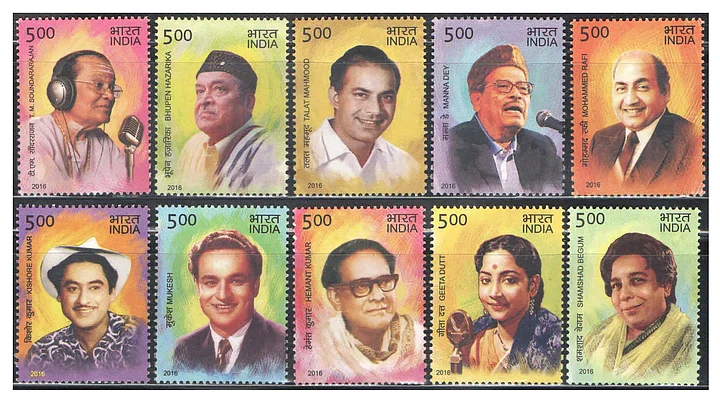
The Legendary Singers of India series brought 10 iconic singers and vocalists into the philatelic spotlight. They were Mohammed Rafi, Kishore Kumar, Mukesh, Manna Dey, Talat Mahmood, Hemant Kumar, Bhupen Hazarika, Geeta Dutt, Shamshad Begum and TM Soundararajan.
It was a particularly welcome acknowledgement of the extraordinary contribution made by playback singers to India's musical and cinematic heritage.
The recognition of regional musical traditions also gathered momentum during this period.
A cluster of Bengali performers associated with Rabindra Sangeet were commemorated, including Shantideb Ghosh and Kanika Bandyopadhyay in 2002, followed by Pankaj Kumar Mullick in 2006.
Telugu playback singer Ghantasala was honoured in 2003.
These issues demonstrated that Indian music was finally beginning to receive recognition in its many regional, linguistic and popular manifestations.
Classical Music Retains Its Place
The growing recognition of film and regional music did not, of course, mean that classical musicians were being overlooked.
On the contrary, the new millennium continued to witness tributes to some of the greatest exponents of Hindustani classical music.
Hafez Ali Khan was commemorated in 2000, Bade Ghulam Ali Khan in 2003 and Ustad Bismillah Khan in 2008.
One of the most significant issues came in 2014, when the Department of Posts released a special set of eight commemorative stamps dedicated to Indian music.
Seven stamps featured leading exponents of Hindustani classical music: Vilayat Khan, Ravi Shankar, Mallikarjun Mansur, Kumar Gandharva, Bhimsen Joshi, Ali Akbar Khan and Gangubai Hangal. Gangubai Hangal was the only female Hindustani musician in the set. The eighth stamp featured DK Pattammal, the celebrated Carnatic musician who had also made a contribution to Tamil playback singing.
Folk Music Finally Gets a Hearing
Another important development was the gradual inclusion of India's folk musical traditions.
Until relatively recently, folk music had received very limited representation on Indian postage stamps. Among the few earlier exceptions were Allah Jilai Bai of Rajasthan and Lalan Fakir of Bengal, both commemorated in 2003.
In 2020, the postal department issued a special set of six se-tenant commemorative stamps under the theme Musical Instruments of Wandering Minstrels.
The six instruments featured were the Kamaicha, Ravanahatha, Surando, Alghoza, Burrakatha Dakki and Ektara.
The issue was significant because it moved beyond the familiar world of urban classical music and acknowledged the musical traditions of India's wandering minstrels and folk communities.
It was another step towards a more representative philatelic portrait of Indian music.
Lata Mangeshkar: A Special Tribute, but Not a Postage Stamp
On the occasion of the Azadi Ka Amrit Mahotsav celebrations marking 75 years of Independence, a commemorative special cover was released in 2022 in honour of Lata Mangeshkar.
The cover featured a commemorative postmark from Indore, her birthplace, dated 22 February 2022. It also carried a five-rupee postage stamp with a special cancellation mark and her iconic words, “Meri Awaaz Hi Pehchaan Hai”.
An interesting feature was the inclusion of a QR code that allowed collectors to scan the cover and listen to her songs.
It was a thoughtful tribute to one of India's greatest musical icons. Yet, it was a special cover rather than a dedicated commemorative postage stamp.
And this brings us to two particularly glaring omissions.
The Curious Case of Lata and Asha
It is remarkable that no dedicated Indian commemorative postage stamp has been issued in honour of Lata Mangeshkar, despite her extraordinary contribution to Indian music and the distinction of being a Bharat Ratna awardee.
Equally surprising is the absence of a dedicated Indian commemorative stamp honouring her younger sister, Asha Bhosle.
The irony is particularly striking because São Tomé and Príncipe, the second-smallest and second-least populous country in Africa, honoured both sisters through commemorative postage stamps issued in 2009 as part of its Cinema and Music Stars of India series.
The country has a small Indian-origin community.
The principal explanation for the absence of individual Indian commemorative stamps during their lifetimes was the postal department's policy against issuing commemorative stamps for living personalities. The intention was to ensure that such honours remained impartial and were generally conferred posthumously.
Both sisters enjoyed exceptionally long lives and extraordinary careers, which meant that their individual commemorative recognition remained subject to this policy.
However, the policy was not without exceptions.
Over the years, commemorative stamps have been issued in honour of several personalities during their lifetimes, including Dhondo Keshav Karve (Maharishi Karve), Dr M Visvesvaraya, Dr Rajendra Prasad, Dr Sarvepalli Radhakrishnan, VV Giri, Rajiv Gandhi, Mother Teresa and Sachin Tendulkar.
There have also been instances of special postal commemorations for living personalities. In 1999, for example, the postal department released a special commemorative cover and cancellation for Shobhaa De to mark her book Speedpost, a collection of letters to her children.
Clearly, the policy has not always been applied without exceptions.
An interesting international recognition came in 2016, when the United Nations issued a commemorative stamp featuring MS Subbulakshmi. It was the first time an Indian musician had been honoured in this manner by the organisation.
What Does the Indian Postage Stamp Tell Us?
The evolution of India's musical representation on postage stamps tells a fascinating story.
In the early decades, the emphasis was on saints, poets, historical personalities and the classical traditions considered integral to India's civilisational identity. Even within music, the focus remained firmly on classical composers and performers.
The 1970s and 1980s saw a gradual expansion, although the preference for classical music, both Indian and Western, remained evident. The 1990s brought greater recognition to individual musicians, including some prominent figures from the world of ghazals and early Indian cinema.
The new millennium ushered in a more meaningful transformation. Women musicians received greater recognition, playback singers were finally acknowledged as important contributors to India's cultural heritage, regional musical traditions found representation, and folk instruments began to occupy a place in the national philatelic narrative.
Indian postage stamps have therefore provided an extensive, if historically uneven, tribute to the country's musical legacy. The journey has been from a narrow, predominantly classical understanding of Indian music towards a more inclusive recognition of its many traditions: Hindustani and Carnatic, film and folk, devotional and regional, classical and popular.
Yet, the omissions remain difficult to explain. The absence of dedicated Indian commemorative stamps for Lata Mangeshkar and Asha Bhosle is particularly conspicuous. These are artists whose contributions transcend generations, languages and geographical boundaries.
Perhaps that is the larger lesson of this philatelic journey.
A postage stamp is not merely a piece of paper carrying a denomination and a portrait. It is a statement about national memory. It tells future generations whom a country considered worthy of remembrance.
As the Iron Maiden stamps demonstrate, a nation can recognise popular music as an enduring cultural achievement without compromising its respect for classical traditions.
India, with its extraordinary musical diversity, has every reason to do the same.
The evolution of Indian postage stamps has mirrored the evolution of India's own understanding of its musical identity. The canvas has become considerably broader, and the story continues.
(Ajay Mankotia is a former IRS Officer and presently runs a Tax and Legal Advisory. This is an opinion piece and all views expressed are the author’s own. The Quint neither endorses nor is responsible for them.)