
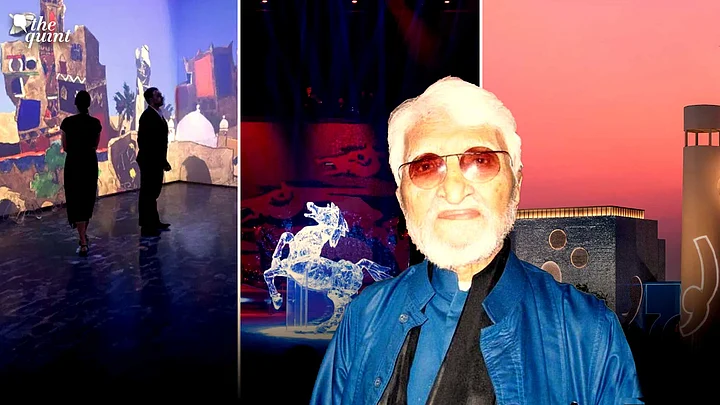
A coloured sketch of a blue building made by MF Husain, the grand master of Modern Indian Art, in 2008, has finally seen the light of the day with much fanfare. That sketch today stands in the form of a museum covering over 3,000 square meters in Doha, his adopted home.
The letters inscribed on the façade of this building read ‘Lawh Wa Qalam’ in Arabic, meaning 'The Tablet and the Pen', and referring to the divine written word. But, in this case, Husain chose to reinterpret the phrase for being the author of the final chapter of his own story.
This final chapter has come to him posthumously, far away from India. A promise kept by his friend and patron, Her Highness of Qatar, Sheikha Moza bint Nasser, who spearheaded and helped realise his dream, even if it took 14 long years to complete after his death in 2011.
A Bridge Between Two Worlds and Eras
As a part of the international art circuit, the Lawh Wa Qalam is sitting in the middle of the East and the West. It will not just preserve the story of Husain but will also bridge two parts of the world and help create a new dialogue.
The year 2025 will be remembered as a year when Husain made the biggest comeback in the world of art. In March, he became the most expensive Indian artist ever with a record-breaking auction of his work Gram Yatra (1954) for Rs 118 crore. And November marks the unthinkable finale for an artist who planned for his legacy beyond his life.
The opening night gala of the museum started with a grand video show that played across the huge façade of the museum building. Qatari royalty, global collectors including Lakshmi Mittal, Gauri Khan, Radhikaraje Gaekwad of Baroda, Indian artists Subodh Gupta and Riyas Komu, along with many other admirers, watched in awe as Husain’s paintings moved across the façade in animated glory—his birds flying across the Mumbai sky, his Kathakali dancers teasing you with their eyes, his horses galloping in full force, and his camels finding peace in the desert sand.
“My long brush like the camel lost in a desert has found the golden sand in Qatar,” Husain once said.
In a letter to the Sheikha, Husain had proposed:
“99 paintings of Arab culture dating back to the Babylon Era. An installation of five horses in crystal as a symbol of strength. A museum to be built to house the collection of my Indian heritage—paintings, sculptures, films and written words. A museum to be built, designed by me. Please consider me a small soldier in the army of your cultural force.”
In response to that note, the Sheikha finally delivered on her promise, as she said, “I am delighted to fulfil the dream of this late, esteemed artist by inaugurating the museum, which will stand as a new landmark in Education City, showcasing pages from his life and a collection of his works.”
Husain's Museum
The museum has over 150 works of Husain across two levels. One collection displays works that he made across decades of his life in India, including a few items close to his heart—his last used paint palette, brushes, last worn kurta with paint splashes, and his Indian passport.
It was an identity booklet of everything he gave up and the pain and struggle he faced amidst frenzied protests and death threats in India for certain controversial works.
His Qatari citizenship came with a promise of peace and building on his legacy further. So the second collection of the museum contains works that he made in Doha till his last breath. These include some of the 35 paintings he made from his unfinished series of 99 works on the Arab civilisation. These have never been seen in public before.
The Battle of Badr (2008) shows Husain’s famous horses depicting the pivotal military victory of 624 AD for the Muslims against the larger Quraysh army of Mecca.
Yemen (2008) takes Husain back to his own Arab roots to depict nomadic life and mud houses in the desert. And Zuljanah (2007) is a portrait of the grey Arabian stallion of Imam Hussain, celebrated for his role in the Battle of Karbala in 680 AD.
The finale of the museum collection is a kinetic installation conceptualised by Husain in 2009, called Seeroo fi al Ardh. It’s an Arabic verse which translates to 'Walk in the Land'.
Remembering a Friend
I say it with great pride and equal humility that MF Husain became my friend in the last and final decade of his life. I met him often to shoot and interview him for my stories. Each conversation was an experience. He was 65 years older than me, but one never felt the age gap.
In my last recorded interview with him in 2009, I had met him when he was on a self-imposed exile in Dubai.
It now serves as a research documentary on his life for other journalists. At that time, he was busy reading books on the Arab civilisation and preparing for his new series.
When I had sat with him inside his red Ferrari for a small drive, he started humming a tune and told me that he plans to make this sports car a part of an upcoming work. I laughed it off at that time.
A week after my shoot, he was flying to Italy to work on his Morano horses. It feels great that he had shared with me these tiny bits which are now part of ‘Seeroo…’.
The work is placed in a huge circular hall next to the main building. A red mosaic wall of ceramic chips that form a painting of Husain’s famous running horses creates a stunning backdrop for the stage. A sculpture of a winged man cast in Husain’s signature style of human form comes swooping down from above. Husain’s sculptural horses galloping around stage in life size, specially created in handblown Murano glass studios in Italy.
The horses are in five stunning colours as light reflects through them to create magical shadows. As they run on stage in circular patterns, they disappear under the stage to clear the way for vintage cars which spring up on hydraulic lifts and zoom in the outer circle.
In Husain’s own words from when he conceptualised it, “The entire ensemble is like a performance of dancing horses in crystal glass set to the tune of traditional song of horsemanship, chivalry, and strength.”
Every aspect of this was left behind by Husain with detailed instructions. He sketched out every movement, every light mood, every musical note, every mould of the glass horses and selected every car for the piece.
His creative zenith also came at a time of mental stress and crisis for him when the protests against some of his works were intensifying back home in India. He later apologised if sentiments were hurt and much to his relief, the Supreme Court cleared his name by supporting the argument of artistic freedom.
He emphatically told me that wherever he travels in the world, he keeps India and the language of Modern Indian Art inside him. After all, it’s an original language that he had created himself!
The museum is a triumph of human spirit, unprecedented posthumous glory and the honour of a promise. Historically, Husain’s art creates a bridge of two ancient Indian and Arab civilisations. Culturally, it’s the rediscovery of an Indian Modern Master who joins the league of today’s top contemporary artists of the world.
(Sahar Zaman is an award-winning author, multimedia journalist, cultural curator and an advocate of the Orange Economy. She has Founded Asia’s first web-channel dedicated to the Arts, called Hunar TV. This is an opinion piece, and the views expressed above are the author’s own. The Quint neither endorses nor is responsible for the same.)
