I had two straight weeks of art and lots of it.
Biennales are usually spread over several months for audience reach and generating an artistic culture and temperament involving local communities. Its origin goes back to 1895 Venice, firmly establishing the city with contemporary international art that was eventually and inevitably followed by “politicisation and festivalisation”.
Fundamentally, it is a platform for contemporary art and in our precarious world, such an event could seize the spectacle to question and resist. So, what did Kochi offer to my somewhat naïve understanding of art?
Looking at Art and Beyond
I was there at the opening and “flag hoisting” of the Biennale in December 2025, and I was there every day for a fortnight to be taken in by the “unfinished spectacle” the curator reportedly spoke about.
I was as lost as many of the artists and the volunteers. Venues were not ready, the centre of the festival, Aspinwall House, had garbage installed (not as art) right in the middle of the courtyard that was later covered with tarpaulin. Several artists’ works were not yet ready to view.
The washroom didn’t exist and when it came to being it was unusable. Drinking water arrived the next day or the day after. And this was the main venue. Tickets were sold, but most venues didn’t have anyone to check them. It didn’t quite feel I was attending an international event and clearly much of it remained “unfinished”. The look and feel were banal.
The massive warehouse on Willingdon Island looked like a real estate factory with artwork next to drilling machines that could well ruin them. Everyone in the know of things apparently knew the Biennale was not ready to start but given their previous misadventure with delays (and artists’ open letters of dissent), the management seems to have forced-started the festival pretending everything is fine.
Volunteers admitted things were not in control and one must truly appreciate the patience and commitment with which they managed angry visitors and annoyed artists. They love art, but they aren’t sure the celebrities at the top management acknowledge their spirit.
Co-Founder Exits
Something else was amiss at the sixth edition too. Before a month of the opening, artist Krishnamachari Bose, co-founder of the Kochi-Muziris Biennale and president of the Biennale, resigned from the Kochi Biennale Foundation (KBF).
“After 15 years of being deeply committed and involved in building the foundation and shaping the Biennale, from its inception as an artist-led initiative to what it is today, I felt this was the right moment to step back, for personal and family reasons, and to return more fully to my own artistic practice,” Bose said in a statement.
Bose, along with artist Riyas Komu, founded the Biennale in 2012 as an artist-led initiative. Riyas and Bose went separate ways in 2018 after allegations of sexual misconduct against Riyas. Since then, the festival has witnessed financial constraints and has been marred with controversies. This time is no different.
The brochure, worth Rs 30, of this edition has a map listing the venues but nothing about what those venues were hosting. Every morning (after a few days of zero information), Instagram informed the day’s schedule, but it still didn’t give an overview of all the exhibits. That is when I started noting down things I wouldn’t want to miss and, in the process, made some unartistic observations and discovered some beautiful work dispersed across venues one could easily miss. In that journey, I also came across exhibits like Shilpa Gupta’s Listening Air at Ginger House, though not part of the Biennale.
Third day at the Kochi Biennale—and I am full of self-doubt mixed with disappointment at the contemporary art scene. The primary venue, Aspinwall House, displayed nothing extraordinary and so far, performance art being the highlight. Not surprising, given this edition’s curator, Nikhil Chopra, loves performance!
A Maze of Artworks
The opening acts were mundane, though the displays and multimedia were worth paying attention but failed to immerse the visitors. One local art enthusiast quipped, “I don’t like art where the blurb must explain what it is unless the art speaks for itself."
There were no takeaways except questions of who selected the artwork and what are the criteria. After three days of searching for art, I walked into Durbar Hall, removed from the main Fort area where the Biennale visitors thronged.
Here was the Ghulam Mohhammed Sheikh retrospective, Of Worlds Within Worlds, the best of the Biennale offerings, but already an exhibition that has had its round in Delhi curated by the KNF. Though Karwaan is the majestic centerpiece, my favourites were his series on the city, horses, and Kabir.
Sheikh is arguably one of our best contemporary artists and to see him made the visit worth it. City, journey, and mapping have long defined Sheikh’s artistic oevure. City for Sale, painted during the communal violence in Baroda in the early 1980s, speaks of the changing but complex relationship between identity, the city and memory. The City Gandhi Left Behind gives a take on spatial violence and weaves it with lived experiences of residents in remembrances. Loss is pervasive but Sheikh as usual refuses to despair. This retrospective demands a piece on its own. My observations are merely to record the importance of this exhibition that brings cartography, kavaad storytelling techniques, and collective memory.
The day before I chanced upon another beautiful piece of work by Kamala Das, her fierce women washed in autumnal colour at a contemporary art gallery in Matancherry. Das lived in Kochi in her later years. Muziris Contemporary featured artists who the curator (of this exhibition) imagines have an intuitive link to the idea of 'Thinai', the Sangam era world-making systems based on how human feeling is at one with our environment, where “the human bhava (emotion) seeks its correspondence in the natural vibhava (cause)”
Though the Biennale curators and creators had conceived this edition with something in mind that may have remained “unfinished”, the author/s of the various blurbs were clearly the standout: they tried to tie up the myriad artworks and practices through the fluidity of memory, identity, and loss.
These words were recurring across the venues and exhibits, often giving a sense of repetition but invoking an echo in the mind, faintly making some sense of the randomness otherwise.
Logistically Challenged but Worth it
Locating venues even with the powerful navigation tool proved tough and tougher was to comprehend what some of them had to offer. As a case in point, the Conflictorium , an Invitations vertical of the Biennale, presented an amateur salad bowl of conflicts that were in no parts art or discourse on art. Across the road not far from this venue is the Students Biennale’s with strikingly original work.
What the Biennale does achieve, however, is transforming the city into art spaces to make art public, converting warehouses into living theaters. It took herculean effort to ensure that they were painted, sealed, made habitable. And all at the last moment, some even after the inauguration.
But where was the real art? The lazy curatorial note trying to weave some brilliant and other mediocre art is at best delusional. Insiders say the idea was never meant to work.
Chopra wanted to be subversive, but this is ineffectual at best. He enunciates that his vision is to resist the pressures of the conventional biennale model as a finished spectacle, and instead shape something that is evolving, responsive, and alive.
The Biennale came to life with performance art, but they were separate scores that couldn’t quite tie themselves to the proverbial red thread. I watched with great interest a Bangladeshi artist carrying stones and earth and couldn’t make any sense of it, even after the Q&A.
There were other hyped performances that I attended earnestly, and enjoyed some while doubting my intelligence with others. The promised showstopping performance is, however, in February by Serbian artist Marina Abramović, though her multimedia exhibition is on display at the Willingon Island warehouse. The 110 chanting nuns and monks have the desired effect.
There has been heightened focus on some artists given their international reputation like Otobong Nkanga, who has planted a tropical garden that will grow throughout the show’s run.
Ibrahim Mahama’s installation Parliament of Ghosts made of salvaged chairs arranged to resemble a parliamentary hall has received adequate attention. And Adrián Villar Rojas’ functioning refrigerator freezer with striking compositions of fresh and pre-packaged food in varying stages of decay drew an audience.
Showcased are works (not necessarily of art) by Bani Abidi, Anupama Kundoo, Jyotti Bhatt, Naeem Mohaiemen, Prabhakar Kamble, Biraaj Dodiya and Birender Yadav.
While Sheikh was a feast as always, the one other venue with rich contemporary and new art was at the Garden Convention Centre by Edam, curated by Aishwarya Suresh and KM Madhusudhanan. One must revisit this for the details and studies of the brilliant work there. Unfortunately, one work in this collection, Last Supper at Nunnery by Tom Vattakuzhy, which really stood out, had to be removed after Christian groups objected to it.
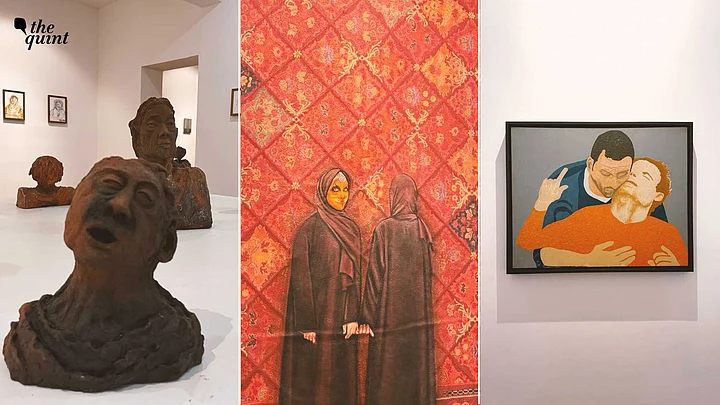
One of the most evocative works can be found at SMS Hall in Matancherry: ten terracotta sculptures and thirty drawings by a nun, sister Malu Joy, an intense rendition of the human condition and a life that has been shaped by “obedience, labour and silence”. Alongside her work is the very powerful art of Gieve Patel, and his recurring motifs of vulnerability and resilience that resides in the interplay of light and shadow.
Kochi Relives its Lives
The Portuguese first landed in Calicut in 1498 and then set up a trading post in the fishing village of Kochi in 1500-1502. But even before that the Chinese fishing nets had arrived in these waters. Calicut was enjoying the reputation of Asia’s busy entrepot and thanks to the Zamorin local rulers, it could well be one of medieval world’s free port traders were provided with guest houses and servants courtesans and security of their goods. Then the Dutch arrived in 1663 trading pepper, cardamom, and other spices. The British took over from 1795 till 1947.
The alleys and landmarks around Fort Kochi and Matancherry are custom made for tourism reels. The Jewish Town where one of the oldest synagogues of the Commonwealth stands, built in 1568 with Belgian glass and Chinese tiles, is always a big draw. Kitschy art cafes are everywhere, and all varieties of tourists are making their way through what has become a maximum art district and if you are invested chances are you will end up discovering some wonderful work like the Amphibian Aesthetics at Ishara House and Shilpi Ranjan Retrospective at Uru Art Harbour.
The Biennale, positioned in this rich historic location drawing from the town’s cosmopolitan character and heritage, certainly contributes to the popularity of the city and encourages artistic temper but the founders and funders must ask tough questions whether the bar is adequately high and pay attention of the governance of the festival. Highlighting visits by celebrity writers and artists is an obvious outreach but I want to return to the Biennale for art and not for a “spectacle” that is “unfinished” and a work-in-progress.
(Kishalay Bhattacharjee is a journalist and Dean, Jindal School of Journalism and Communication and author most recently of Where the Madness Lies: Citizen Accounts of Identity and Nationalism (Orient Black Swan). This is an opinion pieces and the views expressed are the author's own. The Quint neither endorses nor is responsible for them.)