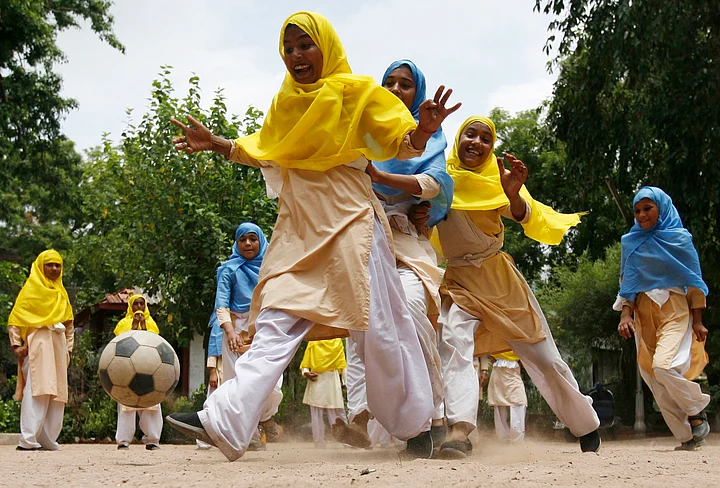
When Jalpana Paul, Mrityunjay Tewari and Bhabani Munda started coaching young girls in football and cricket in rural India, they had nothing. Their charges had to play barefoot. They had no jerseys. Since then many of them have gone to play at the national level, sporting shoes and jerseys.
Jalpana Paul
Jalpana Paul gave her district its first women’s football and cricket teams, and she did it all as a teenager. She started teaching girls in district Malkangiri, a Naxal-infested area of Odisha as a 15-year-old.
The girls, back then, didn’t sport any jerseys, and had just one football to play with. With the families of these girls reluctant to send their daughters even to school – they are required to help their mothers bind beedis at home – convincing them to allow their girls to take up sport was a hard challenge for the coach-captain.
Even now, Jalpana’s path is fettered by financial and infrastructural difficulties. Funds are hard to come by. Sometimes she uses the money out of her own salary as a teacher, a position she got for her service to sport. A teacher gets approximately Rs 7,000 a month.
Jalpana has coached more than a 100 girls. At least 12 of them have gone on to get jobs under the sports quota. But Jalpana has bigger plans – she wants her girls to play at the international level.
Bhabani Munda
Her parents and brothers stopped her from playing football, warning her about her marriage prospects if she broke her leg.
But that didn’t stop Bhabani Munda from starting Dooars XI, a girls’ football team from the Doaars region in Jalpaiguri district of the football-loving state of West Bengal.
When Bhabani first began playing, wearing shorts, villagers called her shameless. Her girls played barefoot. But now, the Dooars XI wear shoes donated by district officials. Private clubs sponsor matches for special occasions. According to Time, they offer prize-money of Rs 3,000-6,000, much of which is donated to families in need.
Bhabani sells tea and snacks. Every night from 9 pm until midnight, she prepares snacks to sell them the next day.
Mrityunjay Tiwari
This Kolkata-based businessman and football-lover started an experiment in the Mastichak village in Bihar. Mrityunjay Tiwari’s offer to the villagers was simple. If they allowed their daughters to play football, his academy would take care of their education till graduation. The bargain has paid off. Today 45 girls from the village have taken to football. Few have even made it to the state team.
The efforts of Jalpana, Bhabani and Mrityunjay notwithstanding, the government it seems favours men over women. Even when it is clear that many more girls and women are interested in rural sports programmes than men, as data from Rajiv Gandhi Khel Abhiyan (RGKA) shows.
In states like Chattisgarh for instance 56,211 women took part in sports competitions under the RGKA scheme, compared to just 19,401 men in 2013-14, according to the Lok Sabha website. But out of the Rs 148 crore earmarked by the centre for 2011-2014, only Rs 14 crore were released for women’s sports, as this IndiaSpend report shows.
(The stories of Jalpana Paul, Bhabani Munda and Mrityunjay Tiwari were covered on Real Heroes on CNN-IBN.)