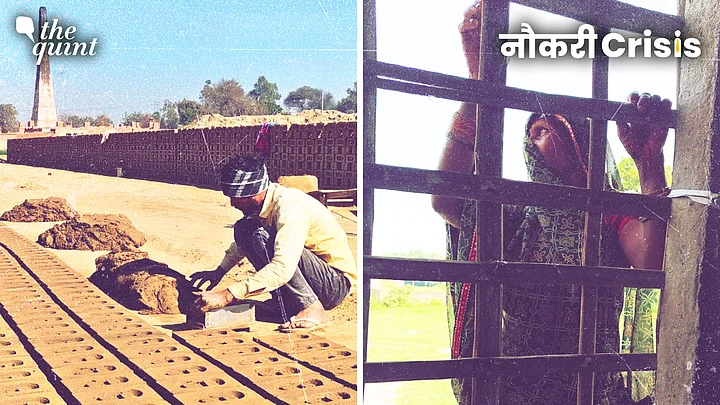
The workers who build the very foundation of India’s growing urban economy—those working in brick kilns, construction sites and agricultural land—are not just exploited, but often trapped in illegal bonded labour.
A report released by the National Campaign Committee for Eradication of Bonded Labour (NCCEBL) on Migrant Bonded Labour in India lays bare the scale of this abuse, revealing damning data and the lived realities of blue-collar workers across India.
The report, prepared by conducting surveys of 950 rescued bonded workers and qualitative research involving an additional 1,000 workers across 19 states in India, exposes a concerning trend.
All 950 workers, rescued from bonded labour, belonged to marginalised social groups—more than 60 percent being Dalits. Besides, nearly half of the rescuees were women.
Wage theft, debt bondage, enslavement, harassment by employers, forced hazardous work and the utter neglect of safety—all outlawed in India—is experienced by millions of informal migrant workers, including women and children even today.
What’s more disturbing is that one in every three rescued workers were again pushed into exploitative labour post-rescue to earn a subsistence living only because the government failed to rehabilitate them—in what is a flagrant violation of the law.
Despite the Narendra Modi government making several tall promises — including inviting 100 rescued bonded workers to India’s 79th Independence Day celebration at the Red Fort in Delhi — to eradicate bonded labour by 2030, its victims are forsaken and forgotten. Why?
All Rescued Bonded Workers Belong to Socially Marginalised Groups
Data from the survey shows that 63 percent of the rescued bonded workers belonged to Scheduled Caste (SC) communities, while the remaining belong to Scheduled Tribes (13 percent) and Other Backward Classes (24%).
NCCEBL’s report attributes this over-representation of Dalits—two in every three rescued workers—to the continuing practice of caste-based occupational segregation and socio-economic exclusion.
“Historically oppressed and denied access to land, education, and secure livelihoods, SC communities remain systematically pushed into the most exploitative and unprotected forms of labour,” the report stated.
It also added that despite clear evidence of caste-based abuse, threats and discrimination, protections under the SC/ST (Prevention of Atrocities) Act were not invoked.
Ironically, more than 98 percent of the rescued workers had migrated from one state to the other in search of work and better livelihood, often out of desperation due to poverty, landlessness, debt, and caste discrimination.
While migration itself is not inherently exploitative, the absence of legal protection and state accountability pushes migrant workers more towards precarity.
Women Bonded Workers Faced Sexual Harassment, Denied Healthcare
According to the data, 54 percent of the rescued workers were men while 46 percent were women. While both faced exploitative work conditions, women encountered unique challenges including sexual harassment and denial of reproductive healthcare.
In March this year, The Quint had reported that an 18-year-old Adivasi girl was trafficked from Dindori district in Madhya Pradesh to Delhi, where she was allegedly raped by the agent and forced into domestic servitude.
The report stated that crucial state schemes such as Anganwadi centers, and services of Accredited Social Health Activists or ASHA workers (who provide maternal and child health support) were largely inaccessible to migrant women workers.
In Maharashtra's Beed, young Dalit and Adivasi women working in sugarcane farms have reportedly undergone medically unnecessary hysterectomy, so that they don’t miss work during menstruation, pregnancy or miscarriage. The Bombay High Court took suo motu cognizance of the issue in March this year and stated that women’s labour under such conditions should be considered a form of bonded labour.
Besides, their wages were often routed through male family members, which not only reinforces patriarchal control over their economic agency but also erases their contribution as a worker.
Again, of the 950 rescued bonded workers, 55 were children including a two-year-old who was rescued from a brick kiln in Uttar Pradesh. More than half of these children and two in every three rescuees have had no access to formal education. Without education, workers are unable to assert their rights and get trapped in the cycle of poverty and exploitation.
Fake Debt, Wage Theft Tools to Coerce Labour
According to NCCEBL’s survey data, more than half of the rescued bonded labour were not paid their salaries—underlining that wage theft has become a dominant characteristic of bonded labour. Of these, 51 percent were owed wages of up to Rs 3 lakh.
“These figures show that exploitation in bonded labour extends beyond debt bondage to include the outright withholding of earned wages, a tactic that sustains control over workers and impedes their ability to break free from exploitative systems,” the report stated.
Debt bondage refers to any form of work extracted from a person in return for a debt or advance, which may be real, inflated or manufactured by the employer to coerce labour—often across generations—and deny workers the freedom to quit.
The report shows that while the average debt per rescued worker was approximately Rs 5,300, the average wage owed per worker was Rs 32,500. This means that employers continued to exploit workers on the pretext of owed debt even when they worked for six times the indebted amount.
It also exposes the flawed rationale often used to justify exploitative labour practices: that workers are being compensated through debt repayment, when debt is clearly being used as a tool for coercion and control.
In August, The Quint had reported that a Muzaffarnagar couple, who had been rescued three times from brick kilns in Jalandhar, Muzaffarnagar, and Saharanpur, were are owed over Rs 15 lakh in unpaid wages. Although the couple was invited to the I-Day celebrations this year, they still haven't received their full rehabilitation.
The workers reported taking debt for medical treatments, food, funerals, marriage and other survival needs which are not incidental but reflect systemic exclusion of marginalised communities from social safety nets.
No FIR in 80% Cases; 2 in 3 Rescued Workers Got No Rehabilitation
Debt bondage, restricted movement, document seizure, and non-payment of legal wages all constitute bonded labour, which is a criminal offence under the Bonded Labour System (Abolition) Act, 1976, and a violation of Article 23 of the Constitution.
However, data from NCCEBL’s report shows that only 17 percent of the rescued workers had an FIR registered even when the Act mandates the District Magistrate to register one.
This means that over 80 percent of the rescued workers did not even have their grievances addressed, effectively perpetuating a culture of impunity for employers engaging in exploitative work practices.
Under the Central Sector Scheme for Rehabilitation of Bonded Labour, 2021, the district administration must issue a Release Certificate to rescued bonded workers so that they can avail rehabilitation assistance to the tune of:
Rs 1 lakh, for male workers,
Rs 2 lakh for women and children workers,
Rs 3 lakh for survivors of sexual exploitation, where all workers are given an interim cash amount for immediate assistance, and the remaining amount is deposited in their bank accounts.
However, as per NCCEBL’s survey data, 63 percent of the rescued workers did not even receive the interim cash assistance. This includes:
29 out of 55 children, or 53 percent rescued child workers, who did not receive any financial rehabilitation;
25 percent rescued women didn’t receive any financial assistance, while 42 percent received only Rs 20,000;
27 percent rescued men didn’t receive any financial rehabilitation, while 41 percent received only Rs 20,000.
One in Three Rescued Workers Now Earns Less Than Rs 200 Per Day
Apart from monetary assistance, rescued workers are entitled to compensation in the forms of land, housing, education and livelihood to ensure complete rehabilitation and prevent rebondage of rescued workers.
However, NCCEBL’s report highlighted a systemic failure in the implementation of these measures by the district administrations and vigilance committees.
For food security, workers must possess a Public Distribution System (PDS) ration card to be able to buy food at subsidised prices. The survey shows that 25 percent of the rescued bonded workers did not have a ration card, while the 75 percent who had one faced significant barriers in redeeming them because of their migrant status. This means that even when workers possess valid ration cards, registered in their hometowns, they frequently cannot redeem rations where they currently live and work.
Besides, 85 percent of workers in brick kiln and construction sectors do not hold BOCW (Building and Other Construction Workers) cards, which give them access to welfare benefits such as health insurance, education support, and financial assistance. Again, 85 percent of the rescued workers reported not receiving any government employment opportunities, including work under the Mahatma Gandhi National Rural Employment Guarantee Act (MNREGA).
Of the 950 rescued workers, 691 were eligible for school admission either for themselves (if children) or for their children. However, only 40 percent of these eligible workers managed to secure school admission— including only 14 of the 55 children. Disturbingly, 20 of the 55 children have been forced back into bonded labour, underlining how lack of education perpetuates the cycle of exploitation.
According to the survey, a striking 94 percent of the workers were rescued from brick kilns. Post-rescue, 38 percent of the workers moved to agriculture work; 24 percent to construction; while 16 percent went back to work at brick kilns—with two in every three workers earning daily wages.
Of them, nearly half of the workers are earning wages less than Rs 200 per day, significantly lower than the statutory minimum wages. “The persistence of sub-minimum wages not only highlights the weakness of post-rescue rehabilitation and monitoring systems but also points to broader failures in labour regulation and rights implementation,” the report stated.